The Impact of Artificial Intelligence Use on Students’ Innovative Behavior and Well-Being: The Mediating Role of Digital Literacy and the Moderating Role of Happiness
DOI:
https://doi.org/10.61838/Keywords:
artificial intelligence, innovative behavior, student well-being, digital literacy, happinessAbstract
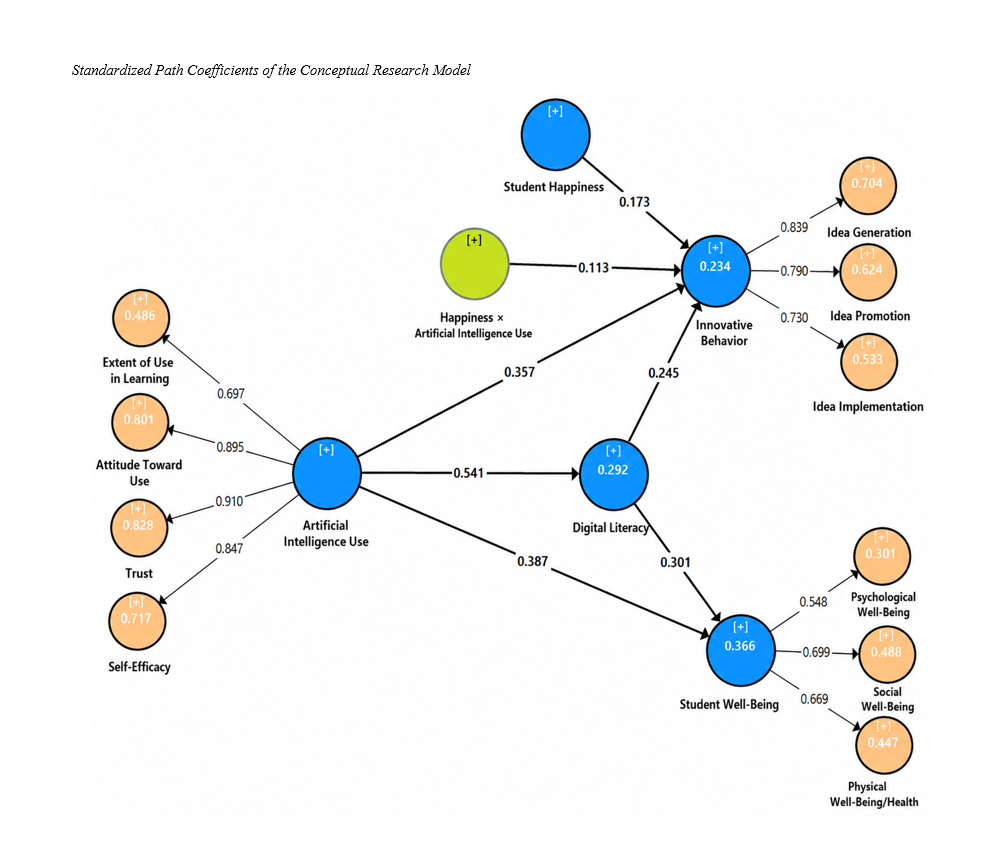
Objective: The present study aimed to investigate the effect of artificial intelligence use on students’ innovative behavior and well-being through the mediating role of digital literacy and the moderating role of happiness.
Methods and Materials: This study was applied research in terms of purpose and descriptive-survey in terms of methodology. The statistical population consisted of all male and female lower and upper secondary school students in Langarud during the 2025–2026 academic year. Based on the Krejcie and Morgan table, 367 students were selected through stratified random sampling. Data collection instruments included the Innovative Behavior Questionnaire by Ng and Lucianetti (2016), Student Well-Being Questionnaire by Zheng et al. (2015), Artificial Intelligence Use Questionnaire by Long and Magerko (2020), Digital Literacy Questionnaire by Ibrahim et al. (2024), and the Happiness Questionnaire by Hills and Argyle (2002). Data analysis was conducted using descriptive statistics, the Kolmogorov–Smirnov test, and structural equation modeling (SEM) through SmartPLS software at a 95% confidence level.
Finding: The results indicated that artificial intelligence use had a positive and significant effect on innovative behavior (β = 0.357, t = 6.165), digital literacy (β = 0.541, t = 14.222), and student well-being (β = 0.387, t = 6.984). In addition, digital literacy positively and significantly affected innovative behavior (β = 0.245, t = 4.786) and student well-being (β = 0.301, t = 5.339). The findings further demonstrated that digital literacy mediated the relationship between artificial intelligence use and both innovative behavior and student well-being. Moreover, happiness significantly moderated the relationship between artificial intelligence use and innovative behavior (β = 0.113, t = 2.298), indicating that higher levels of happiness strengthened the positive effect of artificial intelligence use on innovative behavior.
Conclusion: The findings suggest that artificial intelligence use can improve students’ innovative behavior and well-being when accompanied by higher levels of digital literacy and happiness. Digital literacy plays a crucial role in facilitating the positive outcomes of AI-based educational environments, while happiness strengthens students’ innovative responses to technology use.
Downloads
References
Ahmadi, A., & Geramian, S. A. (2024). The Effect of Workplace Happiness on Innovative Work Behavior with the Mediating Role of Organizational Citizenship Behavior and the Moderating Role of Organizational Innovative Culture: A Case Study of Payame Noor University of Sari. Tenth Scientific Research Conference on the Development and Promotion of Management Sciences with an Approach to Improving Financial Management in Iran, Tehran.
Al Shamsi, J. H., Al-Emran, M., & Shaalan, K. (2022). Understanding key drivers affecting students' use of artificial intelligence-based voice assistants. Education and Information Technologies, 27, 8071-8091. https://doi.org/10.1007/s10639-022-10947-3
Asadi Vakil Kandi, R., Enfarad, A., Behrouz, A., & Sadeghi Asl, M. (2025). The Effect of Educational Artificial Intelligence on Students' Academic Achievement with the Mediating Role of Digital Literacy. First International Conference on New Horizons in Learning Psychology and Education from the Teacher's Perspective, Urmia.
Baumann, M., Amara, M. E., Karavdic, S., & Limbach-Reich, A. (2014). First-year at university: The effect of academic employability skills and physical quality of life on students' well-being. Work: A Journal of Prevention, Assessment and Rehabilitation, 49, 505-515. https://doi.org/10.3233/WOR-131729
Bender, S. M. (2024). Awareness of artificial intelligence as an essential digital literacy: ChatGPT and Gen-AI in the classroom. Changing English, 31(2), 161-174. https://doi.org/10.1080/1358684X.2024.2309995
Chiu, T. K. F., Moorhouse, B. L., Chai, C. S., & Ismailov, M. (2023). Teacher support and student motivation to learn with Artificial Intelligence (AI) based chatbot. Interactive Learning Environments, 32, 3240-3256. https://doi.org/10.1080/10494820.2023.2172044
Everett, M. C. (2017). Fostering first-year students' engagement and well-being through visual narratives. Studies in Higher Education, 42, 623-635. https://doi.org/10.1080/03075079.2015.1064387
Gera, S., Cherian, T., Perumandla, S., & Bhattacharyya, S. S. (2025). Investigating the influence of digital literacy on digital well-being and the dynamics of online social capital and digital addiction. International Journal of Sociology and Social Policy, 45(11-12), 1102-1120. https://doi.org/10.1108/IJSSP-02-2025-0099
Gu, S., Min, X., Xu, J., & Chen, S. (2024). Correlation of negative emotion, fatigue level and internet addiction in college students: Implication for coping strategies. BMC psychiatry, 24, 264. https://doi.org/10.1186/s12888-024-05711-5
Hosseinzadeh, R., Vazifeh Yajloo, F., Shabankareh, S., & Asadi Nigcheh, S. (2025). The Effect of Artificial Intelligence-Based Education and Digital Literacy on Students' Academic Creativity. First International Conference on Artificial Intelligence in Education, Psychology, Educational Sciences, and Religious, Cultural, Social, and Management Studies in the Third Millennium, Bushehr.
Ibrahim, R. K., Al Sabbah, S., & Al-Jarrah, M. (2024). The mediating effect of digital literacy and self-regulation on the relationship between emotional intelligence and academic stress among university students: A cross-sectional study. BMC Medical Education, 24, 1309. https://doi.org/10.1186/s12909-024-06279-0
Kazanidis, I., & Pellas, N. (2024). Harnessing generative artificial intelligence for digital literacy innovation: A comparative study between early childhood education and computer science undergraduates. Ai, 5(3), 1427-1445. https://doi.org/10.3390/ai5030068
Laosum, T. (2023). Development of indicators of happiness in learning of Thai Open University students. Asian Association of Open Universities Journal, 18(1), 61-77. https://doi.org/10.1108/AAOUJ-10-2022-0144
Li, J., & Xue, E. (2023). Dynamic Interaction between Student Learning Behaviour and Learning Environment: Meta-Analysis of Student Engagement and Its Influencing Factors. Behavioral Sciences, 13, 59. https://doi.org/10.3390/bs13010059
Long, D., & Magerko, B. (2020). What Is AI Literacy? Competencies and Design Considerations. Proceedings of the 2020 CHI Conference on Human Factors in Computing Systems,
Luo, J. (2024). How does GenAI affect trust in teacher-student relationships? Insights from students' assessment experiences. Teaching in Higher Education.
Ma, G., Tian, S., Song, Y., Chen, Y., Shi, H., & Li, J. (2025). When Technology Meets Anxiety: The Moderating Role of AI Usage in the Relationship Between Social Anxiety, Learning Adaptability, and Behavioral Problems Among Chinese Primary School Students. Psychology research and behavior management, 18, 151-167. https://doi.org/10.2147/PRBM.S502337
Ma, K., Zhang, Y., & Hui, B. (2024). How Does AI Affect College? The Impact of AI Usage in College Teaching on Students' Innovative Behavior and Well-Being. Behavioral Sciences, 14(12), 1223. https://doi.org/10.3390/bs14121223
Maunula, M., Maunumaki, M., Maroco, J., & Harju-Luukkainen, H. (2023). Developing Students Well-Being and Engagement in Higher Education during COVID-19: A Case Study of Web-Based Learning in Finland. Sustainability, 15, 3838. https://doi.org/10.3390/su15043838
Ng, D. T. K., Leung, J. K. L., Su, J., Ng, R. C. W., & Chu, S. K. W. (2023). Teachers' AI digital competencies and twenty-first century skills in the post-pandemic world. Educational Technology Research and Development, 71, 137-161. https://doi.org/10.1007/s11423-023-10203-6
Ng, T. W., & Lucianetti, L. (2016). Within-individual increases in innovative behavior and creative, persuasion, and change self-efficacy over time: A social-cognitive theory perspective. Journal of Applied Psychology, 101, 14-34. https://doi.org/10.1037/apl0000029
Peng, Z., & Wan, Y. (2024). Human vs. AI: Exploring students' preferences between human and AI TA and the effect of social anxiety and problem complexity. Education and Information Technologies, 29, 1217-1246. https://doi.org/10.1007/s10639-023-12374-4
Quaicoe, J. S., & Pata, K. (2020). Teachers' digital literacy and digital activity as digital divide components among basic schools in Ghana. Education and Information Technologies, 25, 4077-4095. https://doi.org/10.1007/s10639-020-10158-8
Rafiq, N., & Ahmad, M. (2025). Impact of artificial intelligence on students' creativity in ODL: The mediating role of happiness. Asian Association of Open Universities Journal, 20(2), 154-169. https://doi.org/10.1108/AAOUJ-01-2025-0010
Torres-Reynoso, O., Blanco-Moreno, S., Galiano-Coronil, A., & Ravina-Ripoll, R. (2025). Happiness management within communication skills development and satisfaction in the classroom. In Developing Managerial Skills for Global Business Success (pp. 17-30). IGI Global Scientific Publishing. https://doi.org/10.4018/979-8-3693-3057-9.ch002
Von Garrel, J., & Mayer, J. (2023). Artificial Intelligence in studies: Use of ChatGPT and AI-based tools among students in Germany. Humanities and Social Sciences Communications, 10, 799. https://doi.org/10.1057/s41599-023-02304-7
Walton, G. (2016). Digital literacy: Establishing the boundaries and identifying the partners. New Review of Academic Librarianship, 22(1), 1-4. https://doi.org/10.1080/13614533.2015.1137466
Wu, T. J., & Zhang, R. X. (2024). Exploring the impacts of intention towards human-robot collaboration on frontline hotel employees' positive behavior: An integrative model. International Journal of Hospitality Management, 123, 103912. https://doi.org/10.1016/j.ijhm.2024.103912
Zheng, X., Zhu, W., Zhao, H., & Zhang, C. (2015). Employee well-being in organizations: Theoretical model, scale development, and cross-cultural validation. Journal of Organizational Behavior, 36, 621-644. https://doi.org/10.1002/job.1990
Zhou, M., & Peng, S. (2025). The Usage of AI in Teaching and Students' Creativity: The Mediating Role of Learning Engagement and the Moderating Role of AI Literacy. Behavioral Sciences, 15(5), 587. https://doi.org/10.3390/bs15050587
Downloads
Additional Files
Publication Timeline
- Submitted
- Revised
- Accepted