
Identification and Classification of Challenges in Virtual Education Management During Crisis Conditions: A Qualitative Study Using Thematic Content Analysis
DOI:
https://doi.org/10.61838/Keywords:
Virtual education, crisis management, school principals, elementary education, thematic content analysis, ; digital leadership, educational challengesAbstract
Objective: This study aimed to identify and classify the major challenges of virtual education management during crisis conditions from the perspectives of elementary school principals in Lamerd County.
Methods and Materials: This qualitative study was conducted using thematic content analysis. The research population consisted of elementary school principals in Lamerd County, Fars Province, during the 2023–2024 academic year. Participants were selected through purposive sampling with maximum variation in terms of gender, managerial experience, and school location. The final sample included ten principals, including six women and four men, with a mean age of 42 years and a mean managerial experience of 4.5 years. Data were collected through semi-structured interviews lasting 45 to 75 minutes. Interviews were audio-recorded with participants’ permission, transcribed verbatim, and analyzed using Braun and Clarke’s six-phase thematic analysis framework. MAXQDA software was used to organize codes and categories. Credibility was enhanced through member checking, triangulation with school documents, peer review, and inter-coder agreement.
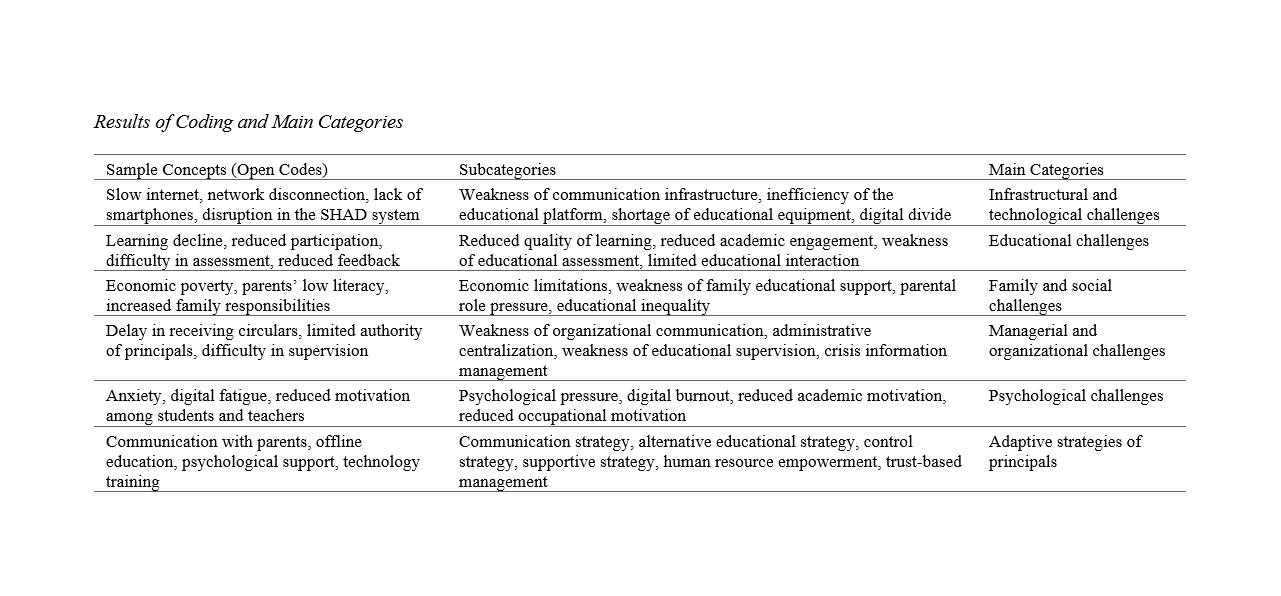
Findings: The analysis led to the extraction of six main categories: infrastructural and technological challenges, educational challenges, family and social challenges, managerial and organizational challenges, psychological challenges, and adaptive strategies of principals. The findings indicated that weak internet infrastructure, platform inefficiency, shortage of digital devices, and the digital divide formed the basic context of virtual education difficulties. Educational challenges included learning decline, reduced participation, weak assessment, and limited teacher-student interaction. Family and social challenges reflected economic limitations, insufficient parental support, increased family responsibility, and educational inequality. Managerial and organizational challenges included delayed instructions, centralized decision-making, weak supervision, and crisis information management. Psychological challenges included anxiety, digital burnout, and reduced motivation among teachers and students.
Conclusion: Virtual education management during crisis conditions is a multidimensional phenomenon shaped by technological, educational, social, organizational, and psychological factors.
Downloads
References
Apaydin, C., & Yalcin, O. M. (2024). The Impact of COVID-19 on K-12 School Principals' Management Processes. Sage Open, 14(3), 1-15. https://doi.org/10.1177/21582440241265328
Ariani, S., & Tawali, T. (2021). Problems of Online Learning During Covid-19 Pandemic in Speaking for Professional Context Class. Jo-ELT (Journal of English Language Teaching), 8(1), 32-37. https://doi.org/10.33394/jo-elt.v8i1.3783
Bansal, S. (2020). Impact of the COVID-19 Pandemic on Education, Rise of Online Teaching-Learning Process and Effects on Health of Kids. SSRN Electronic Journal. https://doi.org/10.2139/ssrn.3595971
Bozkurt, A., Jung, I., Xiao, J., Vladimirschi, V., Schuwer, R., Egorov, G., & Paskevicius, M. (2022). A Global Outlook to the Interruption of Education Due to COVID-19 Pandemic. Asian Journal of Distance Education, 17(1), 1-126.
Cheraghi, G., & Cheraghi, Z. (2019). Challenges, Barriers, and Strategies for Cyberspace Management in Education. National Conference on Professional Research in Psychology and Counseling with an Approach to New Achievements in Educational and Behavioral Sciences from the Teacher's Perspective, Minab.
Clark, P., Chapleo, C., & Suomi, K. (2020). Branding Higher Education: An Exploration of the Role of Internal Branding on Middle Management in a University Rebrand. Tertiary Education and Management, 26(2), 131-149. https://doi.org/10.1007/s11233-019-09054-9
Gandolfi, A. (2020). Planning of School Teaching During COVID-19. ArXiv. https://arxiv.org/abs/2006.03672
Ginting, A. C., Siagian, P., & Surya, E. (2023). Development of Learning Materials Through CTL with Karo Culture Context to Improve Students' Problem Solving Ability. Paradikma Jurnal Pendidikan Matematika, 16(1), 26-31. https://doi.org/10.24114/paradikma.v16i1.42568
Hodges, C., Moore, S., Lockee, B., Trust, T., & Bond, A. (2022). The Difference Between Emergency Remote Teaching and Online Learning. Educational Technology Research and Development, 70(1), 1-12.
Hosseini, P. (2020). Investigating the Undeniable Necessity of Cyberspace Management in Overcoming Harms to the Education System: Turning Threats into Opportunities. Eighth National Conference on Sustainable Development in Educational Sciences and Psychology, Social and Cultural Studies, Tehran.
Ifinedo, E., Rikala, J., & Hamalainen, T. (2023). Factors Affecting Nigerian Teacher Educators' Technology Integration: Considering Characteristics, Knowledge Constructs, ICT Practices and Beliefs. Computers and Education, 146, 103760. https://doi.org/10.1016/j.compedu.2019.103760
Karakose, T., Yirci, R., Papadakis, S., & Ozdemir, T. Y. (2024). Challenges Faced by School Principals During Crisis Management: A Systematic Review. Frontiers in Education, 9, 1449174. https://doi.org/10.3389/feduc.2024.1449174
Leithwood, K., Harris, A., & Hopkins, D. (2024). Seven Strong Claims About Successful School Leadership Revisited. School Leadership & Management, 44(1), 1-18. https://doi.org/10.1080/13632430701799718
Levi-Tamar, A., Shonfeld, M., & Avidov-Ungar, O. (2023). Digital Leadership: Managing Schools' Virtual Spaces in Times of Crisis. Education and Information Technologies, 28(7), 8431-8450.
Mahdavi, M. (2021). Information Technology and Technology Information. Chapar Publishing.
Mohammadi, M., Rezaei, A., & Karimi, S. (2024). Identifying Barriers and Challenges of Educational Leadership in Elementary Schools. Educational Management Quarterly, 18(2), 45-68.
Mousizadeh Ahaghi, M. (2025). Analyzing the effect of e-learning and virtual education environments on the development of learners' cognitive, metacognitive, and self-regulation skills. Sixth International Conference on Educational Sciences, Counseling, Psychology, and Social Sciences,
Rezaei, M., Khashai, A., & Ramazani, Q. (2025). Investigating the Effectiveness of Virtual Education During the COVID-19 Pandemic from the Perspectives of Faculty Members and Students at Kermanshah University of Medical Sciences. Scientific Journal of Babol University of Medical Sciences, 27(Special Issue), 1-10. https://doi.org/10.22088/JBUMS.27.SUPPLEMENT_1,MEDICAL_EDUCATION,.3
Saravani, E., Shariatmadari, M., Kordestani, F., & Hamidifar, F. (2025). Structural Equation Modeling of Virtual Education for Cyber Media Literacy: Case Study of Primary School Teachers in Zahedan. Iranian Journal of Educational Sociology, 8(2), 1-12. https://doi.org/10.61838/kman.ijes.8.2.13
Trust, T., & Whalen, J. (2021). Should Teachers Be Trained in Emergency Remote Teaching? Lessons Learned from the COVID-19 Pandemic. Journal of Technology and Teacher Education, 29(2), 189-199. https://doi.org/10.70725/307718pkpjuu
Downloads
Additional Files
Publication Timeline
- Submitted
- Revised
- Accepted