Developing a Structural Model of Academic Self-Handicapping Based on Perceived School Climate With the Mediating Role of Academic Self-Regulation in Students With Visual Impairment
Keywords:
visual impairment, perceived school climate, academic self-regulation, academic self-handicappingAbstract
Objective: This study aimed to develop and test a structural model explaining academic self-handicapping based on perceived school climate, with the mediating role of academic self-regulation, among students with visual impairment.
Methods and Materials: The present research was fundamental in purpose and descriptive–correlational in design, employing structural equation modeling. The statistical population consisted of male and female students with visual impairment aged 12–22 years in Tehran during the 2024–2025 academic year, from whom 230 participants were selected using convenience sampling. Data were collected using the Academic Self-Handicapping Questionnaire, the Perceived School Climate Questionnaire, and the Academic Self-Regulation Questionnaire. After screening the data for normality, multicollinearity, outliers, and independence of errors, Pearson correlation coefficients and structural equation modeling were conducted using SPSS version 24 and AMOS version 26. The mediating effect of academic self-regulation was examined using the bootstrap method with a 95% confidence interval.
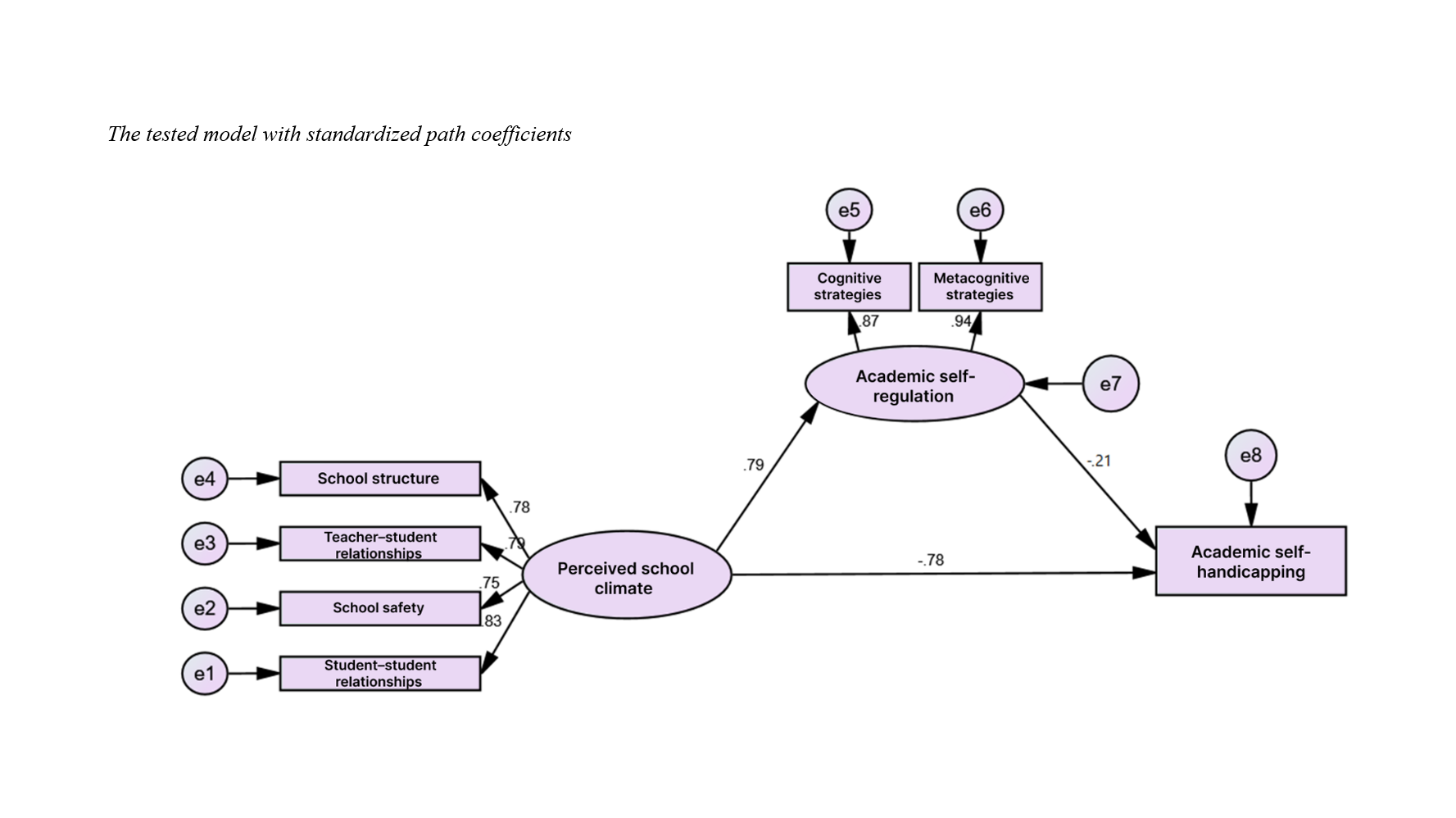
Findings: The results of structural equation modeling indicated that perceived school climate had a significant direct negative effect on academic self-handicapping (β = −0.78, p = .001). Perceived school climate also had a significant positive effect on academic self-regulation, which in turn had a significant negative effect on academic self-handicapping. Bootstrap analysis confirmed the significance of the indirect effect of perceived school climate on academic self-handicapping through academic self-regulation, indicating a partial mediation. Model fit indices demonstrated an acceptable to good fit of the proposed model (χ²/df = 2.85, CFI = 0.98, RMSEA = 0.07).
Conclusion: The findings suggest that a positive perceived school climate reduces academic self-handicapping both directly and indirectly by enhancing academic self-regulation in students with visual impairment.
Downloads
References
Aldridge, J. M., & Blackstock, M. J. (2024). Assessing students' perceptions of school climate in primary schools. Learning Environments Research, 1-24. https://doi.org/10.1007/s10984-024-09492-2
Aldridge, J. M., & McChesney, K. (2018). The relationships between school climate and adolescent mental health and wellbeing: A systematic literature review. International Journal of Educational Research, 88, 121-145. https://doi.org/10.1016/j.ijer.2018.01.012
Aldridge, J. M., McChesney, K., & Afari, E. (2018). Relationships between school climate, bullying and delinquent behaviours. Learning Environments Research, 21, 153-172. https://doi.org/10.1007/s10984-017-9249-6
Alraddadi, M. M., & Zebehazy, K. T. (2025). Exploring inclusive teaching practices to enhance effective learning of students with visual impairments in a secondary school in Saudi Arabia using a self-regulated learning framework. British Journal of Visual Impairment, 43(1), 12-28. https://doi.org/10.1177/02646196231201770
Arbazi, M., & Fouladchang, M. (2022). The relationship between hope for education and academic well-being during virtual learning: Investigating the mediating role of academic self-regulation. Journal of Education and Evaluation, 15(59), 93-122.
Bozorgpoori, M., Kooroshnia, M., Rezaei, A., & Kazemi, S. (2021). The mediating role of basic psychological needs satisfaction in the relationship between perceived classroom environment and academic self-regulation. Journal of Education and Learning Studies, 13(1), 81-96.
Chang, K. J., Seo, J., Kim, M.-J., Song, H.-Y., & Kim, M. S. (2025). Psychological Mechanism Contributing to Academic Burnout and Depression in College Students: Focus on Evaluation Concern Perfectionism, Academic Procrastination, Fear of Failure, and Self-Handicapping. Korean Assoc Learner-Centered Curric Instr, 25(2), 807-824. https://doi.org/10.22251/jlcci.2025.25.2.807
De Smul, M., Heirweg, S., Devos, G., & Van Keer, H. (2020). It's not only about the teacher! A qualitative study into the role of school climate in primary schools' implementation of self-regulated learning. School effectiveness and school improvement, 31(3), 381-404. https://doi.org/10.1080/09243453.2019.1672758
Do, M. N., & Lai, P. H. (2024). The mediating role of self-efficacy in the relationship between the online learning environment and academic self-regulation. Journal of Applied Research in Higher Education, 16(2), 540-553. https://doi.org/10.1108/JARHE-11-2022-0371
Duka, A., Leka, K., Vampa, M., Bursová, J., & Jenisová, Z. (2024). The impact of climate in inclusive classrooms-influencing the motivation of students with special needs. Journal of Education Culture and Society, 15(1), 303-314. https://doi.org/10.15503/jecs2024.1.303.314
Fan, W., & Williams, C. (2018). The mediating role of student motivation in the linking of perceived school climate and achievement in reading and mathematics. Frontiers in Education, 3, 50. https://doi.org/10.3389/feduc.2018.00050
Farahani, A., Mohammadian, A., Malekpour, M., & Abedi, A. (2018). The relationship between self-handicapping and social support with quality of life in blind individuals. Disability Studies, 8.
Fatmala, E. D. (2025). Learning Motivation and Self-Regulation Linked to Academic Procrastination. Indonesian Journal of Education Methods Development, 20(2). https://doi.org/10.21070/ijemd.v20i2.885
Gallo, J. C. (2024). Student Perception of School Climate Before and During the COVID-19 Pandemic University of Oregon].
Gaxiola-Romero, J. C., Gaxiola-Villa, E., Corral-Frías, N. S., & Escobedo-Hernández, P. (2020). Positive learning environment, academic engagement and self-regulated learning in high school students. Acta colombiana de psicología, 23(2), 267-278. https://doi.org/10.14718/ACP.2020.23.2.11
Hunt, S. M., Radliff, K. M., Acton, C., Bible, A., & Joseph, L. M. (2024). Students with disabilities' perceptions of school climate: A systematic review. School Psychology International, 45(2), 115-132. https://doi.org/10.1177/01430343231194732
Kazemi Jujili, M., & Khanzadeh, M. (2022). Investigating the structural pattern of the relationship between resilience and academic achievement mediated by self-regulation strategies and self-esteem in high school students with cerebral palsy. Quarterly Journal of Exceptional Children, 22(2), 61-76.
Losova, K. (2025). Academic Self-Concept as a Mediator Between Self-Compassion and Self-Handicapping https://search.proquest.com/openview/27489648bf4a7c1c713fd5b27b39afef/1?pq-origsite=gscholar&cbl=18750&diss=y
Marraccini, M. E., Fang, Y., Levine, S. P., Chin, A. J., & Pittleman, C. (2020). Measuring student perceptions of school climate: A systematic review and ecological content analysis. School Mental Health, 12(2), 195-221. https://doi.org/10.1007/s12310-019-09348-8
Nuryana, I. K. D., & Wahyuni, D. (2025). The Role of Learning Motivation in Mediating the Influence of Self-Regulated Learning and Peer Social Support on Academic Burnout in Grade XI Boarding School Students at Madrasah Aliyah, Sleman Regency. Ijems, 2(1), 219-237. https://doi.org/10.61132/ijems.v2i1.451
Nwobodo, R. F. D., & Agusiobo, H. C. (2018). School Climate and Peer Relationship as Correlate of Academic Adjustment of Persons with Disabilities in Tertiary Institutions. Journal Homepage: http://ijmr.net.in, 6(03).
Ramazanpour, A., Kooroshnia, M., Mehriyar, A. H., & Javidi, H. (2019). The relationship between dimensions of family communication patterns and school belonging with academic resilience through academic self-regulation. Scientific Quarterly of Psychological Methods and Models, 10(37), 225-246.
Reaves, S., McMahon, S. D., Duffy, S. N., & Ruiz, L. (2018). The test of time: A meta-analytic review of the relation between school climate and problem behavior. Aggression and Violent Behavior, 39, 100-108. https://doi.org/10.1016/j.avb.2018.01.006
Ruben-Clapper, M. C. (2021). Self-Sabotaging Behaviors in the Lives of Students in Alternative High Schools: A Qualitative Case Study Northcentral University].
Şahin, F., & Çoban, Ö. (2020). Effect of school climate, students' self-handicapping behaviors and demographic characteristics on students' achievement. ie: Inquiry in Education, 12(2), 6.
Schwinger, M., Trautner, M., Pütz, N., Fabianek, S., Lemmer, G., Lauermann, F., & Wirthwein, L. (2022). Why do students use strategies that hurt their chances of academic success? A meta-analysis of antecedents of academic self-handicapping. Journal of Educational Psychology, 114(3), 576. https://doi.org/10.1037/edu0000706
Siegel, S. (2024). Perceptions of School Climate University of Nebraska-Lincoln].
Tarahi, R., & Jafarzadeh, M. R. (2021). The mediating role of authentic personality dimensions in the relationship between perceived school climate and academic well-being. Quarterly Journal of Educational Psychology, 17(62), 31-54.
Tentama, F., & Jayanti, H. D. (2019). Self-concept, perception of the learning environment and employability: A study of vocational high school students in Prambanan Yogyakarta, Indonesia. Humanities & Social Sciences Reviews, 7(1), 433-440. https://doi.org/10.18510/hssr.2019.7149
Török, L., Szabó, Z. P., & Orosz, G. (2022). Elite athletes' perfectionistic striving vs. concerns as opposing predictors of self-handicapping with the mediating role of attributional style. Frontiers in psychology, 13, 862122. https://doi.org/10.3389/fpsyg.2022.862122
Valenzuela, R., Codina, N., Castillo, I., & Pestana, J. V. (2020). Young university students' academic self-regulation profiles and their associated procrastination: autonomous functioning requires self-regulated operations. Frontiers in psychology, 11, 354. https://doi.org/10.3389/fpsyg.2020.00354
Wang, H., Xu, Z., Chen, D., Li, H., Zhang, J., Liu, Q., & Shen, H. (2024). Prevalence and causes of blindness and distance visual impairment in Chinese adult population in 2022 during the COVID-19 pandemic: a cross-sectional study. Scientific reports, 14(1), 3890. https://doi.org/10.1038/s41598-024-54325-0
Xu, J., & Wang, Y. (2024). The impact of academic buoyancy and emotions on university students’ self-regulated learning strategies in L2 writing classrooms. Reading and Writing, 37(1), 49-67. https://doi.org/10.1007/s11145-023-10411-9
Yadav, A. K. (2024). Challenges Faced by Visually Impaired Students in Inclusive Higher Education. Educating for Societal Transitions, 27.
Zhang, F. (2022). A Theoretical Review on the Impact of EFL/ESL Students' Self-Sabotaging Behaviors on Their Self-Esteem and Academic Engagement. Frontiers in psychology, 13, 873734. https://doi.org/10.3389/fpsyg.2022.873734