Presenting an Enterprise Architecture Model for the Islamic Azad University, East Azerbaijan Province
DOI:
https://doi.org/10.61838/kman.ijimob.5.5.16Keywords:
Education, University System, Enterprise Architecture, Islamic Azad UniversityAbstract
Objective: The objective of the present study was to propose an enterprise architecture model for the Islamic Azad University, East Azerbaijan Province.
Methodology: This study employed a mixed-methods approach (qualitative-quantitative) and was applied in nature. In the qualitative section, the research population consisted of academic experts, from which 21 individuals were selected through purposive sampling. The research instrument was semi-structured interviews, the validity and reliability of which were examined. Data analysis was conducted using coding methods. In the quantitative section, the statistical population included all faculty members and staff in the fields of management and educational management at the Islamic Azad University, East Azerbaijan Province, totaling 63 individuals. Based on the Morgan table, 56 individuals were selected through stratified random sampling. A researcher-made questionnaire, based on the components extracted in the qualitative section, was used in the quantitative section. Data analysis was conducted using structural equation modeling (SEM) with Smart PLS software.
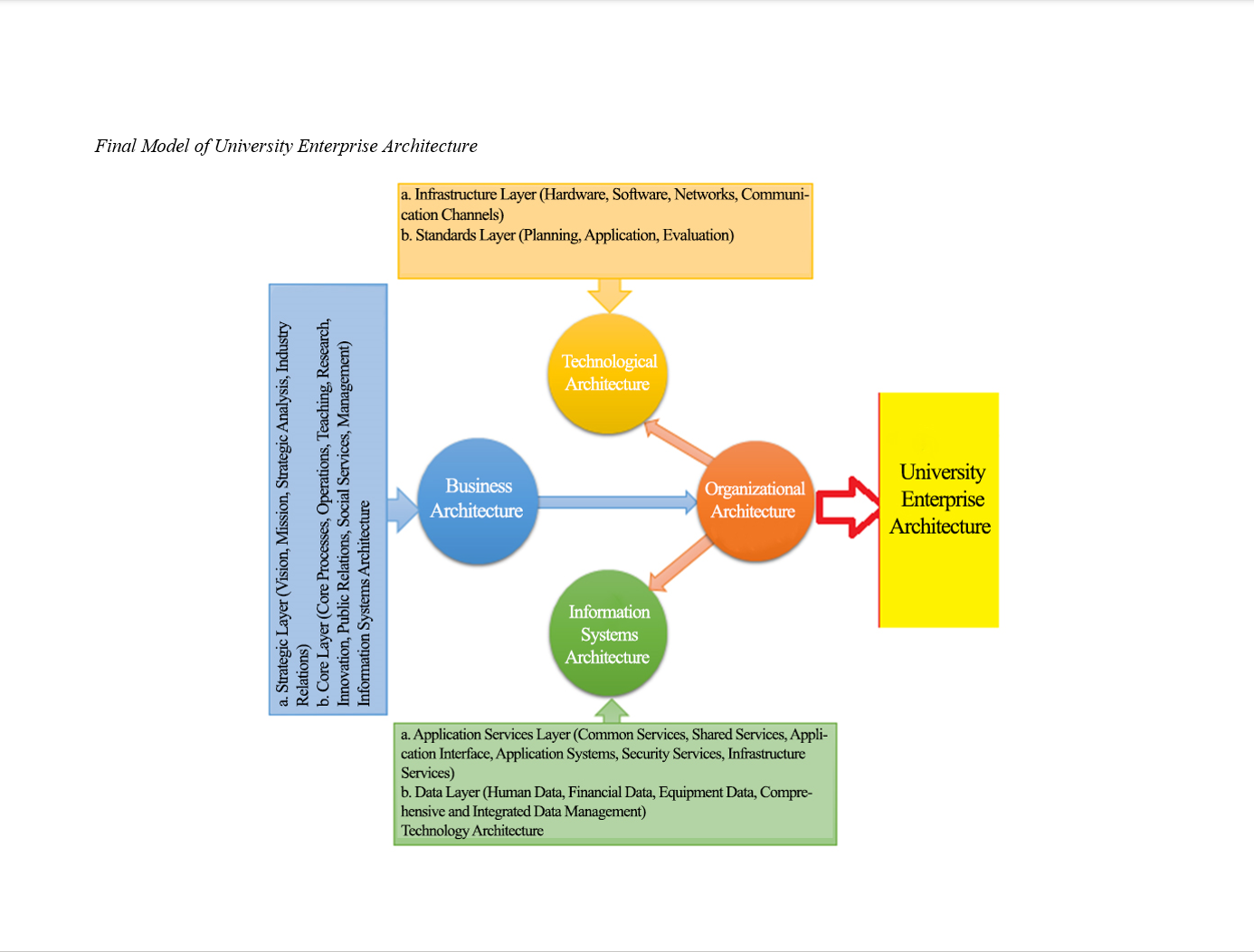
Findings: The findings indicate that the university enterprise architecture model can be classified into three layers: business architecture, information systems architecture, and technology architecture. Additionally, the path coefficient for the business architecture component with university enterprise architecture was 0.98, for information systems architecture it was 0.85, and for technology architecture with university enterprise architecture it was 0.86 (P < 0.05).
Conclusion: The enterprise architecture model of the Islamic Azad University comprises three main components. Paying attention to these components can lead to the development and flourishing of university enterprise architecture. Therefore, the higher education system can focus more on educational architecture to further enhance the flourishing of higher education.
Downloads
References
Ahmadian, N., Seyed Ebrahim, M., & Shabani, A. A. (2014). Qualitative assessment of the current enterprise architecture status of Islamic Azad University and providing a model of architecture services in the desired state. Scientific-Research Quarterly Journal of a New Approach in Educational Management, Islamic Azad University, Marvdasht Branch, Fifth Year, No. 4.
Appiah, G., Amankwah-Amoah, J., & Liu, Y. L. (2020). Organizational architecture, resilience, and cyberattacks. Ieee Transactions on Engineering Management, 69(5), 2218-2233. https://doi.org/10.1109/TEM.2020.3004610
Cunningham, J. A., Lehmann, E. E., & Menter, M. (2022). The organizational architecture of entrepreneurial universities across the stages of entrepreneurship: a conceptual framework. Small Business Economics, 59(1), 11-27. https://doi.org/10.1007/s11187-021-00513-5
Curaj, A., Deca, L., & Pricopie, R. (2018). European higher education area: The impact of past and future policies. In European Higher Education Area (pp. 721). Springer Nature. https://doi.org/10.1007/978-3-319-77407-7_1
Mathews, J., Yezer, K., & Antony, K. M. (2020). Organizational Architecture of Human Resources. Bhutan Journal of Business & Management, 3(1), 1-27. https://doi.org/10.2139/ssrn.3741803
Parsa, S., Haji Heidari, N., & Abbasi, E. (2012). Identification and examination of issues and problems in enterprise architecture in selected Iranian companies: A mixed-method research. Journal of Information Technology Management, 4(13), 1-24. https://www.sid.ir/paper/480351/en
Ross, J. (2014). Demand Shaping: Changing the Conversation About IT. MIT CISR Research. https://cisr.mit.edu/publication/2014_1001_DemandShaping_RossBeathWixom
Salman Al-Oda, A. H., Sadeghi, M., Al-Murshidi, R. H. A., & Sharifi, S. (2024). Investigating the Relationship Between Talent Management Implementation Categories in the Basra Province Education Organization [Research Article]. Iranian Journal of Educational Sociology, 7(1), 1-9. https://doi.org/10.61838/kman.ijes.7.1.1
Verma, P., Kumar, V., Yalcin, H., & Daim, T. (2023). Organizational architecture of strategic entrepreneurial firms for digital transformation: A bibliometric analysis. Technology in Society, 75, 102355. https://doi.org/10.1016/j.techsoc.2023.102355
Wahju, A., Emanuel, R., Galih, J., & Negara, P. (2019). Enterprise Architecture Design Strategies for UGK Using TOGAF ADM st Borobudur International Symposium on Humanities, Economic, Yogyakarta. https://www.atlantis-press.com/proceedings/bis-hess-19/125939528
Zamani, S., Paryab, S., Zarouj Hosseini, K., Masoudi, G., Zarouj Hosseini, R., Arab Asadi, F., & Garkaz, O. (2024). Examining the Counseling and Guidance Needs of Sudents of Shahroud University of Medical Sciences in the AcademicYear 2021-2022. ajaums-mcs, 10(3), 258-266. http://mcs.ajaums.ac.ir/article-1-524-en.html
Downloads
Additional Files
Publication Timeline
- Submitted
- Revised
- Accepted
Issue
Section
License
Copyright (c) 2024 Masoume Saraei, Omid Ali Hosseinzadeh, Asadollah Khadivi (Author)

This work is licensed under a Creative Commons Attribution-NonCommercial 4.0 International License.