Structural Equation Modeling of Personality Traits and Job Satisfaction with the Mediating Role of Social Support During the COVID-19 Pandemic (Case Study: Educational-Therapeutic Staff of Teaching Hospitals in Tabriz)
DOI:
https://doi.org/10.61838/kman.ijimob.3699Keywords:
Social support, structural equation modeling, personality traits, COVID-19 pandemic, job satisfactionAbstract
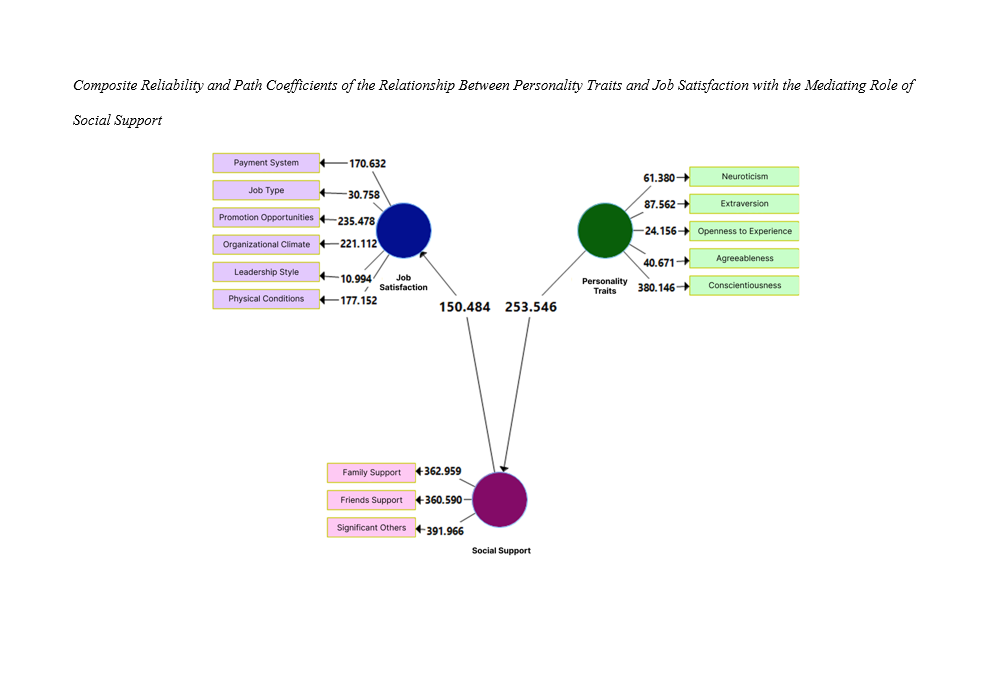
Objective: The present study aimed to model the structural equation relationships between personality traits and job satisfaction, with the mediating role of social support among the educational-therapeutic staff of teaching hospitals in Tabriz.
Methodology: This study was a descriptive-correlational research utilizing structural equation modeling. The statistical population comprised 8,500 educational-therapeutic staff members of teaching hospitals in Tabriz during 2020–2021. The sampling method was cluster sampling, and the sample size, determined based on Krejcie and Morgan’s (1970) table, was 384 participants. Data were collected using the NEO Personality Inventory, the Minnesota Job Satisfaction Questionnaire, and the Perceived Social Support Scale. Data analysis was conducted using correlation coefficients and structural equation modeling.
Findings: The findings indicated a significant positive relationship between personality traits and job satisfaction, as well as between social support and job satisfaction. Furthermore, the mediating role of social support in the relationship between personality traits and job satisfaction was confirmed. Accordingly, it is concluded that considering employees' personality traits can improve the work environment and enhance their job satisfaction. Additionally, the role of social support as a mediator highlights the importance of creating a supportive atmosphere in the workplace.
Conclusion: Therefore, organizations should design social support programs for their employees to strengthen self-esteem and coping abilities, ultimately contributing to increased job satisfaction.
Downloads
References
Abdulmohdi, N. (2024). The relationships between nurses' resilience, burnout, perceived organisational support and social support during the second wave of the COVID‐19 pandemic: A quantitative cross‐sectional survey. Nursing Open, 11(1), e2036.
Adnan Kamel, A., Mahdad, A., Abdulkadhim Johni, A., & Sajjadian, I. (2024). The Moderating Role of Perceived Social Support in the Relationship Between Professional Quality of Life, PTSD Symptoms, and Psychological Well-Being of Nurses in Karbala. Health Nexus, 2(3), 18-26. https://doi.org/10.61838/kman.hn.2.3.3
Alameri, R. A., Almulla, H. A., Al Swyan, A. H., & Hammad, S. S. (2024). Sleep quality and fatigue among nurses working in high-acuity clinical settings in Saudi Arabia: a cross-sectional study. BMC Nurs, 23(1), 1-7. https://doi.org/10.1186/s12912-023-01693-z
Alhawatmeh, H. (2025). Holistic Healing Through Mindfulness: An Experimental Study Addressing Psychological Challenges Among Nurses Caring for Patients With COVID-19. Journal of Holistic Nursing. https://doi.org/10.1177/08980101251323021
Asl, N., Dokaneifard, F., & Jahangir, P. (2022). Presenting a model for predicting emotional divorce based on personality traits and job self-efficacy mediated by perceived social support in working married women. Journal of counseling research. https://publish.kne-publishing.com/index.php/QJCR/article/view/8844
Asl, N., Dookanei-Fard, F., & Jahangir, P. (2021). A model for predicting emotional divorce based on personality traits and job self-efficacy with the mediating role of perceived social support among employed married women. Scientific Quarterly of Counseling Research, 20(80), 316-339. https://ensani.ir/fa/article/497585/
Dehghan Harati, M., Barzegar Bafrooei, K., & Dehghan Manshadi, M. (2024). Design and Internal Validation of an Educational-Therapeutic Model for Addressing Co-Dependency Based on Perceived Lived Experiences of Adolescents. Journal of Psychological Dynamics in Mood Disorders (PDMD), 3(1), 198-211. https://doi.org/10.22034/pdmd.2024.457056.1091
Diannita, C. G., Permatasari, H., & Mulyono, S. (2024). Occupational Stress and Professional Quality of Life Among Community Health Nurses During the COVID-19 Pandemic. J Holist Nurs, 42(2_suppl), S110-S117. https://doi.org/10.1177/08980101231204774
Fakhri, Z., Shojai, S., & Kheirandish, M. (2021). Investigating Factors Affecting the Psychological Empowerment of Employees in Educational-Therapeutic Hospitals in Tehran. Scientific Research Journal of Birjand University of Medical Sciences, 28(3), 234-245.
Gul, K., Sabir, J., Bukhtiar, A., & Saleem, H. A. R. (2025). Examining Marriage Anxiety, Psychological Distress and Social Support Among Adults of Separated and Non-Separated Families. CRSSS, 3(1), 1478-1493. https://doi.org/10.59075/kdspey16
Hassan, A. F., & Majeed, H. I. S. R. (2024). Nurses' knowledge and protective health behaviors about prevention of COVID-19 pandemic complications at Baghdad Teaching Hospitals. Journal of education and health promotion, 13(1), 107. https://doi.org/10.4103/jehp.jehp_844_23
Keramati, M. R. (2021). A Comparison of Health-Related Quality of Life and Job Satisfaction in Physically Active and Sedentary Faculty Members. International Journal of Education and Cognitive Sciences, 2(3), 23-32. https://doi.org/10.22034/injoeas.2021.160725
Kwon, M., & Song, Y. (2024). Impact of Emotional Labor and Positive Psychological Capital on the Turnover Intention of Nurses Caring for Patients With COVID-19: A Descriptive Survey Study. Journal of nursing management, 2024, 1-7. https://doi.org/10.1155/2024/5517249
Li, L., Kanchanapoom, K., Deeprasert, J., Duan, N., & Zhou, Q. (2025). Unveiling the Factors Shaping Teacher Job Performance: Exploring the Interplay of Personality Traits, Perceived Organizational Support, Self-Efficacy, and Job Satisfaction. BMC psychology, 13(1). https://doi.org/10.1186/s40359-024-02324-1
M.Y, Y. S., Samsinar, S., & Intani, T. M. (2025). The Influence of Social Support on Postpartum Depression Risk Among Pregnant Women. Thejoas, 2(2), 587-595. https://doi.org/10.59613/qkhvsw65
Malek, N., & Soltani, S. (2015). Examining the Application of the "Design for Humans" Principle in Designing Educational-Therapeutic Buildings for Children (Case Study: Autism Educational-Therapeutic Center in Shiraz). 1st Annual Conference on Architectural, Urban Planning, and Urban Management Research,
Mansouri, P., Rivaz, M., Soltani, R., & Tabei, P. (2025). The relationship between professional quality of life and sleep quality among nurses working in intensive care units: a cross-sectional study. BMC Nurs, 24(1), 34. https://doi.org/10.1186/s12912-025-02693-x
Mardani, M., Besharat, M. A., Firoozi, M., & Vosoughi, T. (2025). Investigating the Effectiveness of Paradox Therapy on Death Anxiety in Female Patients With Cancer. JCCNC, 11(1), 75. https://doi.org/10.32598/JCCNC.11.1.702.1
Mi, Y., Wang, Z., Peng, L., Zhang, C., & Xu, H. (2025). Exploring the Impact of Interpersonal Sensitivity on Anxiety Symptoms: The Mediating Role of Psychological Capital and Social Support Among Nursing Students. BMC psychology, 13(1). https://doi.org/10.1186/s40359-025-02621-3
Nasab, K., Hamid, B., Ganji, L., Amini, M., Pashmdarfard, M., & Davari, Z. (2025). Relationship of Loneliness, Perceived Social Support, and Dysfunctional Attitudes with Death Anxiety in Older Adults; the Mediating Role of Spiritual Health. Iranian Journal of War and Public Health, 17(1), 29-35.
Ok, C., Cho, E., & Park, J. (2023). The Impact of Workaholism on Job Satisfaction Depending on Personality: Focusing on the Moderating Role of Conscientiousness. The Institute of Management and Economy Research, 14(4), 217-231. https://doi.org/10.32599/apjb.14.4.202312.217
Rahgoi, A. (2024). The Relationship Between Perceived Social Support, Psychological Capital, Job Burnout, and Work Engagement in Nurses Working on the Front Line of the Fight Against the Coronavirus. https://doi.org/10.21203/rs.3.rs-4281322/v1
Rezaei, F. (2023). The relationship between sleep quality and work-life quality with occupational stress among nurses and hospital staff in Kermanshah during the COVID-19 pandemic. Journal of Paramedical Sciences and Military Health, 18(1), 28-37. http://jps.ajaums.ac.ir/browse.php?a_code=A-10-577-1&slc_lang=fa&sid=1
Shari'atnejad, A., Sepahvand, R., & Arefnejad, M. (2019). Identifying and Prioritizing Factors Affecting the Acceptance of Information Technology in Educational-Therapeutic Hospitals Using Structural-Interpretive Modeling. Human Resource Management Research, 11(3), 151-178. https://hrmj.ihu.ac.ir/article_208840.html
Uye, E. E., Adejuwon, L., & Ehondor, E. (2024). Workplace Stress, Social Support and Coping Strategy as Predictors of Mental Well-Being Among Nurses in Ibadan. Ijasse, 2(2), 169-180. https://doi.org/10.59890/ijasse.v2i2.1753
Weerasekara, W. M. S. K., & Perera, G. D. N. (2024). The Impact of Big Five Personality on Executive Employees’ Job Performance: Mediating Role of Job Satisfaction in a Selected Public Financial Institution in Sri Lanka. International Journal of Governance and Public Policy Analysis, 6(1). https://doi.org/10.31357/ijgppa.v6i1.7649
Xu, Y., Zheng, Q.-X., Jiang, X.-M., Guo, S.-B., Kang, Y.-L., Lin, Y.-P., & Liu, G.-H. (2023). Effects of coping on nurses' mental health during the COVID-19 pandemic: Mediating role of social support and psychological resilience. Nursing Open, 10(7), 4619-4629. https://doi.org/10.1002/nop2.1709
Yan, Y.-y., Ya, M. A., Xu, L., & Lv, Y. (2024). Impact of Perceived Social Support on Anxiety and Depression in Women Undergoing in Vitro Fertilization-Embryo Transfer: The Role of Psychological Resilience. Journal of Assisted Reproduction and Genetics, 42(1), 231-242. https://doi.org/10.1007/s10815-024-03308-1
Yang, Q. (2024). Neuroticism and Depression Among First-Year College Students Using a Moderated Mediation Model of Perceived Social Support and Perceived Stress. https://doi.org/10.21203/rs.3.rs-4617838/v1
Zarrin Kolak, H. R., Davari, R., & Hashemi, N. (2023). Job burnout modeling based on resilience and social support mediated by personal values among military industry employees. Nurse and Physician in War, 10(37), 64-73. https://npwjm.ajaums.ac.ir/article-1-911-fa.html
Downloads
Additional Files
Publication Timeline
- Submitted
- Revised
- Accepted
Issue
Section
License
Copyright (c) 2025 Nasim Saberi (Author); Jahangir Yari Haj Atalou (Corresponding Author); Omid Ali Hosseinzadeh (Author)

This work is licensed under a Creative Commons Attribution-NonCommercial 4.0 International License.