Explaining and Designing a Framework for the Phenomenon of Educational Corruption with a Grounded Theory Approach in Universities
DOI:
https://doi.org/10.61838/kman.ijimob.5.4.9Keywords:
Educational corruption, grounded theory, universities, higher education institutionsAbstract
Objective: The main goal of this study was to explain and design a framework for the phenomenon of educational corruption using a grounded theory approach in universities.
Methodology: The statistical population of the study consisted of twelve university administrators, faculty members, and staff members from higher education institutions in Tehran. Semi-structured interviews were conducted with them through a snowball sampling method until theoretical saturation was reached. Data analysis was performed in three stages: open coding, axial coding, and selective coding, using the qualitative analysis software MAXQDA. Based on this analysis, the qualitative model of the research was designed.
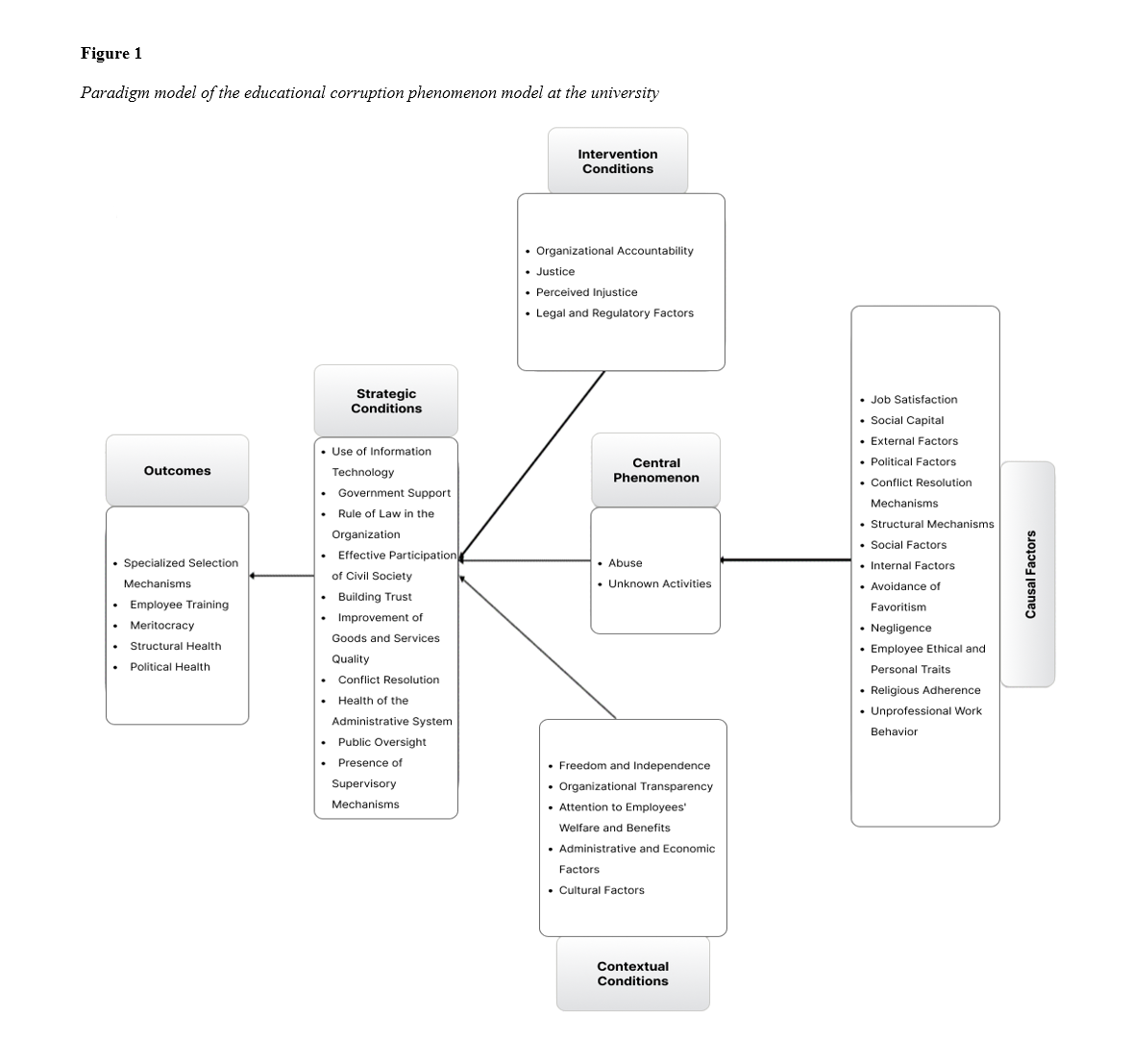
Findings: The results showed that the paradigm model included causal conditions (organizational commitment, employee job satisfaction, social capital, external factors, political factors, problem-solving mechanisms, structural mechanisms, social factors, internal factors, avoidance of favoritism, negligence, individual and ethical characteristics of employees, religious adherence, inappropriate professional behaviors); the core category (practical solutions for combating corruption, abuse, and unknown activities); strategies (use of information technology, legalism in organizations, effective participation of civil society, trust-building, conflict resolution, administrative integrity, public oversight, existence of monitoring mechanisms); intervening conditions (solutions related to rulers and holders of power, accountability within organizations, justice, feelings of injustice); contextual conditions (ethical orientation, freedom and independence, organizational transparency, attention to livelihood and legal rights and benefits, administrative and economic factors, cultural factors); and outcomes (specialized selective mechanisms, employee training, meritocracy, structural integrity, political integrity). These elements reflect the educational corruption process in universities and the relationships between various dimensions and their components.
Conclusion: Educational corruption is a multifaceted issue with various causes and reasons. To combat it, policymakers can design educational environments in a way that increases transparency, based on the findings of this study.
Downloads
References
Abbasi, A., Farzan, F., & Zayer, B. (2014). Individual Factors and Types of Scientific Misconduct. Communication Management in Sports Media(6), 21-29. https://sportmedia.journals.pnu.ac.ir/article_1575.html?lang=en
Asghr, K. (2025). Examining the Effect of Ai Tools on Critical Thinking and Problem Solving Skills Among Higher Education Students. Gomal University Journal of Research, 41(1), 105-114. https://doi.org/10.51380/gujr-41-01-10
Assefa, Y., Gebremeskel, M. M., Moges, B. T., Tilwani, S. A., & Azmera, Y. A. (2025). Rethinking the digital divide and associated educational in(equity) in higher education in the context of developing countries: the social justice perspective. The International Journal of Information and Learning Technology, 42(1), 15-32. https://doi.org/10.1108/IJILT-03-2024-0058
Bagherimajd, K., Khajedad, K., & Mahmoudi, F. (2024). Design of a model to reduce academic corruption in higher education. International Journal of Ethics Education, 1-25. https://doi.org/10.1007/s40889-024-00197-x
Chapman, D. W., & Lindner, S. (2016). Degrees of integrity: the threat of corruption in higher education. Studies in Higher Education, 41(2), 247-268. https://doi.org/10.1080/03075079.2014.927854
Chronicle, T. (2002). Corruption plagues academe around the world. http://chronicle.com/prm/weekly/v48/i47/47a93201.htm
Danjuma, M., Yauta, S. A., & Jerry, M. (2018). Outsourcing as an Alternative for Higher Education Financing (HEF) in Nigeria: The Case of Adamawa State University Mubi, Gombe State University and Taraba State University, Nigeria. European Scientific Journal, ESJ, 14(16). https://doi.org/10.19044/esj.2018.v14n16p263
Deliversky, J. (2016). Preventing corruption in the education system. Journal of educational and instructional studies in the world, 6(1), 141-146. https://www.researchgate.net/publication/315685849_PREVENTING_CORRUPTION_IN_THE_EDUCATION_SYSTEM
Duerrenberger, N., & Warning, S. (2018). Corruption and education in developing countries: The role of public vs. private funding of higher education. International Journal of Educational Development, 62, 217-225. https://doi.org/10.1016/j.ijedudev.2018.05.002
Feoktistova, Y. (2014). Corruption in higher education and government measures for its prevention. Procedia-Social and Behavioral Sciences, 112, 167-172. https://doi.org/10.1016/j.sbspro.2014.01.1152
Gholamzadeh, D., Abbasi, M., & Ahmadi Rad, M. (2022). Administrative Corruption and Its Bottlenecks in Organizational and Managerial Structures: A Case Study of Scientific and Academic Centers (Administrative Headquarters and Applied Science Centers). Journal of Accounting and Management Outlook, 5(63), 59-76. https://www.jamv.ir/article_153717_1f79f1056101eda3f5f7e030e3b3a2a9.pdf?lang=en
Gill, J. (2013). Global Corruption Report: Education. Routledge. https://transparency.bg/wp-content/uploads/2021/07/Global_Corruption_Report_EDUCATION_2013_1_compressed.pdf
Hosseini Hashemzadeh, D., Fazeli, M., & Mohaddesi Giloei, H. (2016). Proposal of a Multidimensional Framework and Method for Measuring Corruption in Higher Education. Iranian Journal of Social Studies, 10(4), 116-148. http://www.jss-isa.ir/article_31602.html?lang=en
Kirya, M. (2019). Corruption in universities: Paths to integrity in the higher education subsector. U4. https://www.u4.no/publications/corruption-in-universities-paths-to-integrity-in-the-higher-education-subsector
Mohammadian Sharif, K., Salimi, J., Azizi, N., Mohammadi, S., & Amin Bidokhti, A. A. (2020). Factor Structure of the Academic Corruption Questionnaire in Higher Education in Iran. Studies in Educational Measurement and Evaluation, 10(32), 139-158. https://jresearch.sanjesh.org/article_244028.html?lang=en
Moqaddari, A., & Dahmarde, M. (2012). Cheating and Misconduct in Medical Research. Zahedan Journal of Medical Research (Tabib Shargh), 14(1), 1-7. https://www.magiran.com/paper/961835/fraud-and-misconduct-in-medical-research?lang=en
Mugala, A., Masaiti, G., & Mwila, K. (2022). Unpacking academic corruption in Zambia's higher education: forms, causes and mitigation measures. Creative Education, 13(1), 55-74. https://doi.org/10.4236/ce.2022.131004
Naizabekov, A. A. (2021). Corruption risks in higher education institution. Вестник КазНУ. Серия Юридическая, 98(2), 16-23. https://doi.org/10.26577/JAPJ.2021.v98.i2.02
Osipian, A. L. (2013). Recruitment and admissions: Fostering transparency on the path to higher education. In Global Corruption Report: Education (pp. 148-154). Routledge. https://www.taylorfrancis.com/chapters/edit/10.4324/9780203109816-30/recruitment-admissions-ararat-osipian
Oulamine, A., El Gareh, F., Hattabou, & Elmenssouri, A. (2025). The evolution of e-learning and its challenges in higher education: A theoretical review. African Scientific Journal, 3(28), 174-196. http://africanscientificjournal.com/index.php/AfricanScientificJournal/article/view/1034
Öztel, H. (2025). Practice Driven Thought Leadership in Higher Education Professional Services. Perspectives Policy and Practice in Higher Education, 29(1), 1-2. https://doi.org/10.1080/13603108.2024.2432750
Priputneva, D. (2022). The Effect of Corruption on Higher Education: A case study of Russia https://www.diva-portal.org/smash/record.jsf?pid=diva2:1706871
Rahman, M. A. (2022). The Discursive Construction of Strategies for Implementing Anti-Corruption Education at State Islamic Higher Educational Institutions. Jurnal Ilmiah Peuradeun, 10(3), 555. https://doi.org/10.26811/peuradeun.v10i3.737
Sabharwal, N. S., & Tierney, W. G. (2023). Analyzing the Culture of Corruption in Indian Higher Education. In Corruption in Higher Education (pp. 111-116). Brill. https://doi.org/10.1163/9789004433885_017
Silova, I., Johnson, M., & Heyneman. (2007). Education and the Crisis of Social Cohesion in Azerbaijan and Central Asia. Comparative Education Review, 51(2), 159-180. https://doi.org/10.1086/512022
Downloads
Additional Files
Publication Timeline
- Submitted
- Revised
- Accepted
Issue
Section
License
Copyright (c) 2025 Solayman Solaymani Tabar, Nader Soleimani, Hamid Shafizadeh (Author)

This work is licensed under a Creative Commons Attribution-NonCommercial 4.0 International License.