Identifying and Ranking the Factors Affecting Visionary Educational Leadership: A Mixed-Methods Approach (Case Study: Primary Schools in Tehran Metropolitan Area)
DOI:
https://doi.org/10.61838/kman.ijimob.3585Keywords:
Visionary educational leadership, vision, educational leadershipAbstract
Objective: The aim of this study is to identify and rank the factors affecting visionary leadership in primary schools.
Methodology: This research is applied in terms of its objective, descriptive-survey in terms of data collection, and classified as a mixed-method study with both qualitative and quantitative approaches within the inductive-deductive paradigm. The research method is fuzzy Delphi. The statistical population for the qualitative part consisted of professors in educational management, human resource management, and educational sciences. According to the research purpose, purposive sampling was conducted with a sample size of 18 participants. The statistical population for the quantitative part comprised school principals in the Tehran metropolitan area, with a non-probabilistic convenience sampling method used to determine a sample size of 58 principals. The data collection tools for the qualitative part were interviews, and for the quantitative part, a questionnaire. Validity and reliability were confirmed using the CVR index, Cohen's kappa test, and test-retest methods. In the qualitative section, the qualitative data obtained from interviews were analyzed using Maxqda 2020 software and coding techniques. The quantitative analysis and final analysis were performed using the fuzzy Delphi method.
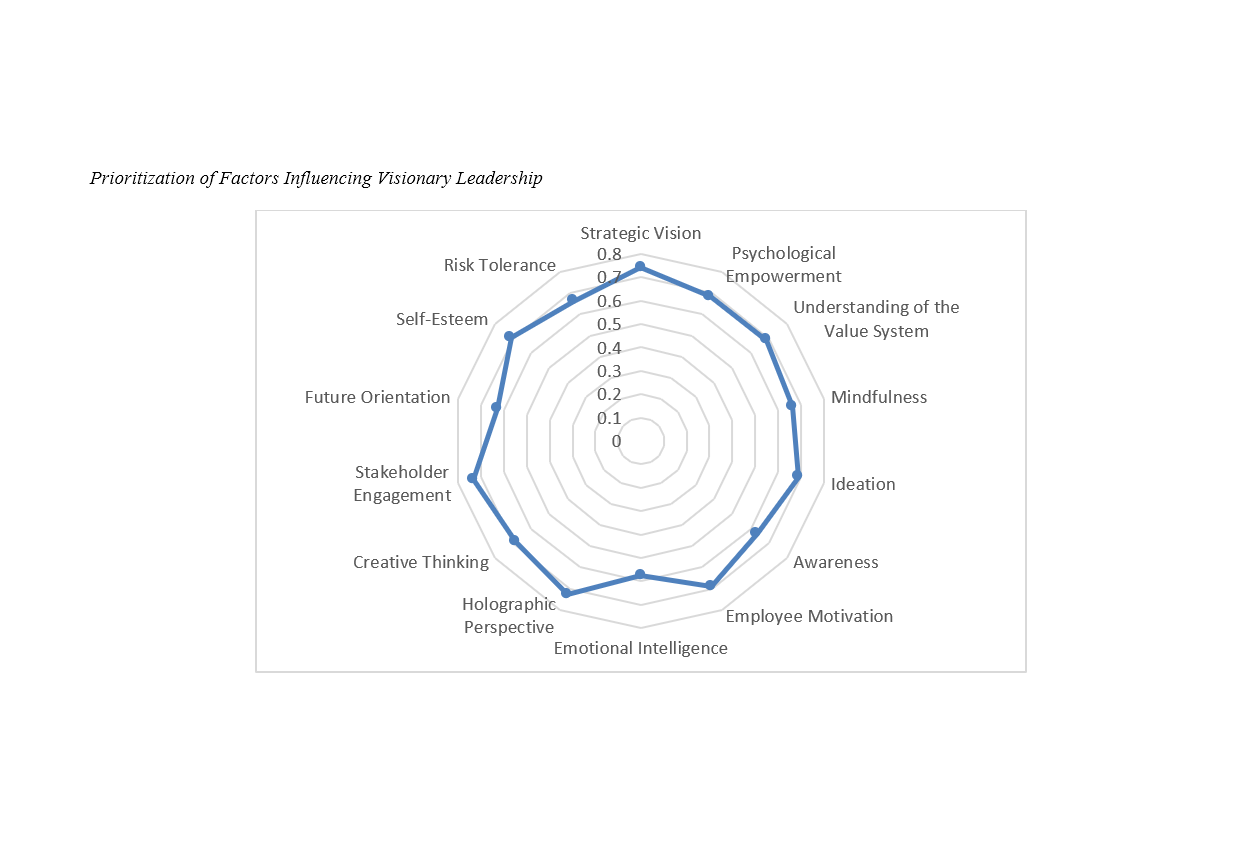
Findings: Through the qualitative data obtained from exploratory interviews, 14 factors affecting visionary leadership were identified. These factors were then ranked using quantitative research methods.
Conclusion: The results of the research indicate that strategic vision, communication with key stakeholders, self-esteem, and a holographic perspective are the most important factors influencing visionary leadership.
Downloads
References
Alaei, F., Ahghar, G., & Fathi Vernosfaderani, L. (2024). Identification and Explanation of Organizational Health Dimensions and Components among Middle School Teachers in Tehran. iase-idje, 7(2), 36-42. https://doi.org/10.61838/kman.ijes.7.2.5
Alwaely, S. A., Aboutaleb, A. H., Alqudah, H., Musleh, O. A., Abusalma, A., Halim, M., & Darawsheh, S. R. (2024). Empowering Educational Leadership: Examining Self-Management of School Leaders and its Impact on Teachers' Participation in Decision-Making within the United Arab Emirates (UAE). Kurdish Studies, 12(2), 2559-2570. https://kurdishstudies.net/menu-script/index.php/KS/article/view/2292
Cowen, S., & Seifter, B. (2018). Winnebagos on Wednesdays: How visionary leadership can transform higher education (Vol. 108). Princeton University Press. https://doi.org/10.23943/9781400889532 10.2307/j.ctvc77627
Daučianskaitė, A., & Žydžiūnaitė, V. (2020). Differences and similarities between coaching, instructional and educational leadership styles. Acta Educationis Generalis, 10(3), 87-100. https://doi.org/10.2478/atd-2020-0022
Handayani, E. (2023). Competence of Visionary Leaders of Educational Institutions in the Challenges of Technology-Disruption. Edumaspul: Jurnal Pendidikan, 7(1), 892-901. https://doi.org/10.33487/edumaspul.v7i1.5713
Hemmatyar, Z., Abdollahi, B., navehebrahim, A., & Zaynabadi, H. R. (2019). Identifying dimensions and behavioral symptoms of visionary educational leaders in elementary schools: Qualitative and phenomenological inquiry. School administration, 7(3), 160-143. https://journals.uok.ac.ir/article_60991.html
Kadir, A. N. J., Adebayo, T. A., & Olumide, S. A. (2020). Visionary leadership and staff innovative behaviour in public colleges of education in Kwara State, Nigeria. International Journal of Education, 12(2), 63-72. https://doi.org/10.17509/ije.v12i2.18998
Khoiri, M. (2020). Visionary leadership on transforming organizational change in the era of disruption. International Journal of Multicultural and Multireligious Understanding, 7(10), 490-495. https://ijmmu.com/index.php/ijmmu/article/view/2053
Kusumawati, E. (2023). Analysis of the Relationship Between the School Principal's Visionary Leadership and Kindergarten Teachers' Performance. Journal of Innovation in Educational and Cultural Research, 4(1), 89-97. https://doi.org/10.46843/jiecr.v4i1.526
McGreal, R., & Olcott Jr, D. (2022). A strategic reset: micro-credentials for higher education leaders. Smart Learning Environments, 9(1), 9. https://doi.org/10.1186/s40561-022-00190-1
Mohammadi Komroudi, M. J., Ahmadi, M., & Farhadi Mahalli, A. (2024). Designing an Ethically-Oriented Management Model for Employee Education Development in Higher Education Using Grounded Theory (Case Study: Free Universities of Mazandaran Province) [Research Article]. Iranian Journal of Educational Sociology, 7(2), 114-123. https://doi.org/10.61838/kman.ijes.7.2.14
Moradkhah, A. H., & Seyedeh, P. (2024). Conceptualizing entrepreneurial leadership from the perspective of school administrators: A phenomenological approach. Educational Leadership Research.
Na'imah, T., & Muhibbin, A. (2020). Characteristics of Islamic education leadership: Literature review. Technium Soc. Sci. J., 11, 59. https://doi.org/10.47577/tssj.v11i1.1423
Ubaidillah, M., Christiana, R., & Sahrandi, A. (2019). The Visionary Leadership Strategy in Advancing Educational Institutions. Erudio Journal of Educational Innovation, 6(2), 206-215. https://doi.org/10.18551/erudio.6-2.7
Zhang, Y., & He, Q. (2024). Neuro‐educational leadership: Pioneering educational leadership through neuroscience research. Future in Educational Research.
Downloads
Additional Files
Publication Timeline
- Submitted
- Revised
- Accepted
Issue
Section
License
Copyright (c) 2025 Fatemeh Khorasani (Author); Hamid Shafizadeh (Corresponding Author); Fakhredin Ahmadi, Maryam Afzal Khani (Author)

This work is licensed under a Creative Commons Attribution-NonCommercial 4.0 International License.