Identifying the Challenges of COVID-19 Crisis Management in the Education System (Case Study: Khoy County)
DOI:
https://doi.org/10.61838/kman.ijimob.4882Keywords:
Crisis management, COVID-19 pandemic, education system, challenges, Khoy CountyAbstract
Objective: This study aims to identify and analyze the key challenges of COVID-19 pandemic crisis management in the education system of Khoy County.
Methods and Materials: A mixed-methods design was employed, combining qualitative content analysis with quantitative survey analysis. In the qualitative phase, semi-structured interviews were conducted with 24 stakeholders, including education administrators, crisis management officials, school principals, teachers, students, parents, and experts, until theoretical saturation was reached. Interview data were analyzed through open, axial, and selective coding using MAXQDA software. In the quantitative phase, a researcher-developed questionnaire was administered to 384 respondents selected using Cochran’s formula. Face validity and reliability (Cronbach’s alpha) were confirmed. Quantitative data were analyzed using SPSS, with the Friedman ranking test applied to examine differences in the prioritization of crisis management challenges.
Findings: The Friedman test results indicated no statistically significant difference among the identified crisis management challenges (χ² = 5.374, df = 4, p = 0.251). Mean ranks showed minimal variation across dimensions, with educational inequality and the digital divide ranking highest (mean rank = 3.14) and psychological and social pressures ranking lowest (mean rank = 2.89). The lack of significant differences demonstrates that respondents perceived all crisis management challenges as uniformly critical, confirming the homogeneity and systemic nature of the problems rather than the dominance of any single dimension.
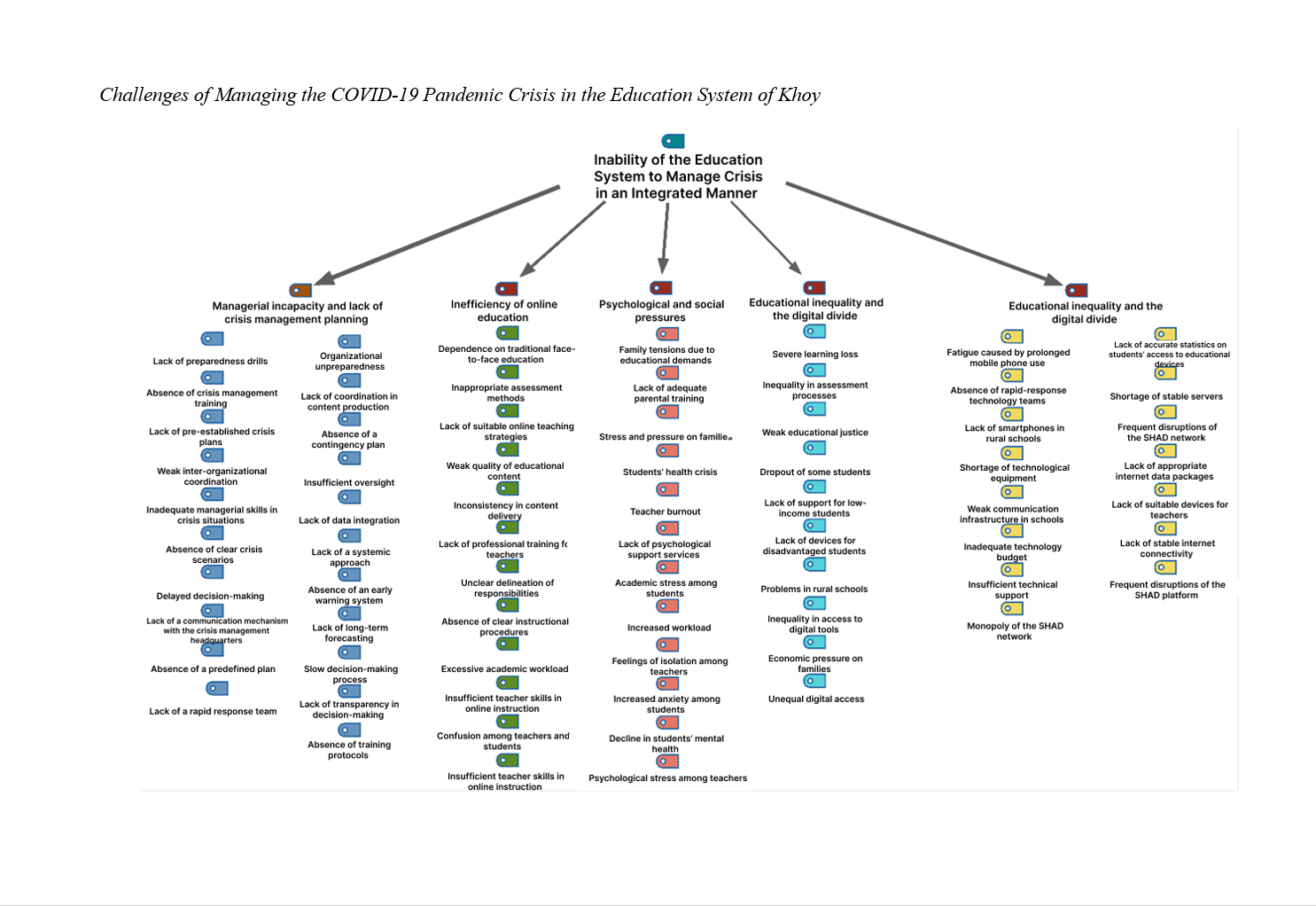
Conclusion: The findings indicate that crisis management failure in the education system of Khoy County is systemic and structural, arising from the simultaneous interaction of managerial incapacity, infrastructural weaknesses, educational inequality, inefficiency of online education, and psychological pressures. The absence of differentiated priorities suggests that effective improvement requires comprehensive, integrated, and simultaneous interventions across all dimensions rather than fragmented or selective approaches.
Downloads
References
Al-Janabi, A. S. H., Mhaibes, H. A., & Hussein, S. A. (2022). The role of learning organizations in crisis management strategy: A case study. Corporate & Business Strategy Review, 3(1), 8-21. https://doi.org/10.22495/cbsrv4i1art1
Ben, V. (2025). Examining critical crisis management skills in the educational environment. International Journal of Educational Development, 32(3), 482-492. https://www.researchgate.net/publication/388208470_Examining_Crisis_Management_Approaches_and_Leadership_Effectiveness_in_Lagos_Public_Secondary_Schools
Chatzipanagiotou, P., & Katsarou, E. (2023). Crisis Management, School Leadership in Disruptive Times and the Recovery of Schools in the Post COVID-19 Era: A Systematic Literature Review. Education Sciences, 13(2), 118. https://doi.org/10.3390/educsci13020118
Elbedour, S., Alsubie, F., Al'Uqdah, S. N., & Bawalsah, J. A. (2020). School crisis management planning. Children & Schools, 42(4), 208-215. https://doi.org/10.1093/cs/cdaa021
Gainey, B. S. (2010). Crisis management in public school districts. Organization Development Journal, 28(1), 89. https://digitalcommons.kennesaw.edu/cgi/viewcontent.cgi?article=2642&context=facpubs
Gharari, M., Mohammadi, R., & Ghorbani, M. (2020). An examination of the harms and challenges of the COVID-19 pandemic on education. Iranian Journal of Epidemiology, 16(5), 29-37. https://irje.tums.ac.ir/browse.php?a_id=6914&sid=1&slc_lang=fa
Hidayat, D. A. S. R. U. N., Anisti, P., & Wibawa, D. (2020). Crisis management and communication experience in education during the covid-19 pandemic in Indonesia. Jurnal Komunikasi: Malaysian Journal of Communication, 36(3), 67-82. https://doi.org/10.17576/JKMJC-2020-3603-05
Jabeen, M., Kayani, A. I., & Yousuf, M. I. (2022). Crisis Management in Schools of the Punjab: An Exploratory Study of Factors Affecting Strategic Planning. Journal of Development and Social Sciences, 3(2), 141-149. https://doi.org/10.47205/jdss.2022(3-II)14
Javaheri, A., Vakili, M., & Esmaeili, A. (2022). The lived experiences of students regarding educational challenges after returning to school during the COVID-19 pandemic. Ruyesh Psychology, 11(6), 174-165. https://frooyesh.ir/browse.php?a_id=3637&sid=1&slc_lang=fa
Kedačić-Buzina, K., & Klarin, T. (2024). Challenges of crisis management in educational institutions of the Republic of Croatia. Crisis Management Days,
Mazhabi, Z. (2025). Investigating leadership attributes and strategies during times of crisis and educational change: A story of public primary school principals in Lombok, Indonesia. Educational Management Administration & Leadership. https://doi.org/10.1177/17411432241300280
Nickerson, A. B., & Sulkowski, M. L. (2021). The COVID-19 pandemic as a long-term school crisis: Impact, risk, resilience, and crisis management. School Psychology, 36(5), 271-276. https://doi.org/10.1037/spq0000470
Redding, S., & Walberg, H. J. (2012). Promoting Learning in Rural Schools. Academic Development Institute. https://eric.ed.gov/?id=ED573693
Salimi, S., & Fardin, M. A. (2020). The role of the coronavirus in virtual education, with an emphasis on opportunities and challenges. Scientific Research Quarterly in School and Virtual Learning, 8(2), 49-60. https://etl.journals.pnu.ac.ir/article_7243.html?lang=fa
United States Agency International, D. (2010). Guide to education in natural disasters: How USAID supports education in crises. https://unesdoc.unesco.org/ark:/48223/pf0000190223
Downloads
Additional Files
Publication Timeline
- Submitted
- Revised
- Accepted