Contextual Procedures Framework of Career Plateauing among Accountants in the Health Insurance Organization: A Multi-Faceted Grounded Theory Approach
DOI:
https://doi.org/10.61838/kman.ijimob.5100Keywords:
Career plateauing, structural factors of plateauing, decreased valuation of specialization, health insuranceAbstract
Objective: The present study aimed to develop a grounded theoretical model explaining the functional factors, contextual conditions, strategic responses, and consequences of career plateauing among accountants working in the Health Insurance Organization.
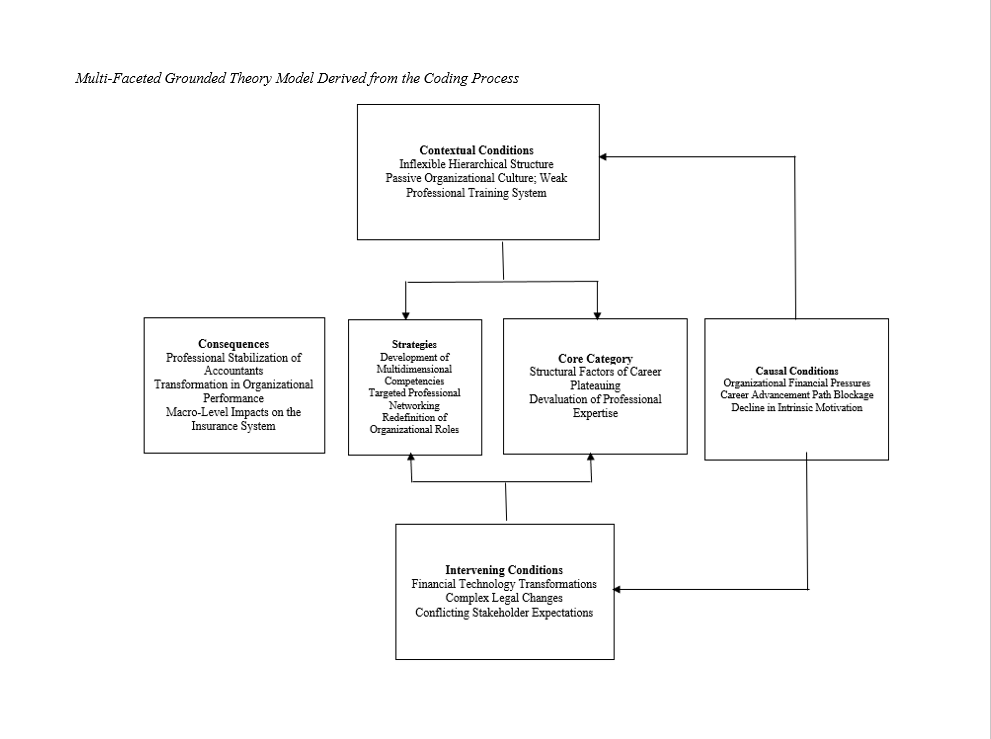
Methods and Materials: This research adopted a qualitative exploratory design based on a multi-faceted grounded theory approach. The statistical population consisted of experienced financial managers and professional accountants employed within the Health Insurance Organization. Participants were selected using purposive and theoretical sampling to ensure rich experiential data. Data were collected through in-depth semi-structured interviews conducted during 2025, continuing until theoretical saturation was achieved. Data analysis followed systematic grounded theory procedures including open coding, focused coding, axial coding, and selective coding. Constant comparative analysis was applied to identify patterns, relationships, and conceptual categories. The rigor and credibility of findings were ensured through memo writing, continuous comparison, participant validation, and theoretical integration. The final analytical outcome was the construction of a paradigmatic model linking causal conditions, contextual and intervening factors, strategies, the central phenomenon, and resulting organizational outcomes.
Findings: The results indicated that career plateauing among accountants is primarily driven by organizational financial pressures, blocked promotion pathways, and declining intrinsic motivation. Contextual conditions such as inflexible hierarchical structures, passive organizational culture, and weaknesses in professional training systems were found to sustain plateau experiences. Intervening factors—including financial technology transformations, complex regulatory changes, and conflicting stakeholder expectations—intensified professional stagnation while simultaneously creating opportunities for role transformation. The core phenomenon emerged as structural career plateauing accompanied by devaluation of professional expertise. Strategic responses such as multidimensional competency development, targeted professional networking, and organizational role redefinition were associated with positive outcomes including professional stabilization, improved organizational performance, and broader systemic impacts on the insurance sector.
Conclusion: The study demonstrates that career plateauing is a multidimensional organizational phenomenon rather than an individual limitation and that strategic managerial interventions focused on competency development, professional recognition, and structural redesign can transform plateau conditions into opportunities for professional consolidation, organizational effectiveness, and institutional sustainability.
Downloads
References
Bajo, W., & Min, H. (2010). Causes and effects of career plateauing among police officers in Taiwan. Criminal Justice and Behavior, 37(5), 585-600. https://doi.org/10.1177/0093854810363567
Burns, N., & Grove, S. K. (2006). Understanding nursing research: Building an evidence-based practice. Saunders Co. https://books.google.com/books?hl=en&lr=&id=Y9T3QseoHiYC&oi=fnd&pg=PP1&dq=Burns,+N.+and+S.+K.+Grove+(2006).+Understanding+nursing+research:+Building+an+evidence-based+practice,+Saunders+Co.+%09&ots=_t06_6z63I&sig=VAb_z8Gb5bjcvct1V4e4jKjg8aQ
Chang, P. C., Geng, X., & Cai, Q. (2024). The impact of career plateaus on job performance: The roles of organizational justice and positive psychological capital. Behavioral Sciences, 14(2), 144. https://doi.org/10.3390/bs14020144
Creswell, J. W. (2012). Educational research: Planning, conducting, and evaluating quantitative and qualitative research. Pearson. https://www.academia.edu/download/31111669/MCTE690-syllabus-summer2003.pdf
Darabi Amarti, A., & Moradi, H. (2023). Analysis of the effect of job plateau on organizational commitment mediated by teachers' organizational silence. Research in Educational Systems, 17(60), 78-93. https://www.jiera.ir/article_177209.html?lang=fa
Darling, S., & Cunningham, B. (2023). Perceived causes of career plateau in the public service. Administrative Sciences, 13(3), 73. https://doi.org/10.3390/admsci13030073
Farjam, S., Elahiyari, A., & Davali, M. M. (2022). The effect of job compatibility on job plateau with the moderating role of job self-efficacy. Journal of Industrial and Organizational Psychology Studies, 9(2), 259-278. https://jiops.scu.ac.ir/article_17899.html?lang=fa
Farooq, N. (2017). An empirical study of career plateau, organizational commitment and job performance: A case of private sector universities in Peshawar city. City University Research Journal, 7(2), 178-190. https://www.cusit.edu.pk/curj/Journals/CURJ%20July%202017.pdf#page=18
Godai, R., Martinez, P., & Chen, X. (2013). Entrepreneurship and the negative role of plateaued knowledge workers in employer success. Journal of Business and Psychology, 28(3), 421-435. https://doi.org/10.1007/s10869-012-9288-z
Hashemi, Z., Shahrestani, S., & Moeinoddin, M. (2022). The reasons for the need to pay attention to the issue of job plateau in the accounting profession: Concept, effects and consequences. The 9th International Conference on Management, Economics and Accounting, Tehran.
Hashemi, Z., Shahrestani, S., & Moeinoddin, M. (2023). Investigating the effect of job plateau on accountants' mental well-being with the moderating role of emotional intelligence. The 9th International Conference on Management Sciences and Accounting, Tehran.
Iranzadeh, S., Bagherzadeh Khajeh, M., & Baghernejad, S. (2021). Investigating the effect of job enrichment on reducing employees' job plateau (Case study: Employees of National Bank branches in East Azerbaijan province). Journal of Accounting and Management Perspective, 4(53), 63-72. https://www.jamv.ir/article_143542.html
Jena, B. P., Choudhary, A., Pal, M. K., & Misra, S. (2024). Job content plateau and career commitment: The mediating role of developmental i-deals and the moderating role of proactive personality. Evidence-based HRM: a Global Forum for Empirical Scholarship, [Advance online publication]. https://doi.org/10.1108/EBHRM-08-2023-0219
Kurji, S. A., Abdulwahhab, F. L., & Majeed, S. A. (2023). An analytical study of the impact of career plateau on job security at the Faculty of Administration and Economics/Al-Mustansiriya University. International Journal of eBusiness and eGovernment Studies, 15(1), 194-216. https://doi.org/10.34111/ijebeg.202315110
Mayasari, L. (2009). Managing career plateau professionally in organization setting. Journal of Human Capital, 1(2), 40-61. https://repository.paramadina.ac.id/513/1/6%20Managing%20career%20plateau.pdf
Mohammadpour, A. (2010). Quality assessment in qualitative research: Principles and strategies of validation and generalizability. Social Sciences Quarterly(48), 73-105. https://www.sid.ir/fa/VEWSSID/J_pdf/77913894803.pdf
Nugroho, A., Mujanah, S., & Ardiana, I. D. K. R. (2025). The Effect of Workload, Distributive Injustice and Job Burnout on Employee Performance With Quiet Quitting as an Intervening Variable in Employees at Public Works and Highways Department of East Java Province. Marginal Journal of Management Accounting General Finance and International Economic Issues, 4(2), 321-338. https://doi.org/10.55047/marginal.v4i2.1610
Sichamba, S., Matafwali, M., & Kawimbe, S. (2024). Professional trajectories: A qualitative exploration of push and pull factors on career advancement progression for accountants in government institutions in Lusaka District. Journal of Business and Economics in 4IR, 1(1), 12-22. https://doi.org/10.xxxx/jbe4ir.2024.010102
Wang, J., Huang, X., Chen, M., Deng, J., & Deng, H. (2025). Implicit Competency and Its Relationship with Post Competency and Job Burnout among General Practitioners in Primary Healthcare in Chongqing: Analysis Using Structural Equation Modelling. Modern Health Science, 8(1), 91-104. https://doi.org/10.30560/mhs.v8n1p91
Wang, Y., Hu, C., Hurst, C. S., & Yang, C. (2014). Antecedents and outcomes of career plateaus: The roles of mentoring others and proactive personality. Journal of Vocational Behavior, 85(3), 319-323. https://doi.org/10.1016/j.jvb.2014.08.003
Yang, Y., Niven, K., & Johnson, S. (2022). Career plateau: A review of 40 years of research. Journal of Vocational Behavior, 137, 286-302. https://doi.org/10.1016/j.jvb.2022.103768
Yasini, A., Adinehvand, M., & Moradi, R. (2025). Investigating the impact of job burnout on employees' extra-role behaviors considering the role of hardiness personality and job attitude. Psychological Research in Management, 11(2), 37-67.
Zhao, Z., Gao, H., Chen, F., & Dong, H. (2025). The mediating effect of job burnout on perceived stress and presenteeism among geriatric caregivers in long-term care facilities. Geriatric Nursing, 61, 538-543. https://doi.org/10.1016/j.gerinurse.2024.12.007
Downloads
Additional Files
Publication Timeline
- Submitted
- Revised
- Accepted