Identifying Factors Affecting the Absence of Behavioral Nudges in Auditors’ Decision-Making Using Grounded Theory
Keywords:
Behavioral Nudges, Auditor Decision-Making, Audit Organization, Grounded Theory, Open Coding, Axial Coding, Selective CodingAbstract
Objective: This study aimed to identify and conceptualize the factors contributing to the absence of behavioral nudges in auditors’ decision-making through a grounded theory approach.
Methods and Materials: This applied qualitative study employed a descriptive-analytical design and grounded theory methodology. The study population consisted of auditors working in the Audit Organization who met predetermined expertise criteria, including at least 15 years of auditing experience, a master’s degree or higher, and a minimum level of familiarity with the concept of behavioral nudges. Participants were recruited using snowball sampling, and sampling continued until theoretical saturation was achieved. Data became repetitive after the twelfth interview; however, interviews continued with 15 participants to ensure saturation. Data were collected through in-depth semi-structured interviews. Data collection and analysis were conducted concurrently according to the Strauss and Corbin grounded theory framework. The analytical procedure involved open coding, axial coding, and selective coding to identify concepts, categories, relationships, and the core dimensions underlying the absence of behavioral nudges in auditors’ professional decision-making.
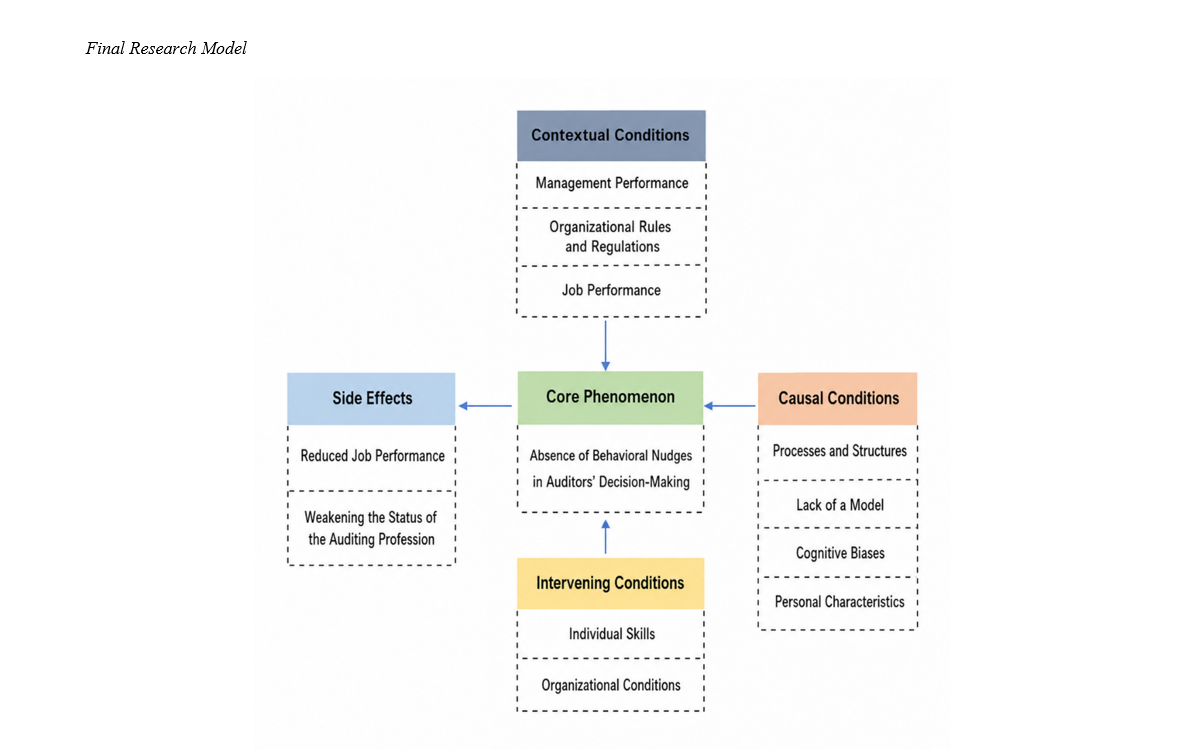
Findings: Grounded theory analysis demonstrated that the absence of behavioral nudges in auditors’ decision-making was influenced by three major groups of determinants. Causal conditions consisted of four dimensions: processes and structures, lack of appropriate models, cognitive biases, and personal characteristics. Contextual conditions comprised three dimensions: management performance, organizational regulations, and job performance. Intervening conditions were represented by two dimensions: individual skills and organizational conditions. The resulting conceptual model further indicated that the absence of behavioral nudges produced adverse professional consequences, particularly reduced job performance and weakening of the professional status and position of auditing.
Conclusion: Therefore, strengthening behavioral decision-support mechanisms requires simultaneous attention to auditors’ competencies, organizational structures, management practices, and professional working conditions.
Downloads
References
Aparna, A. S., & Biju, A. V. (2021). Effect of Nudges in the Work Behavior and Work Culture of Corporate Sector Employees During the Outbreak of COVID-19
Ashrafi, B., Hajiha, Z., & Tehrani, R. (2024). Examining Factors Affecting Auditors' Behavioral Biases Using a Mixed-Methods Approach. Investment Knowledge, 13(4), 653-686.
Berthet, V. (2022). The Impact of Cognitive Biases on Professionals' Decision-Making: A Review of Four Occupational Areas. Frontiers in psychology, 12, 802439. https://doi.org/10.3389/fpsyg.2021.802439
Diekert, F., & Eymess, T. (2024). Changing Collective Action: Nudges and Team Decisions. Games and Economic Behavior, 147, 388-406. https://doi.org/10.1016/j.geb.2024.07.009
Ebrahimi, E., & Esmaeilzadeh, H. (2015). Cognitive Biases in Professional Audit Judgment. Accounting and Auditing Studies, 4(13), 74-87.
Forberger, S., Wichmann, F., & Comito, C. N. N. (2020). Using Nudges to Promote Physical Activity and to Reduce Sedentary Behaviour in the Workplace: A Scoping Review Protocol. BMJ open, 10(11), e038205. https://doi.org/10.1136/bmjopen-2020-038205
Gajewski, J. F., Heimann, M., Meunier, L., & Teye, P. (2020). Nudging to Improve Financial Auditors' Behavior: Preliminary Results of an Experimental Study. In Information Systems and Neuroscience (pp. 191-197). Springer. https://doi.org/10.1007/978-3-030-60073-0_22
Hocine, K., & Soumia, M. (2026). Artificial Intelligence in Accounting and Auditing: A Paradigm Shift Toward Smart Data and Continuous Auditing. The Sankalpa: International Journal of Management Decisions, 12(1), 1146-1160.
Khalif Rashid, F., Aghaei Chadegani, A., Duhairib Al-Rubaie, M. S., & Alimoradi, M. (2025). The Effect of Internal Auditors' Motivation to Whistleblow on Unethical Conduct on Their Whistleblowing Judgments and Decisions, Considering the Moderating Role of Organizational Factors. Empirical Accounting Research, 15(1), 209-230.
Kristof-Brown, A., Schneider, B., & Su, R. (2023). Person-Organization Fit Theory and Research: Conundrums, Conclusions, and Calls to Action. Personnel psychology, 76(2), 375-412. https://doi.org/10.1111/peps.12581
Milazzo, E. (2023). Responsibility Shirking in the EU. In Refugee Protection and Solidarity. Oxford University Press. https://doi.org/10.1093/oso/9780192885715.003.0005
Mohammadnezami, S., Hajian, N., & Karimi Jafari, F. (2025). The effect of auditor type on earnings quality considering the moderating role of audit adjustments. Judgment and Decision Making in Accounting Quarterly, 5(18), 1-22.
Nwafor, O., Singh, R., Collier, C., DeLeon, D., Osborne, J., & DeYoung, J. (2021). Effectiveness of Nudges as a Tool to Promote Adherence to Guidelines in Healthcare and Their Organizational Implications: A Systematic Review. Social Science & Medicine, 286, 114321. https://doi.org/10.1016/j.socscimed.2021.114321
Olaborede, A., & Meintjes-Van der Walt, L. (2020). Cognitive Bias Affecting Decision-Making in the Legal Process. Obiter, 41(4), 806-830. https://doi.org/10.17159/obiter.v41i4.10489
Parker, J., & Davies, B. (2020). No Blame No Gain? From a No Blame Culture to a Responsibility Culture in Medicine. Journal of Applied Philosophy, 37(4), 646-660. https://doi.org/10.1111/japp.12433
Pedrami, M., & Vaezi, S. K. (2025). Behavioral Nudges on the Horizon of Organizational Productivity: A Theoretical Analysis of Influential Factors. Humanities Development, 6(11), 197-218.
Rouhani Rad, S., & Keshavarz, M. (2022). Examining the Role of Organizational Nudges and Psychological Capital in Organizational Retention in Brokerage Firms with the Mediating Role of Corrupt Behaviors. Financial and Behavioral Research in Accounting, 2(3), 1-19.
Samagaio, A., Francisco, P. M., Felício, T., & Verga Matos, P. (2025). The Relationship between Time Pressure, Ethical Culture and Audit Quality. Management Decision. https://doi.org/10.1108/MD-04-2024-0870
Setayesh, M. H., Sadeghi, M., Masoudi, Y., & Dehdari, E. (2025). The Effect of Strategic Intelligence on Audit Quality. Judgment and Decision-Making in Accounting, 13(4), 1-26.
Touqi, A. (2018). Examining the Effects of Individual, Social, and Situational Factors on Auditors' Professional and Expert Judgment Islamic Azad University, Shahroud Branch].
Vaezi, S. K., & Hosseini, M. (2024). The Capability of Behavioral Nudges to Reduce the Phenomenon of Failure to Act in the Public Sector. Public Administration, 16(2), 221-248.
Downloads
Additional Files
Publication Timeline
- Submitted
- Revised
- Accepted