Ethical Leadership, Psychological Safety, Knowledge Sharing, Employee Creativity, and Organizational Innovation Performance: A Structural Equation Modeling Analysis
DOI:
https://doi.org/10.61838/kman.ijimob.5438Keywords:
Ethical leadership, Psychological safety, Knowledge sharing, Employee creativity, Organizational innovation performance, Structural equation modeling, Innovation management, Organizational behaviorAbstract
Objective: This study aimed to examine the direct and indirect relationships among ethical leadership, psychological safety, knowledge sharing, employee creativity, and organizational innovation performance and to test a structural model explaining how ethical leadership contributes to innovation outcomes through psychological and behavioral mechanisms.
Methods and Materials: This quantitative cross-sectional study was conducted among 548 employees working in medium-sized and large organizations across multiple industries in Canada. Data were collected using standardized questionnaires measuring ethical leadership, psychological safety, knowledge sharing, employee creativity, and organizational innovation performance. The reliability and validity of all measurement instruments were confirmed through Cronbach’s alpha, composite reliability, average variance extracted, and confirmatory factor analysis. Structural equation modeling (SEM) using AMOS 29 was employed to evaluate the measurement and structural models. Model fit was assessed using multiple fit indices, including χ²/df, CFI, TLI, IFI, GFI, AGFI, RMSEA, and SRMR. Direct and indirect effects were examined using bootstrap analysis with 5,000 resamples.
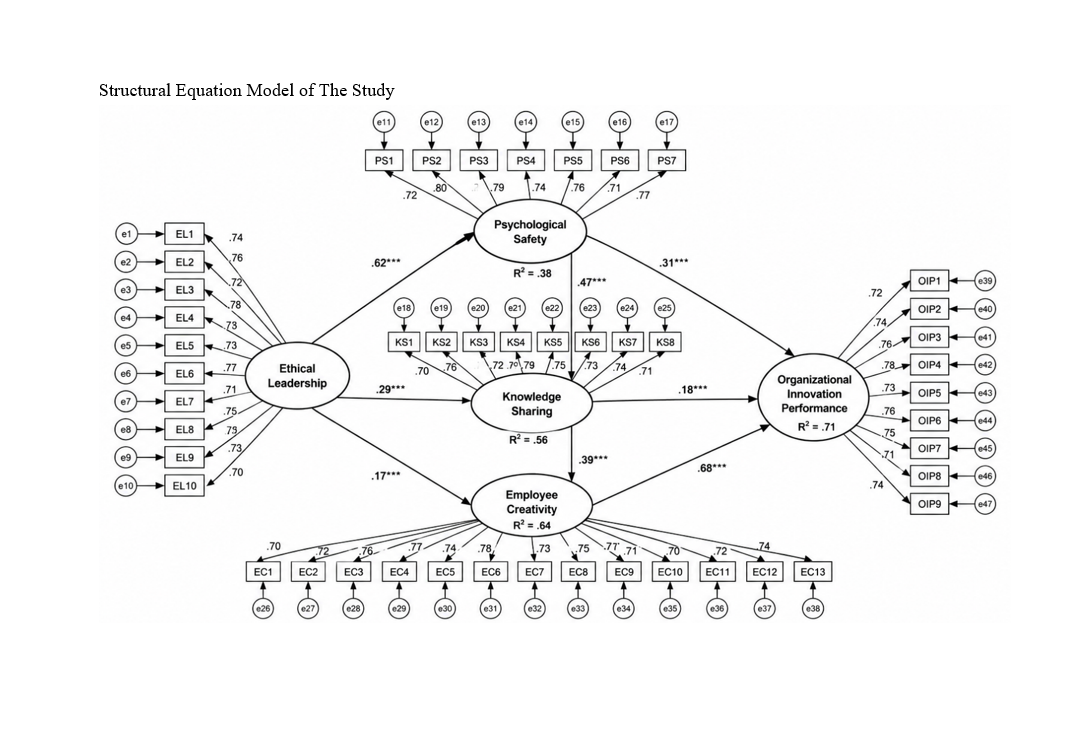
Findings: The results demonstrated that ethical leadership had significant positive effects on psychological safety (β = 0.62, p < .001), knowledge sharing (β = 0.29, p < .001), and employee creativity (β = 0.17, p < .001). Psychological safety significantly predicted knowledge sharing (β = 0.47, p < .001) and employee creativity (β = 0.31, p < .001). Knowledge sharing positively influenced employee creativity (β = 0.39, p < .001) and organizational innovation performance (β = 0.18, p < .001). Employee creativity exhibited the strongest direct effect on organizational innovation performance (β = 0.68, p < .001). The structural model demonstrated excellent fit (χ²/df = 2.37, CFI = 0.958, TLI = 0.953, RMSEA = 0.050). Bootstrap analyses confirmed significant indirect effects of ethical leadership on innovation performance through psychological safety, knowledge sharing, and employee creativity. The model explained 71% of the variance in organizational innovation performance.
Conclusion: The findings indicate that ethical leadership serves as a critical organizational resource that enhances innovation performance by fostering psychologically safe environments, promoting knowledge-sharing behaviors, and stimulating employee creativity. Organizations that cultivate ethical leadership practices and supportive workplace climates are more likely to achieve sustainable innovation outcomes and maintain competitive advantage in dynamic business environments.
Downloads
References
Ding, X. (2026). Digital leadership, digital platform capability and digital business model innovation of start-ups. Journal of Innovation & Knowledge, 14, 100970.
Esmaeilian, H., Ahmadzadeh, S., & Bakhshandeh, M. (2026). Predicting Digital Entrepreneurship Development Based on Entrepreneurial Leadership: Testing a Conceptual Model in Knowledge-Based Companies. Journal of Entrepreneurship Research, 4(3).
Khan, M. T., & Ullah, S. (2025). Balancing Innovation: The Role of Paradoxical Leadership and Ambidexterity in Fostering Team Creativity. International Journal of Innovation Science.
Kyambade, M., Tushabe, M., Mugerwa, G. W., & Namatovu, A. (2025). Am not contented at work: Unraveling socially responsible leadership and psychological safety on job satisfaction in Ugandan public universities. Management Research Review, 48(6), 863–882. https://doi.org/10.1108/MRR-05-2024-0344
Luo, H., Gu, Y., & Yao, Z. (2025). Unleashing Innovative Potential through Digital Leadership: A Moderated Mediation Model of Work Engagement and Psychological Safety. International Journal of Organizational Leadership, 14(4). https://doi.org/10.33844/ijol.2025.60534
Mei-jiao, H. (2025). How Green Mindful Leadership Drives Employee Green Creativity: The Role of Employee Resilience, Green Identity, and Workplace Digitalization. Sage Open, 15(3). https://doi.org/10.1177/21582440251366007
Odai, L. A., Xiao, Y., Korankye, B., & Ahakwa, I. (2026). Navigating digital transformation: the critical role of knowledge sharing and digital transformational leadership in boosting innovation capability in Sub-Saharan Africa. Business Process Management Journal, 32(2), 653-678.
Ok, C., Choi, M.-C., & Kim, H. E. (2025). The Effect of Psychological Safety Climate on Voice Behavior in Chinese Technology Innovation Companies: Focusing on the Moderating Effect of Guanxi With Team Leaders. Sustainability, 17(15), 7139. https://doi.org/10.3390/su17157139
Piao, J. (2025). How Safety Leadership Influences Employee Safety Participation and Compliance Through Safety Knowledge: The Moderating Role of Psychological Resilience. Frontiers in psychology, 16. https://doi.org/10.3389/fpsyg.2025.1615084
Shah, S. M. A., Ahmed, N., Haq, A. U., & Saba, S. (2025). Leadership for Innovation: Fostering the Culture of Creativity in Organization: A Systematic Literature Review. Journal of Asian Development Studies, 14(2), 945-957. https://doi.org/10.62345/jads.2025.14.2.72
Shoukat, I. K., Muhammad, I. A., Khan, M. A., & Kakar, A. (2025). Does Digital Leadership Capability, Knowledge Management Capability, and Organizational Agility Foster Digital Transformation in China? A Time-Lagged Survey-Based Assessment in Digital Transformation Projects. Journal of Engineering and Technology Management, 76, 12-29.
Takeed, Z., Ali, M. D., Shah, S. I., Muhammad, A., & Qiu, S. (2025). The Effect of Entrepreneurial Leadership on Innovative Work Behavior: The Mediating Roles of Creative Self-Efficacy and Organizational Learning. Journal of Entrepreneurship in Emerging Economies, 17(5), 1288-1310. https://doi.org/10.1108/jeee-08-2024-0326
Tho, N. D., Trang, N. T. M., & Thu, N. N. (2025). Ambidextrous Leadership and Innovation Ambidexterity in a Business Function: The Role of Managers’ Psychological Capital and Proactive Personality. Journal of Knowledge Management, 29(5), 1446-1464. https://doi.org/10.1108/jkm-09-2024-1109
Tran, M. N. (2025). Fostering Organizational Innovation Capability Through Transformational Leadership and Creativity in Public Educational Institutions: Moderating Roles of AI-enabled Job Complexity and Innovation Climate. International Journal of Educational Management, 1-17. https://doi.org/10.1108/ijem-12-2024-0851
Ts, S., & Sasikumar, M. (2025). Preventing Silent Resignation Through Leadership and Psychological Safety. https://papers.ssrn.com/sol3/papers.cfm?abstract_id=5285618
Yuliawati, A. K. (2025). The Effect of Inclusive Leadership and Intrinsic Motivation on Innovation Work Behavior: The Mediating Role of Creative Self-Efficacy. Journal of Social Research, 4(8), 2097-2106. https://doi.org/10.55324/josr.v4i8.2736
Zafar, H., Cheah, J. H., Ho, J. A., Suseno, Y., & Tian, F. (2025). How green servant leadership influences organizational green performance? The roles of employee green creativity, voluntary pro-environmental behavior and green psychological climate. Personnel Review, 54(4), 971-995. https://doi.org/10.1108/PR-10-2023-0843
Zarei, R., & Pashazadeh, Y. (2025). The Role of Digital Leadership in Digital Transformation. Proceedings of the First National Conference on Dynamic Management and Knowledge-Based Economy,
Downloads
Additional Files
Publication Timeline
- Submitted
- Revised
- Accepted