Applying Machine Learning to Examine Psychological Ownership and Work Passion in Innovation Processes
DOI:
https://doi.org/10.61838/kman.ijimob.5257Keywords:
Machine Learning, Psychological Ownership, Work Passion, Innovation ProcessesAbstract
Objective: This study aims to apply supervised machine learning algorithms to evaluate the non-linear predictive power of psychological ownership and work passion on employee engagement in organizational innovation processes.
Methods and Materials: A quantitative, cross-sectional design was employed, utilizing a self-administered questionnaire to collect data from a sample of Moroccan professionals. To capture complex, non-linear interactions without the constraints of traditional linear models, the data was analyzed using advanced supervised machine learning algorithms, specifically Random Forest, Support Vector Machine (SVM), and Gradient Boosting Regressor.
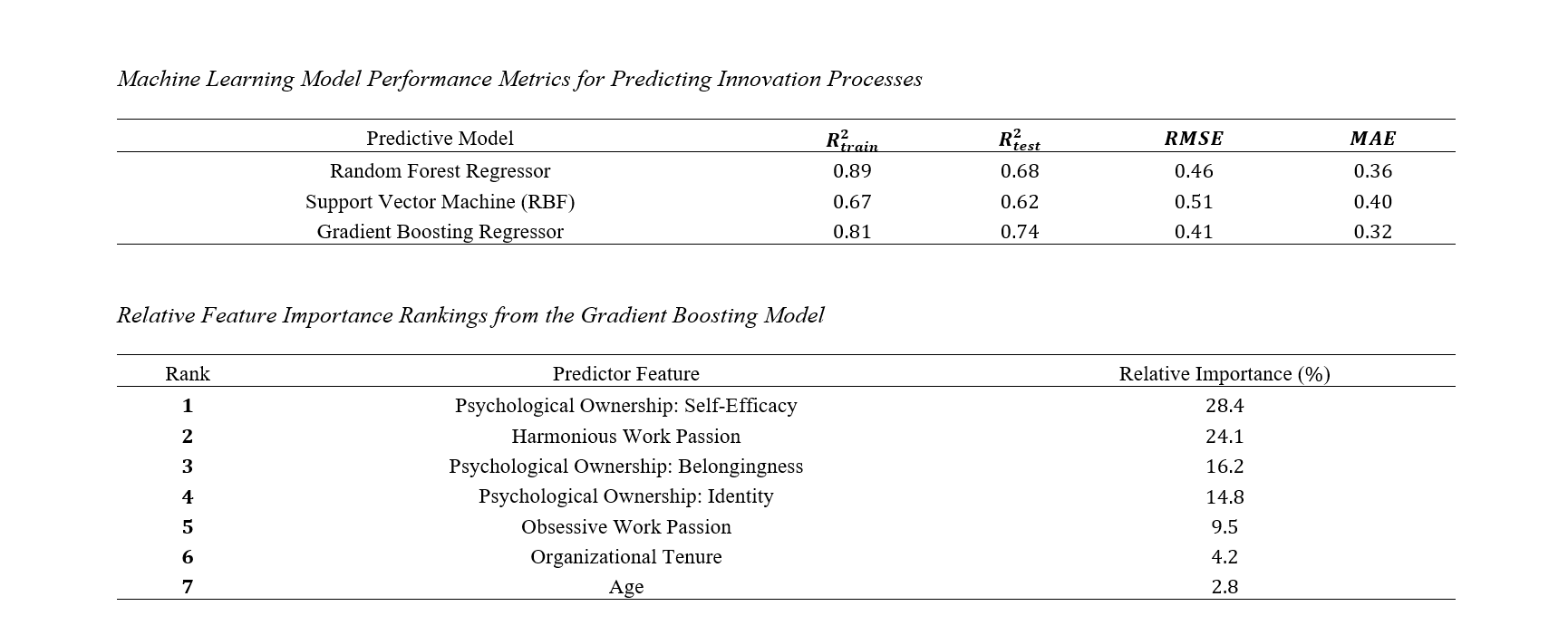
Findings: The Gradient Boosting regressor demonstrated the highest predictive accuracy, successfully explaining of the variance in innovation process engagement ( , ). Feature importance analysis identified self-efficacy as the most critical predictor, accounting for of the variance, followed closely by harmonious work passion ( ), belongingness ( ), and identity ( ). Obsessive work passion contributed to the model and exhibited a non-linear threshold effect, indicating that excessive obsession diminishes innovative output, while demographic variables (age, tenure) collectively contributed less than to the predictive power.
Conclusion: Cultivating intrinsic psychological states—specifically high self-efficacy and harmonious passion—is significantly more critical for driving organizational innovation than demographic factors, highlighting the need for compassionate, autonomy-supportive human resource strategies.
Downloads
References
Abdollahi, R., & Bejani, H. (2024). The Mediating Role of Organizational Loyalty in the Relationship between Work Personality, Job Passion and Work Attachment of Employees. Quarterly Journal of Logistics & Human Resources Management, 1403(71), 85-110. http://harold.jrl.police.ir/article_102120.html?lang=en
Bloem, V., & Salimi, N. (2022). Role of knowledge management processes within different stages of technological innovation: evidence from biotechnology SMEs. Journal of Knowledge Management. https://doi.org/https://doi.org/10.1080/14778238.2022.2064352
Endres, H., Huesig, S., & Pesch, R. (2022). Digital innovation management for entrepreneurial ecosystems: services and functionalities as drivers of innovation management software adoption. Review of managerial science, 16(1), 135-156. https://doi.org/10.1007/s11846-021-00441-4
Fait, M., Magni, D., Perano, M., Briamonte, M. F., & Sasso, P. (2022). Grassroot Processes of Knowledge Sharing to Build Social Innovation Capabilities. Journal of Knowledge Management, 27(5), 1390-1408. https://doi.org/10.1108/jkm-04-2022-0338
Gundorova, M. A., Kakhrimanova, D. G., Sultanova, A. V., Korotkikh, T. N., & Fraymovich, D. Y. (2022). Comparison of indicators of human resources involvement in regional innovation processes and digitalization of the economic structure. In Сooperation and sustainable development (pp. 1599-1607). Springer International Publishing. https://doi.org/10.1007/978-3-030-77000-6_185
Haghparast, S., Jamshidi, Z., & Mirchi, S. (2023). The Role of Business Innovation on the Relationship Between Entrepreneurial Orientation and New Product Performance Development (Case Study: Companies in the Pardis Technology Park, Tehran). First National Conference on Development and Foresight in Industries with a Focus on Internal Processes. https://civilica.com/doc/2035661/
Healy, L., Payne, A., & Kirby, J. N. (2024). The effectiveness of brief workplace compassion-focused training in improving wellbeing of stressed school employees. Mindfulness. https://doi.org/10.1007/s12671-025-02590-z
Huang, J., Chen, S., Yang, W., & Wang, Y. (2023). The Network Dynamics of Self‐compassion Components and Psychological Symptoms During an Intervention. Applied Psychology Health and Well-Being, 16(1), 296-314. https://doi.org/10.1111/aphw.12488
Islam, T., Khatoon, A., Cheema, A. U., & Ashraf, Y. (2024). How Does Ethical Leadership Enhance Employee Work Engagement? The Roles of Trust in Leader and Harmonious Work Passion. Kybernetes, 53(6), 2090-2106. https://doi.org/10.1108/K-09-2022-1343
Khodaei, H. (2022). The Impact of Customer Relationship Management and Open Innovation Processes on E-Business Performance with the Mediating Role of Product Innovation Agility: Case Study of Companies in Yazd Science and Technology Park Imam Javad Higher Education Institute, Faculty of Humanities, Yazd]. https://ganj.irandoc.ac.ir/#/articles/b4db9b38097282aa9009ae5b9578e989/search/d1e0f501993f38d47642eb37a273004b
Liang, J. (2025). Parents’ Work–family Conflict and Parent‒child Relationship: The Mediating Role of Parenting Burnout and the Moderating Role of Self-Compassion. PLoS One, 20(3), e0319675. https://doi.org/10.1371/journal.pone.0319675
Liu, X., Fang, H., Tian, T., Zhang, J., Ji, Y., & Zhong, Y. (2025). Self-Compassion and Work Engagement Among Clinical Nurses: The Mediating Role of Moral Resilience. Frontiers in Public Health, 13. https://doi.org/10.3389/fpubh.2025.1507539
Mirzai, V., & Zarei, F. (2024). Analysis of the relationship between perceived organizational policy and workplace rumors: The moderating role of organizational compassion (Case study: Nishabur Registration Office). Faslnameh-e Rooykarha-ye Pajuheshi Now dar Management va Hesabdar, 8(39), 3651-3601.
Mughal, M. F., Cai, S., Faraz, N. A., & et al. (2024). Green servant leadership and employees' workplace green behavior: interplay of green self-efficacy, green work engagement, and environmental passion. Current Psychology, 43, 26806-26822. https://doi.org/10.1007/s12144-024-06320-x
Oliveira, M., Sousa, M., Silva, R., & Santos, T. (2021). Strategy and Human Resources Management in Non-Profit Organizations: Its Interaction with Open Innovation. Journal of Open Innovation: Technology, Market, and Complexity, 7(1), 75. https://doi.org/10.3390/joitmc7010075
Pank, C., von Boros, L., Lieb, K., Dalkner, N., Egger-Lampl, S., Lehr, D., & et al. (2025). The role of self-care and self-compassion in networks of resilience and stress among healthcare professionals. Scientific reports, 15(1), 18545. https://doi.org/10.1038/s41598-025-01111-1
Paños-Castro, J., & Arruti, A. (2021). Innovation and entrepreneurship in education, irreconcilable differences? A first approach through Spanish expert judgment. International Journal of Innovation Science, 13(3), 299-313. https://doi.org/10.1108/IJIS-07-2020-0106
Saeedi motlagh, M. h., & Karimishad, F. (2022). Open innovation through the lens of the home appliance industry. Journal of Innovation Ecosystem, 2(4), 37-52. https://doi.org/10.22111/innoeco.2023.44091.1048
Serrano-Ruiz, J. C., Ferreira, J., & Jardim-Goncalves, R. (2024). Relational network of innovation ecosystems generated by digital innovation hubs: a conceptual framework for the interaction processes of DIHs from the perspective of collaboration within and between their relationship levels. J Intell Manuf. https://doi.org/10.1007/s10845-024-02322-5
Shaalan, L. A. A. B., Elsaid, A. M., & Aboul-Ela, G. M. B. E. (2022). Knowledge management processes and strategic human resources management: Creating competitive advantage through employee innovation behavior. The Business & Management Review, 13(2), 237-245. https://doi.org/10.24052/BMR/V13NU02/ART-21
Shin, H., & Perdue, R. R. (2022). Developing creative service ideas through hotel customer engagement for open innovation: Focused on empowerment and motivation processes. International Journal of Hospitality Management, 100, 103077. https://doi.org/10.1016/j.ijhm.2021.103077
Torabian, E., Rahmani, J., Ghomshi, S. F. E., & Ataei, M. M. (2023). Designing a working affiliation model for primary school teachers based on a mixed approach. Journal of Transcendental Education, 3(1), 1-12. https://www.magiran.com/paper/2615694
Unjai, S., Forster, E. M., Mitchell, A. E., & Creedy, D. K. (2024). Interventions to promote resilience and passion for work in health settings: A mixed-methods systematic review. International Journal of Nursing Studies Advances, 100242. https://doi.org/10.1016/j.ijnsa.2024.100242
Willis, D. N., Dowling, A. P. C., Deehan, T., & O'Reilly, P. G. (2023). Exploring the Impact of Trauma and the Role of Compassion Before and After a Phase-orientated Intervention for Complex Trauma. European Journal of Trauma & Dissociation, 7(1), 100308. https://www.sciencedirect.com/science/article/pii/S2468749922000503
Witherspoon, A. (2021). The Role of Team Processes in Innovation Development to Sustain Learning Organizations. The Learning Organization, 29(1), 21-37. https://doi.org/10.1108/tlo-09-2020-0164
Zuochun, W. E. I. (2023). An Empirical Study of Competitive Intelligence Activities, Knowledge Management Processes and Innovation Performance. International Journal of Science and Business, 83-96. https://doi.org/10.58970/ijsb.2078
Downloads
Additional Files
Publication Timeline
- Submitted
- Revised
- Accepted