Predicting Employee Creativity Based on Inclusive Leadership and Psychological Safety: The Mediating Role of Work Engagement
Keywords:
inclusive leadership, psychological safety, work engagement, employee creativity, structural equation modeling, CanadaAbstract
Objective: This study aimed to predict employee creativity based on inclusive leadership and psychological safety and to examine the mediating role of work engagement among employees working in Canada.
Methods and Materials: The study employed a quantitative, cross-sectional, correlational design. The participants were 312 employees working in public and private organizations in Canada who were recruited using convenience and purposive sampling. Data were collected using the nine-item Inclusive Leadership Scale, the seven-item Psychological Safety Scale, the nine-item Utrecht Work Engagement Scale, and the 13-item Employee Creativity Scale. Data were analyzed using Pearson correlation coefficients, confirmatory factor analysis, and structural equation modeling in IBM SPSS Statistics and AMOS. The significance of indirect effects was examined using bias-corrected bootstrapping with 5,000 resamples and 95% confidence intervals.
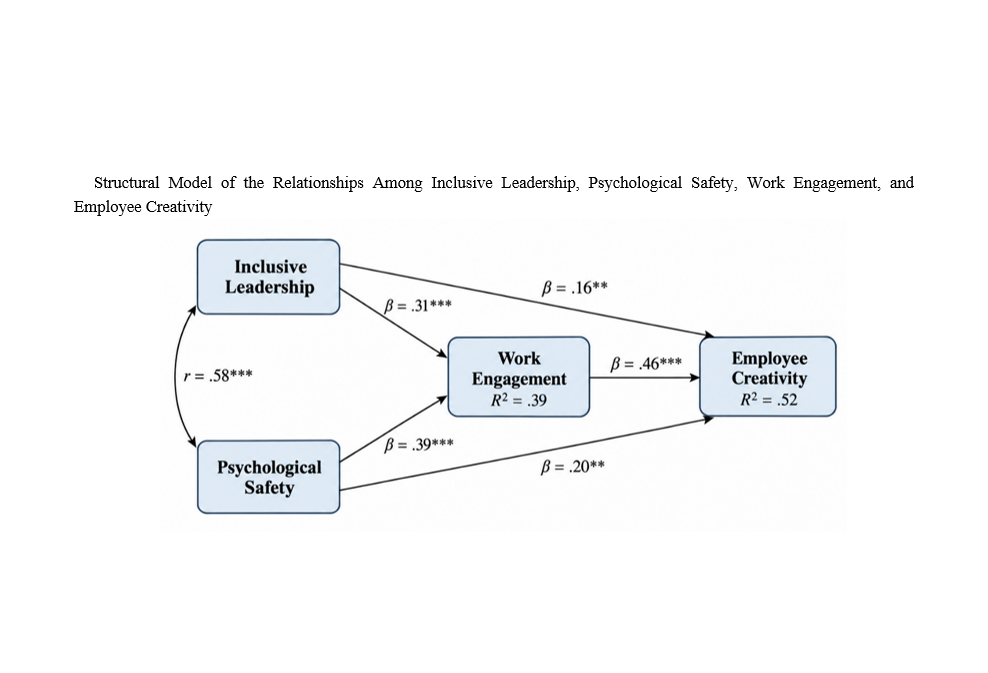
Findings: Inclusive leadership significantly predicted work engagement (β = .31, p < .001) and employee creativity (β = .16, p = .005), while psychological safety significantly predicted work engagement (β = .39, p < .001) and employee creativity (β = .20, p = .003). Work engagement was the strongest direct predictor of employee creativity (β = .46, p < .001). Inclusive leadership and psychological safety jointly explained 39% of the variance in work engagement, while the overall model explained 52% of the variance in employee creativity. Bootstrap analysis showed that work engagement significantly mediated the relationship between inclusive leadership and employee creativity (β = .14, 95% CI [.09, .21], p < .001) and the relationship between psychological safety and employee creativity (β = .18, 95% CI [.11, .26], p < .001). Because both corresponding direct effects remained significant, the mediation effects were partial.
Conclusion: The findings indicate that inclusive leadership and psychological safety contribute to employee creativity both directly and indirectly by strengthening employees' work engagement, highlighting the importance of supportive leadership, interpersonal safety, and motivational involvement in fostering workplace creativity.
Downloads
References
AlMunthiri, O., Bani‐Melhem, S., Shamsudin, F. M., & Al-Naqbi, S. A. (2024). Does Leading With Inclusiveness Promote Innovative Behaviours? Examining the Role of Work Engagement and Psychological Safety. International Journal of Organizational Analysis, 32(10), 2468-2493. https://doi.org/10.1108/ijoa-09-2023-4003
Budreikaitė, J., Rapuano, V., & Raišienė, A. G. (2024). State of Play in the Implementation of the Principles of Inclusive Leadership in Fintech Companies in Lithuania. Merits, 4(4), 400-413. https://doi.org/10.3390/merits4040028
Chen, J., Zheng, W., & Jiang, B. (2022). The Impact of Moral Leadership on Physical Education Teachers’ Innovation Behavior: The Role of Identification With Leader and Psychological Safety. Frontiers in psychology, 13. https://doi.org/10.3389/fpsyg.2022.1030245
Elkhwesky, Z., Salem, I. E., Ramkissoon, H., & Castañeda-García, J.-A. (2022). A Systematic and Critical Review of Leadership Styles in Contemporary Hospitality: A Roadmap and a Call for Future Research. International Journal of Contemporary Hospitality Management, 34(5), 1925-1958. https://doi.org/10.1108/ijchm-09-2021-1128
Forte, D. W., Karmel Cristina Nardi da, S., Cristiano José Castro de Almeida, C., & Silva, S. M. d. (2024). Study of the Relationchips Between Leadership and Psychological Safety. Revista E-Tech Tecnologias Para Competitividade Industrial - Issn - 1983-1838, 17(1). https://doi.org/10.18624/etech.v17i1.1317
Fu, Q., Cherian, J., Ahmad, N., Scholz, M., Samad, S., & Comite, U. (2022). An Inclusive Leadership Framework to Foster Employee Creativity in the Healthcare Sector: The Role of Psychological Safety and Polychronicity. International journal of environmental research and public health, 19(8), 4519. https://doi.org/10.3390/ijerph19084519
Guchait, P., Peyton, T., Madera, J. M., Gip, H., & Molina, A. (2023). 21st Century Leadership Research in Hospitality Management: A State-of-the-Art Systematic Literature Review. International Journal of Contemporary Hospitality Management, 35(12), 4259-4296. https://doi.org/10.1108/ijchm-05-2022-0620
Ibnis Shaid Bin Abdul, R., Singh, S. S. B., Taat, M. S., & Mosin, M. b. (2024). Exploring the Effect of Inclusive Leadership on Psychological Distress Through Organizational Climate Mediation and Moderation. Humanities and Social Sciences Letters, 12(2), 425-442. https://doi.org/10.18488/73.v12i2.3787
Jin, S., Li, Y., & Xiao, S. (2022). What Drives Employees' Innovative Behaviors in Emerging-Market Multinationals? An Integrated Approach. Frontiers in psychology, 12. https://doi.org/10.3389/fpsyg.2021.803681
Kyambade, M., Namatovu, A., Mugambwa, J., Namuddu, R., & Namubiru, B. (2024). Socially Responsible Leadership and Job Engagement in University Context: Mediation of Psychological Safety. Seisense Journal of Management, 7(1), 51-66. https://doi.org/10.33215/61rnkr91
Labrague, L. J., & Toquero, L. M. (2023). Leadership Styles and Nurses' Innovative Behaviors. Jona the Journal of Nursing Administration, 53(10), 547-553. https://doi.org/10.1097/nna.0000000000001332
Li, T., & Tang, N. (2022). Inclusive Leadership and Innovative Performance: A Multi-Level Mediation Model of Psychological Safety. Frontiers in psychology, 13. https://doi.org/10.3389/fpsyg.2022.934831
Mai, S., Wang, L., & Na, M. (2025). The Influence of Organizational Fairness, Identity and Empowerment on Employee Creativity: Mediating Role of Corporate Social Responsibility. Sage Open, 15(1). https://doi.org/10.1177/21582440251328475
Malodia, L., & Goyal, I. (2023). Psychological Process That Links Authentic Leadership With Followers’ Creative Behaviour. Metamorphosis, 22(1), 28-37. https://doi.org/10.1177/09726225231173837
Matsuo, A., Tsujita, M., Kita, K., Ayaya, S., & Kumagaya, S. (2024). The Mediating Role of Psychological Safety on Humble Leadership and Presenteeism in Japanese Organizations. Work a Journal of Prevention Assessment & Rehabilitation, 79(1), 437-447. https://doi.org/10.3233/wor-230197
Mehmood, W., Shah, S. J., Khan, S., & Zada, M. (2025). Inclusive Leadership: Catalyzing Creative Self-Efficacy and Challenge-Oriented Organization Citizenship Behavior in IT Industry. Human Systems Management, 44(5), 796-806. https://doi.org/10.1177/01672533251320787
Mo, D., Han, X., & Li, Y.-Y. (2023). How Inclusive Leadership Affects Teachers' Innovative Behavior in Chinese Kindergartens: The Sequential Mediation Role of Teacher Efficacy and Psychological Safety. https://doi.org/10.21203/rs.3.rs-3596241/v1
Nasir, H. M. U., Mukhtar, S., & Ramzan, A. (2023). HOW LEADERSHIP STYLES EFFECTS CONTINUOUS IMPROVEMENT AND INNOVATION: A MEDIATION &Amp; MODERATION MODEL. Journal of Social Research Development, 4(01), 81-99. https://doi.org/10.53664/jsrd/04-01-2023-07-81-99
Nejati, M., & Shafaei, A. (2023). The Role of Inclusive Leadership in Fostering Organisational Learning Behaviour. Management Research Review, 46(12), 1661-1678. https://doi.org/10.1108/mrr-10-2022-0716
Parku, K., Obuobisa‐Darko, T., & Asiedu, E. A. (2023). Psychological Contract Breach, Stress and Employee Engagement During and After COVID-19: The Role of Inclusive Leadership. Journal of Business Management and Social Studies, 2(4), 175-194. https://doi.org/10.53748/jbms.v2i4.49
Patel, T., & Bakari, H. (2022). The Impact of Paternalistic Leadership on Innovative Work Behavior. A Test of Mediation Model. Etikonomi, 21(2), 295-312. https://doi.org/10.15408/etk.v21i2.21602
Rasheed, R., Rashid, A., Ngah, A. H., & Rahi, S. (2026). Fostering Sustainable Supply Chain Performance Through Inclusive Leadership and a Green Psychological Climate With a Mediation of Employee Green Creativity. Knowledge and Process Management, 33(3), 613-631. https://doi.org/10.1002/kpm.70045
Saber, L. (2024). A Mixture of Authoritative &Amp; Participative Leadership Styles: Recommendations to Achieve a Positive Workplace Environment. https://doi.org/10.32920/26046613
Sekiguchi, T., & Cuyper, N. D. (2022). Addressing New Leadership Challenges in a Rapidly Changing World. Applied Psychology, 72(4), 1741-1750. https://doi.org/10.1111/apps.12401
Siyal, S. (2023). Inclusive Leadership and Work Engagement: Exploring the Role of Psychological Safety and Trust in Leader in Multiple Organizational Context. Business Ethics the Environment & Responsibility, 32(4), 1170-1184. https://doi.org/10.1111/beer.12556
Titrek, O., Carlos Francisco de Sousa, R., Jurs, P., Sezen-Gültekin, G., & Sempere, P. J. G. (2025). Editorial: Creative Organization Development Through Leadership. Frontiers in psychology, 16. https://doi.org/10.3389/fpsyg.2025.1701897
Vakira, E., Shereni, N. C., Ncube, C. M., & Ndlovu, N. (2022). The Effect of Inclusive Leadership on Employee Engagement, Mediated by Psychological Safety in the Hospitality Industry. Journal of Hospitality and Tourism Insights, 6(2), 819-834. https://doi.org/10.1108/jhti-09-2021-0261
Wu, G., & Li, M. (2023). Impact of Inclusive Leadership on Employees’ Innovative Behavior: A Relational Silence Approach. Frontiers in psychology, 14. https://doi.org/10.3389/fpsyg.2023.1144791
Zhao, Z., & Ren, J. (2025). Diverse and Inclusive Human Resource Practices and Employee Creativity: The Psychological Fit Mechanisms and the Role of Inclusive Leadership. Frontiers in psychology, 16. https://doi.org/10.3389/fpsyg.2025.1679943
Κatsaros, K. K. (2025). Gen Z Employees’ Adaptive Performance in Hybrid Workplaces: The Role of Inclusive Leadership, Creativity, and Work Engagement. The Journal of Applied Behavioral Science, 61(4), 636-657. https://doi.org/10.1177/00218863251315493
Downloads
Additional Files
Publication Timeline
- Submitted
- Revised
- Accepted