Exploring Leadership Strategies That Promote Psychological Safety and Employee Voice During Organizational Change
Keywords:
leadership strategies, psychological safety, employee voice, organizational change, inclusive leadership, employee participation, QatarAbstract
Objective: This study aimed to explore the leadership strategies that promote psychological safety and employee voice during organizational change among managers and employees working in organizations in Qatar.
Methods and Materials: This qualitative exploratory study was conducted with 24 participants from public- and private-sector organizations in Qatar, comprising 10 managers and organizational leaders and 14 employees who had directly experienced at least one significant organizational change during the preceding two years. Participants were selected through purposive sampling based on relevant organizational and change-related experience. Data were collected through semi-structured, in-depth individual interviews focused on leadership communication, accessibility, responses to disagreement, participation in decision-making, treatment of mistakes, trust, inclusion, and employee willingness to express concerns and suggestions. Interviews lasted approximately 45–70 minutes, were audio-recorded with consent, and transcribed verbatim. Data collection continued until thematic saturation was reached. Reflexive thematic analysis was used to code the transcripts, organize related codes, develop candidate themes, and refine the final thematic structure through repeated comparison with the complete dataset.
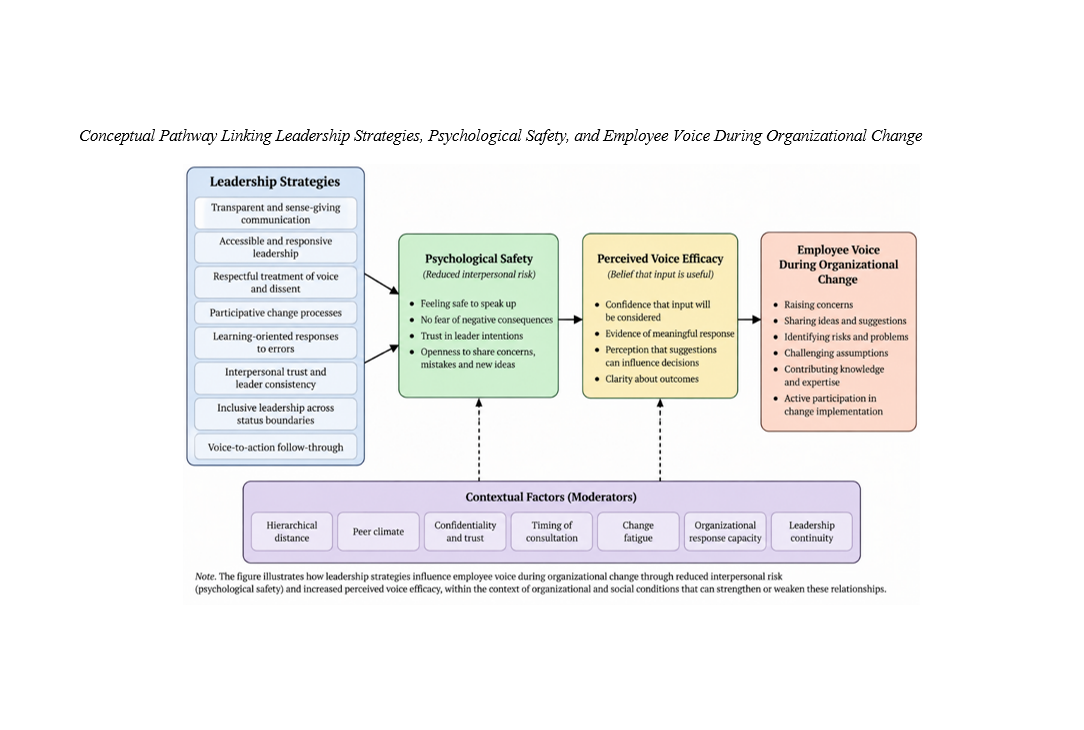
Findings: The analysis identified eight interrelated themes: transparent and sense-giving communication, accessible and responsive leadership, respectful treatment of voice and dissent, participative change processes, learning-oriented responses to errors, interpersonal trust and leader consistency, inclusive leadership across status boundaries, and voice-to-action follow-through. Psychological safety emerged as a key mechanism through which leadership reduced perceived interpersonal risk, while perceived voice efficacy determined whether employees believed speaking up would produce meaningful consideration or action. Hierarchical distance, peer climate, confidentiality, timing of consultation, change fatigue, organizational response capacity, and leadership continuity influenced the translation of psychological safety into sustained employee voice.
Conclusion: Effective leadership during organizational change requires both creating an interpersonally safe climate and demonstrating that employee contributions are consequential, thereby reducing the risks of speaking up while strengthening employees’ willingness to participate actively in change processes.
Downloads
References
Aedi, N., Luxfiati, B. A., Amaliyah, N., & Wei, L. B. (2026). Digital Leadership and System-Level Transformation in Indonesian Higher Education: A Mixed-Methods Study of Institutional Change and Governance.
Cataloni, S., Forsyth, D., Brougham, D., & Thorn, K. (2026). Leadership Competence and Psychosocial Safety Climate Implementation in an Evolving School Work Environment. International journal of environmental research and public health, 23(5), 573. https://doi.org/10.3390/ijerph23050573
Cui, H., Yin, J., Wang, Y., Sun, Y., Tang, C., Zheng, J., Xu, S., Dai, Y., Li, L., Lin, H., Jin, Y., & Shang, H. (2024). Accurate Determination of the Meaning and Implications of Traditional Chinese Medicine Using Panoramic Spatiotemporal Life Atlas. Scientia Sinica Vitae. https://doi.org/10.1360/ssv-2023-0304
De Silva, A., Peiris, I., & Kumara, U. (2026). Spiritual leadership: Sustainability and spiritual leadership. In The Palgrave Encyclopedia of Leadership and Organizational Change (pp. 1-10). https://doi.org/10.1007/978-3-031-51650-4_164-1
Guo, H., Zou, Z., Chen, G., Zhou, G., Shi, L., & Hu, X. (2024). Thoughts on the Support of Scientific Data for Major National Strategic Requirements. Chinese Science Bulletin (Chinese Version). https://doi.org/10.1360/tb-2023-0537
Kyambade, M., Tushabe, M., Mugerwa, G. W., & Namatovu, A. (2025). Am not contented at work: Unraveling socially responsible leadership and psychological safety on job satisfaction in Ugandan public universities. Management Research Review, 48(6), 863–882. https://doi.org/10.1108/MRR-05-2024-0344
Lang, Y., & Wang, G. (2024). The Logical Mechanism and Breakthrough Path for the Activation of Ecological Resources Value to Promote Rural Revitalization. 自然资源学报, 39(1), 29. https://doi.org/10.31497/zrzyxb.20240102
Luo, H., Gu, Y., & Yao, Z. (2025). Unleashing Innovative Potential through Digital Leadership: A Moderated Mediation Model of Work Engagement and Psychological Safety. International Journal of Organizational Leadership, 14(4). https://doi.org/10.33844/ijol.2025.60534
Maduforo, A. N., Salvador, E. E. P., Yan, S., Davis, J., & Jacobsen, M. (2026). Global Perspectives on Leadership and Change in Higher Education: A Scoping Review of Empirical Studies. Research in Comparative and International Education, 17454999261444818. https://doi.org/10.1177/17454999261444818
Masih, S., Punchanathan, U. E., Naqshbandi, M. M., & Ahmed, F. (2025). How Inclusive Leadership Drives Change-Oriented Extra-Role Behaviors via Leader-Member Exchange and Trust in Leadership. Global Knowledge, Memory and Communication. https://doi.org/10.1108/GKMC-05-2024-0276
Mazhabi, Z. (2025). Investigating leadership attributes and strategies during times of crisis and educational change: A story of public primary school principals in Lombok, Indonesia. Educational Management Administration & Leadership. https://doi.org/10.1177/17411432241300280
Mirghafouri, S., Aghazadeh Bafq, M., & Saffari Darbarzi, A. (2024). The Effect of Synergistic Leadership Behaviors on Knowledge Hiding of Kashan Teachers: The Mediating Role of Professional Learning Community and Organizational Voice. Strategic Management of Organizational Knowledge, 7(3), 11-20. https://doi.org/10.47176/SMOK.2024.1779
Mohase, K., Donald, F. M., & Israel, N. (2025). Inclusive Leadership, Psychological Safety, and Employee Voice in Remote and Hybrid Work Employees. South African Journal of Psychology, 55(3), 432-446. https://doi.org/10.1177/00812463251365484
Neto, S., & Camkin, J. (2024). 10 years of World Water Policy Journal: The Past, Present and Future. World Water Policy, 10(2), 380-384. https://doi.org/10.1002/wwp2.12197
Piao, J. (2025). How Safety Leadership Influences Employee Safety Participation and Compliance Through Safety Knowledge: The Moderating Role of Psychological Resilience. Frontiers in psychology, 16. https://doi.org/10.3389/fpsyg.2025.1615084
Sabino, A., Cesário, F., & Antunes, A. (2024). Linking Toxic Leadership to Exit, Voice, Silence and Neglect: The Mediating Role of Loyalty. Management Research the Journal of the Iberoamerican Academy of Management, 22(1), 18-34. https://doi.org/10.1108/mrjiam-10-2023-1471
Sharif, S., Tongkachok, K., Akbar, M., Iqbal, K., & Lodhi, R. N. (2024). Transformational leadership and innovative work behavior in three-star hotels: mediating role of leader-member exchange, knowledge sharing and voice behavior. VINE Journal of Information and Knowledge Management Systems, 54(1), 1-21. https://doi.org/10.1108/VJIKMS-07-2021-0122
Sulphey, M. M., & Jasim, K. M. (2025). Can Paradoxical Leadership Revert Silence Imposed by Corporate Hypocrisy and Organizational Inertia Bring in Voice Behavior: An Examination Using SEM. Sage Open, 15(2), 21582440251341673.
Taylor, A. (2026). Exemplary Board‐Level Leadership in the Water Sector: Insights From Victoria, Australia. World Water Policy, 12(2). https://doi.org/10.1002/wwp2.70082
Umar, S. B., Ahmad, J., Mohd Bukhori, M. A. B., Ali, K. A. M., & Hussain, W. M. H. W. (2025). Transforming Higher-Education-Institutes: Impact of Change Management on Sustainable Performance through Transformational Leadership and Knowledge Management. Sustainability, 17(6), 2445. https://doi.org/10.3390/su17062445
Yu, Y., & Pitafi, S. (2024). Exploring the influence of spiritual leadership, leader-member exchange, and traditionality orientation on employee voice behavior. BMC psychology, 12(1), 543.
Downloads
Additional Files
Publication Timeline
- Submitted
- Revised
- Accepted