Designing a Model of Organizational Authenticity, Its Antecedents and Consequences at Kerman University of Medical Sciences
DOI:
https://doi.org/10.61838/Keywords:
Organizational Authenticity, Authentic Leadership, Value-Based Organizational Culture, Organizational Trust, Thematic Analysis.Abstract
Objective: The present study was conducted with the aim of developing a model of organizational authenticity and identifying its antecedents and consequences at Kerman University of Medical Sciences.
Methods and Materials: This study was applied-developmental in terms of purpose and qualitative in terms of research approach. Data were collected through a review of the relevant literature, upstream policy documents, and semi-structured interviews with 15 experts and managers from Kerman University of Medical Sciences. Participants were selected using purposive sampling, and interviews continued until theoretical saturation was achieved. Data were analyzed using thematic analysis with the assistance of MAXQDA 2018 software.
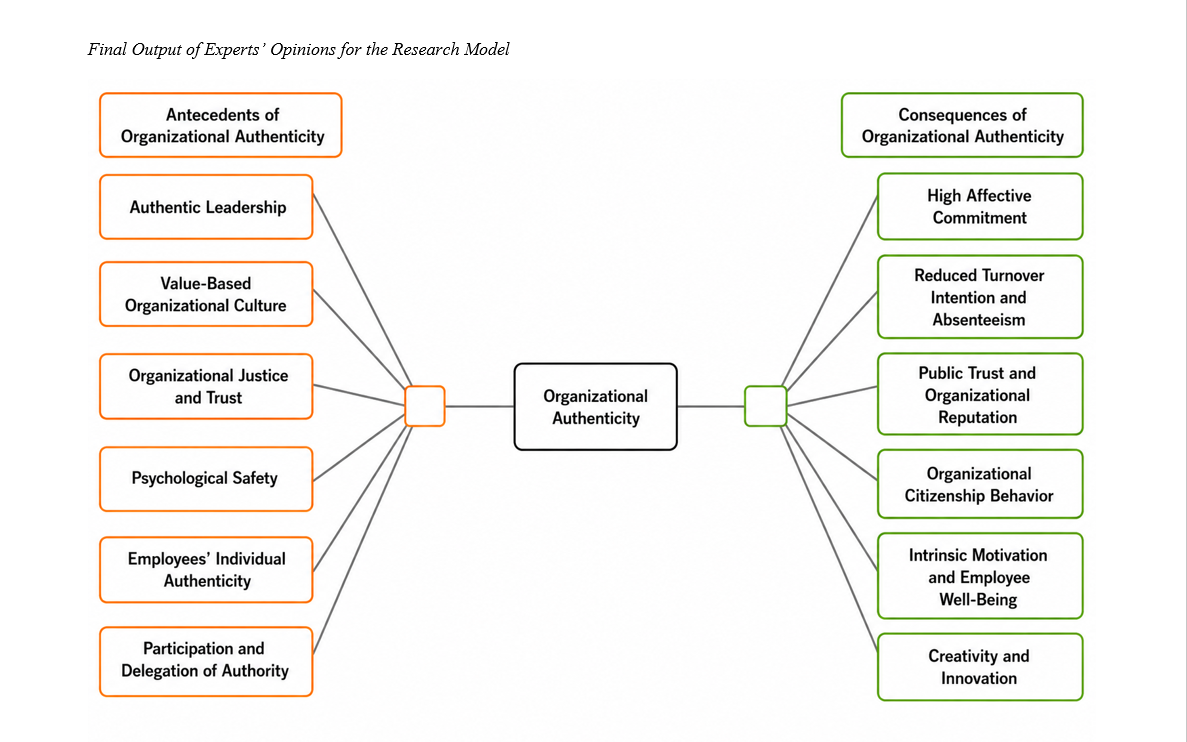
Findings: The results of the data analysis led to the identification of a set of antecedents and consequences of organizational authenticity. The antecedents of organizational authenticity included authentic leadership, value-based organizational culture, organizational justice and trust, psychological safety, employees’ individual authenticity, and participation and empowerment. Furthermore, the most significant consequences of organizational authenticity included affective commitment, reduced turnover intention and absenteeism, public trust and organizational reputation, organizational citizenship behavior, intrinsic motivation, employee well-being, and creativity and innovation. The findings indicated that organizational authenticity is a multidimensional and dynamic phenomenon that emerges from the interaction of individual, managerial, and cultural factors and generates extensive outcomes for employees, organizations, and stakeholders.
Conclusion: The findings suggest that organizational authenticity in medical universities is not merely an identity-related characteristic; rather, it represents a strategic mechanism for strengthening trust, enhancing organizational cohesion, and improving performance. The proposed model can assist managers and policymakers within the healthcare system in designing management interventions grounded in authentic organizational values and in promoting organizational effectiveness.
Downloads
References
Arabi, F., Heidari, E., & Hasanpour, A. (2024). Examining the Effect of Authentic Leadership on Organizational Behaviors Considering the Mediating Role of Psychological Capital and Perceived Organizational Support. Behavioral Studies in Management, 1-28.
Asif, M., Ma, Z., Li, M., Xie, G., & Hu, W. (2025). Authentic Leadership: Bridging the Gap between Perception of Organizational Politics and Employee Attitudes in Public Sector Museums.
Bakhtiari, Z., Sadeghi, A., Maleki Jamasbi, M., & Tapak, L. (2024). Relationship between Authentic Leadership of Nursing Supervisors, Job Satisfaction, and Quality of Nursing Services in Medical Education Centers. Avicenna Journal of Nursing and Midwifery Care, 32(2), 130-139.
Baquero, A. (2023). Authentic Leadership, Employee Work Engagement, Trust in the Leader, and Workplace Well-Being: A Moderated Mediation Model. Psychology research and behavior management, 16, 1403-1424. https://doi.org/10.2147/PRBM.S407672
Eldor, L. (2025). The Relationship between Organizational Authenticity Perceptions and Employees' Work Performance: Evidence from a Field Experiment. Journal of Management. https://doi.org/10.1177/01492063241310153
Lim, J. S., & Zhang, J. (2025). Stakeholder Engagement and Authenticity in Corporate Social Advocacy: Pathways to Corporate Reputation via Perceived Legitimacy. Journal of Public Relations Research, 37(5), 470-497. https://doi.org/10.1080/1062726X.2025.2494517
Lux, A. A., & Lowe, K. B. (2024). Authentic Leadership: 20-Year Review Editorial. Journal of Management & Organization, 30(6), 1634-1641. https://doi.org/10.1017/jmo.2024.59
Men, L. R., Thelen, P. D., & Qin, Y. S. (2024). The Impact of Diversity Communication on Employee Organizational Identification and Employee Voice Behaviors: A Moderated Mediation Model. Public Relations Review, 50(4), 102492.
Novitasari, D., Utami, H., Purnawan, J., Choirida, & Amiruddin, J. (2024). Examining the Impact of Authentic Leadership and Organizational Culture on Organizational Commitment in Universities: A Structural Equation Modeling Approach. International Journal of Social and Management Studies, 5(1), 72-84. https://doi.org/10.5555/ijosmas.v5i1.393
Pamphile, V. D., & Ruttan, R. L. (2023). The (Bounded) Role of Stated-Lived Value Congruence and Authenticity in Employee Evaluations of Organizations. Organization Science, 34(5), 1234-1251. https://doi.org/10.1287/orsc.2022.1578
Pauluzzo, P., Fedele, P., Dokalskaya, I., & Garlatti, A. (2024). The Role of Digital Technologies in Public Sector Co-Production and Co-Creation: A Structured Literature Review. Financial Accountability & Management, 40(4). https://doi.org/10.1111/faam.12391
Rook, C., Leroy, H., Zhu, J., & Anisman-Razin, M. (2024). The Different Ways of Being True to Self at Work: A Review of Divergence among Authenticity Constructs. Human Relations, 78(8), 1061-1089. https://doi.org/10.1177/00187267241288109
Tadesse Bogale, A., & Debela, K. L. (2024). Organizational Culture: A Systematic Review. Cogent Business & Management, 11(1). https://doi.org/10.1080/23311975.2024.2340129
Turker, D., Can, Ö., & Aras-Beger, G. (2023). How Authenticity of Corporate Social Responsibility Affects Organizational Attractiveness: Stakeholder Perceptions of Organizational Ideology. Corporate Social Responsibility and Environmental Management, 30(1), 87-102. https://doi.org/10.1002/csr.2444
Wilcox, A., Koontz, A., Gau, J. M., Jasinski, J. L., Reinhart, D. R., & Walters, L. J. (2025). Advancing Equity in Academia: STEM Faculty Perceptions of Organizational Justice and Organizational Authenticity. Journal of Diversity in Higher Education. https://doi.org/10.1037/dhe0000609
Yagi, K., Iida, J., & Fuji, K. (2024). The Positive Role of Authentic Leadership in Organizations: Cognitive Diversity and Information Elaboration. Frontiers in psychology, 15, 1276585. https://doi.org/10.3389/fpsyg.2024.1276585
Zhu, L. (2025). Conceptualizing and Measuring Strategic Authenticity: A Reflective-Formative Second-Order Model. Journal of Business Research. https://doi.org/10.1016/j.jbusres.2025.115582
Downloads
Additional Files
Publication Timeline
- Submitted
- Revised
- Accepted