Predicting Organizational Ambidexterity from Knowledge Management Capability and Strategic Flexibility: The Mediating Role of Organizational Learning
Keywords:
Organizational Ambidexterity, Knowledge Management Capability, Strategic Flexibility, Organizational Learning, Structural Equation ModelingAbstract
Objective: This study aimed to predict organizational ambidexterity based on knowledge management capability and strategic flexibility and to examine the mediating role of organizational learning in these relationships.
Methods and Materials: This quantitative, cross-sectional, correlational study was conducted among 312 employees and managers working in medium-sized and large organizations in Canada. Participants were recruited through convenience and professional network sampling and completed standardized self-report measures assessing knowledge management capability, strategic flexibility, organizational learning, and organizational ambidexterity. Data were analyzed using Pearson correlation coefficients, confirmatory factor analysis, and structural equation modeling. The measurement model was evaluated through factor loadings, Cronbach’s alpha, composite reliability, average variance extracted, and standard goodness-of-fit indices. Mediation effects were tested using bootstrapping with 5,000 resamples, and statistical significance was set at p < .05.
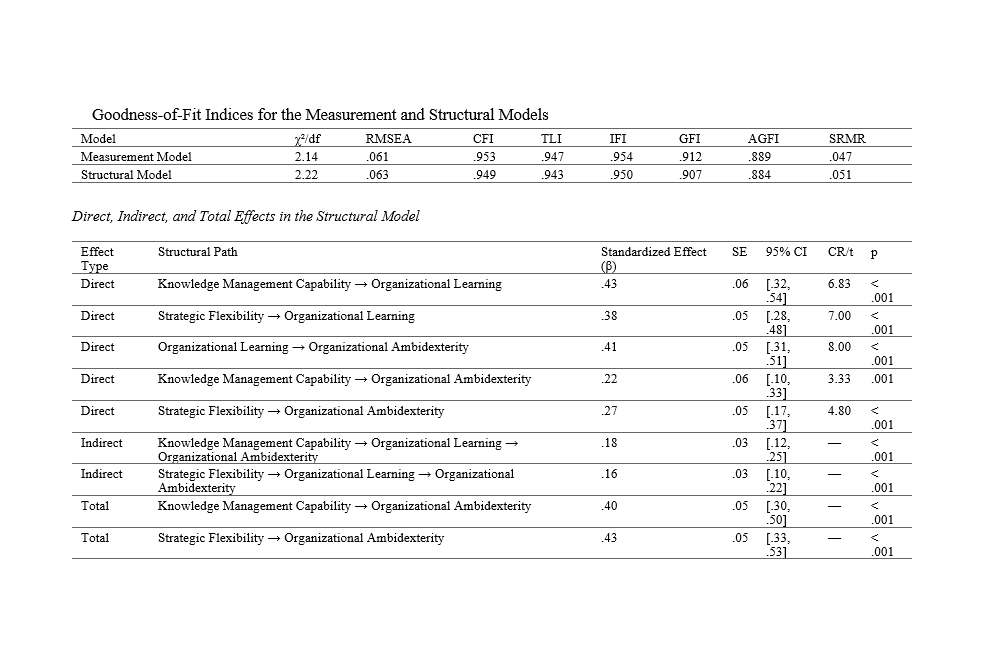
Findings: Knowledge management capability significantly predicted organizational learning (β = .43, p < .001) and organizational ambidexterity (β = .22, p = .001). Strategic flexibility also significantly predicted organizational learning (β = .38, p < .001) and organizational ambidexterity (β = .27, p < .001). Organizational learning had a significant positive effect on organizational ambidexterity (β = .41, p < .001). The indirect effect of knowledge management capability on organizational ambidexterity through organizational learning was significant (β = .18, 95% CI [.12, .25], p < .001), as was the indirect effect of strategic flexibility through organizational learning (β = .16, 95% CI [.10, .22], p < .001). The model explained 52% of the variance in organizational learning and 64% of the variance in organizational ambidexterity.
Conclusion: Knowledge management capability and strategic flexibility are important predictors of organizational ambidexterity, and organizational learning partially mediates both relationships, indicating that organizations are more likely to achieve ambidexterity when they effectively manage knowledge, remain strategically adaptable, and convert these capabilities into continuous learning processes.
Downloads
References
Adusei, E., Mensah, H. K., & Demah, E. (2022). Examining the Performance Outcome of Intellectual Capital: A parallel Mediation Analysis. African Journal of Economic and Management Studies, 13(4), 568-581. https://doi.org/10.1108/ajems-11-2021-0508
Al-Amrany, W. (2026). The Impact of Dynamic Capabilities in Achieving Organizational Ambidexterity: A Field Study at Hayel Saeed Anam Industrial Group in Taiz Governorate, Yemen. https://doi.org/10.21203/rs.3.rs-10271447/v1
Alamsjah, F., & Asrol, M. (2023). The Impacts of Middle Managers' Ambidexterity, Continuous Improvement, and Organizational Agility on Business Performance: A Knowledge-Based View. Journal of Industrial Engineering and Management, 16(1), 27. https://doi.org/10.3926/jiem.4610
Alaskar, T. H., Alsadi, A. K., Aloulou, W. J., & Ayadi, F. (2024). Big Data Analytics, Strategic Capabilities, and Innovation Performance: Mediation Approach of Organizational Ambidexterity. Sustainability, 16(12), 5111. https://doi.org/10.3390/su16125111
Alharbi, G. L. (2023). The Effect of Knowledge Management Systems on Organizational Ambidexterity: A Conceptual Model. Journal of Economics Management and Trade, 29(5), 40-51. https://doi.org/10.9734/jemt/2023/v29i51093
Alkhawaldeh, A. E., & Shawabkeh, K. M. A. (2023). The Impact of Strategic Orientations on Supply Chain Performance: The Mediating Role of Organizational Ambidexterity at Jordanian Extractive and Mining Companies. International Journal of Academic Research in Business and Social Sciences, 13(6). https://doi.org/10.6007/ijarbss/v13-i6/17166
Ameen, N., Tarba, S. Y., Cheah, J. H., Xia, S., & Sharma, G. D. (2024). Coupling Artificial Intelligence Capability and Strategic Agility for Enhanced Product and Service Creativity. British Journal of Management, 35(4), 1916-1934. https://doi.org/10.1111/1467-8551.12797
Asiaei, K., Bontis, N., Askari, M. R., Yaghoubi, M., & Barani, O. (2023). Knowledge Assets, Innovation Ambidexterity and Firm Performance in Knowledge-Intensive Companies. Journal of Knowledge Management, 27(8), 2136-2161. https://doi.org/10.1108/jkm-04-2022-0277
Batra, I., & Dhir, S. (2023). Toward Improved International Joint Ventures Performance in India: The Mediating Role of Ambidexterity and the Moderating Role of Environmental Dynamism. Cross Cultural & Strategic Management, 30(3), 488-506. https://doi.org/10.1108/ccsm-08-2022-0142
Fiaz, M., Ikram, A., Jafri, S. K. A., & Naveed, K. (2021). Product Innovations Through Ambidextrous Organizational Culture With Mediating Effect of Contextual Ambidexterity: An Empirical Study of IT and Telecom Firms. Journal of Open Innovation Technology Market and Complexity, 7(1), 9. https://doi.org/10.3390/joitmc7010009
Giudice, M. D., Scuotto, V., Papa, A., Tarba, S. Y., Bresciani, S., & Warkentin, M. (2021). A Self‐Tuning Model for Smart Manufacturing SMEs: Effects on Digital Innovation. Journal of Product Innovation Management, 38(1), 68-89. https://doi.org/10.1111/jpim.12560
Islam, T., & Munir, S. (2022). How Important Strategic Learning Capabilities Are During COVID-19? A Model for Innovation Ambidexterity. Journal of Workplace Learning, 35(1), 35-56. https://doi.org/10.1108/jwl-11-2021-0144
Johannes, W. F. C. v. L., Velden, J. M. v. d., Blomme, R. J., & Peters, P. (2021). The Interrelatedness of Organizational Ambidexterity, Dynamic Capabilities and Open Innovation: A Conceptual Model Towards a Competitive Advantage. European Journal of Management Studies, 26(2/3), 39-62. https://doi.org/10.1108/ejms-01-2021-0007
Jum’a, L., Zaid, A. A., & Othman, M. (2025). Influence of Supply Chain Ambidexterity on Supply Chain Sustainability: The Mediating Role of Green Product Innovation. Logistics, 9(3), 87. https://doi.org/10.3390/logistics9030087
Kardes, O., Eti, S., Doguc, O., Ertosun, Ö. G., Dinçer, H., & Yüksel, S. (2026). Psychological Drivers of Organizational Ambidexterity: Evidence From Agentic Artificial Intelligence Supported Fuzzy Decision Modeling. https://doi.org/10.21203/rs.3.rs-8653058/v1
Kim, G., & Lee, W. (2021). The Venture Firm’s Ambidexterity: Do Transformational Leaders Boost Organizational Learning for Venture Growth? Sustainability, 13(15), 8126. https://doi.org/10.3390/su13158126
Könönen, L., & Joensuu‐Salo, S. (2025). The Mediating Role of Organizational Ambidexterity on Environmental Proactivity And SME Performance. Corporate Social Responsibility and Environmental Management, 32(6), 7755-7771. https://doi.org/10.1002/csr.70107
Latukha, M., Michailova, S., Selivanovskikh, L., & Козачук, Т. А. (2022). Talent Management, Organizational Ambidexterity, and Firm Performance: Evidence From Russian Firms. Thunderbird International Business Review, 64(5), 379-392. https://doi.org/10.1002/tie.22251
Liao, S., Hu, Q., & Wei, J. (2023). How to Leverage Big Data Analytic Capabilities for Innovation Ambidexterity: A Mediated Moderation Model. Sustainability, 15(5), 3948. https://doi.org/10.3390/su15053948
Lissillour, R., & Rodríguez-Escobar, J. A. (2022). Organizational Ambidexterity and the Learning Organization: The Strategic Role of a Corporate University. The Learning Organization, 30(1), 55-75. https://doi.org/10.1108/tlo-01-2021-0011
López-Zapata, E., & Ramírez-Gómez, A. D. J. (2021). Intellectual Capital, Organizational Culture and Ambidexterity in Colombian Firms. Journal of Intellectual Capital, 24(2), 375-398. https://doi.org/10.1108/jic-08-2020-0286
Pereira, V., Temouri, Y., Arslan, A., Degbey, W. Y., & Tarba, S. Y. (2022). Ambidextrous Organizations in and From Emerging Markets—Editors' Special Issue Introduction. Thunderbird International Business Review, 64(5), 369-378. https://doi.org/10.1002/tie.22306
Pinheiro, J., Lages, L. F., Silva, G. M., Dias, Ã. l., & Preto, M. T. (2021). Effects of Absorptive Capacity and Innovation Spillover on Manufacturing Flexibility. International Journal of Productivity and Performance Management, 71(5), 1786-1809. https://doi.org/10.1108/ijppm-04-2020-0156
Przytuła, S., Rank, S., & Tracz‐Krupa, K. (2022). Ambidexterity as the Response of Smart Industry 4.0 – Towards Better HR Practices. 51-67. https://doi.org/10.1108/s1877-636120220000028006
Restuputri, D. P., Masudin, I., Septira, A. P., Govindan, K., & Widayat, W. (2024). The Role of Knowledge Management to Improve Organizational Performance Through Organizational Ambidexterity Within the Uncertainties. Business Process Management Journal, 30(7), 2237-2282. https://doi.org/10.1108/bpmj-08-2023-0614
Sağlam, M., & İyigün, N. Ö. (2022). An Investigation of Mediator Roles and the Effects of Learning Organization Approach and Intellectual Capital on Organizational Ambidexterity and Organizations’ Entrepreneurial Orientation: A Comparison of the Service and Production Sectors. Istanbul Business Research, 0(0), 0-0. https://doi.org/10.26650/ibr.2021.51.804628
Sahoo, S., Kumar, A., Mangla, S. K., & Ishizaka, A. (2024). Examining the Effects of Industry 4.0 Adoption, Information Acquisition Capability, and Organizational Ambidexterity on Innovation and Circular Economy Performance. Business Strategy and the Environment, 34(2), 1590-1606. https://doi.org/10.1002/bse.4067
Samimi, M., Lee, Y., & Anderson, M. H. (2025). CEO Construal Level, Cognitive Flexibility, and Firm Ambidexterity. Organization Studies, 47(2), 305-330. https://doi.org/10.1177/01708406251370499
Shehadeh, H. K., & Mohammed Abed Hussein Al, t. (2022). Organizational Ambidexterity and Its Impact on Organizational Citizenship Behavior: A Case Study in Islamic International Arab Bank in Amman City-Jordan. Academic Journal of Interdisciplinary Studies, 11(4), 270. https://doi.org/10.36941/ajis-2022-0115
Singer-Coudoux, K., Kretschmer, M., & Houssni, K. A. (2024). Navigating Dualities: A Literature Review of the Role of Organizational Learning in Fostering Ambidexterity. European Conference on Management Leadership and Governance, 20(1), 537-546. https://doi.org/10.34190/ecmlg.20.1.3052
Susilo, H., Yudiono, N., & Priambada, S. (2024). Antecedents of Ambidextrous Behavior and Its Influence on MSME Performance (Study of MSMEs in Malang Regency). International Journal of Religion, 5(10), 5247-5256. https://doi.org/10.61707/az8zxt05
Ürü, F. O., Gözükara, E., & Ünsal, A. A. (2024). Organizational Ambidexterity, Digital Transformation, and Strategic Agility for Gaining Competitive Advantage in SMEs. Sosyal Mucit Academic Review, 5(1), 1-23. https://doi.org/10.54733/smar.1386357
Wang, C., Zhang, M., & Ma, H. (2024). The More Ambidexterity the Better? The Moderating Effect of Organizational Learning Between High-Performance HR Practices and Organizational Performance. Frontiers in psychology, 14. https://doi.org/10.3389/fpsyg.2023.1283637
Yang, M., Mamun, A. A., & Salameh, A. A. (2023). Leadership, Capability and Performance: A Study Among Private Higher Education Institutions in Indonesia. Heliyon, 9(1), e13026. https://doi.org/10.1016/j.heliyon.2023.e13026
Zada, M., Abdalla, A. A., Contreras-Barraza, N., & Vega-Muñoz, A. (2025). The Impact of Ecocentric Leadership on Organizational Green Innovation Examining the Serial Mediation of Green Knowledge Sharing and Ambidexterity. Scientific reports, 15(1). https://doi.org/10.1038/s41598-025-07512-6
Zahoor, N., Khan, Z., Marinova, S. T., & Cui, L. (2023). Ambidexterity in Strategic Alliances: An Integrative Review of the Literature. International Journal of Management Reviews, 26(1), 82-109. https://doi.org/10.1111/ijmr.12348
Downloads
Additional Files
Publication Timeline
- Submitted
- Revised
- Accepted