Predicting Innovative Work Behavior from High-Performance Work Practices and Perceived Organizational Support: The Mediating Role of Employee Engagement
Keywords:
Innovative Work Behavior, High-Performance Work Practices, Perceived Organizational Support, Employee Engagement, Structural Equation Modeling, ArgentinaAbstract
Objective: This study aimed to predict innovative work behavior from high-performance work practices and perceived organizational support and to examine the mediating role of employee engagement among employees in Argentina.
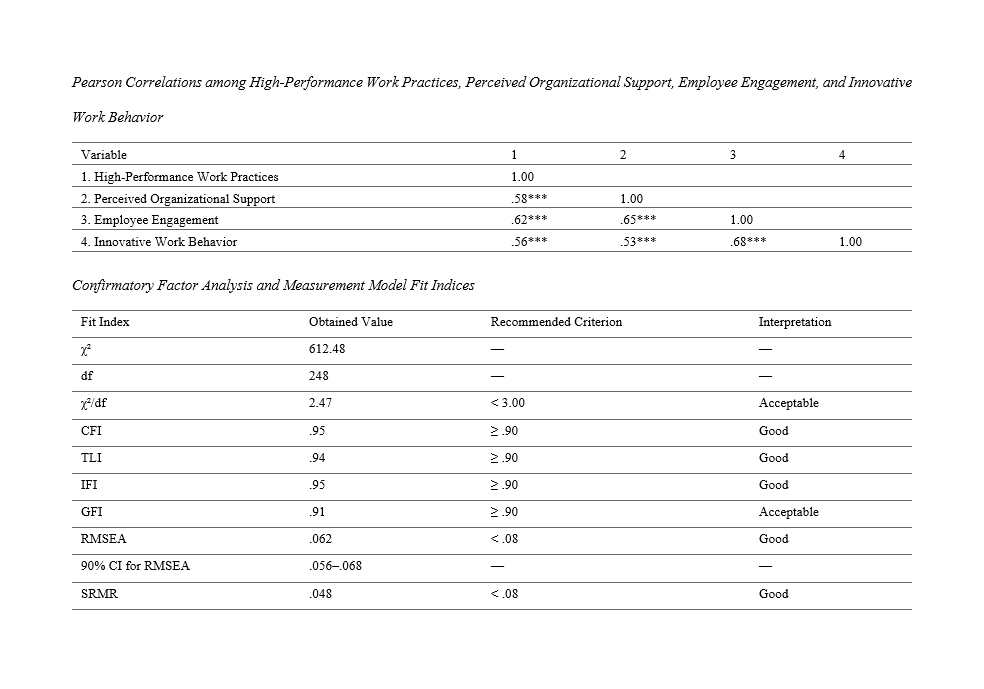
Methods and Materials: This quantitative, cross-sectional, correlational study was conducted among 384 employees working in public and private organizations in Argentina. Participants were selected through convenience sampling and completed self-report measures of high-performance work practices, perceived organizational support, employee engagement, and innovative work behavior. Employee engagement was assessed using the nine-item Utrecht Work Engagement Scale, while innovative work behavior was measured using Janssen’s nine-item scale. Data were analyzed using Pearson correlation coefficients, confirmatory factor analysis, and structural equation modeling. Model fit was evaluated using χ²/df, CFI, TLI, IFI, RMSEA, and SRMR. The significance of indirect effects was assessed through bootstrapping with 5,000 resamples and 95% confidence intervals.
Findings: High-performance work practices significantly predicted employee engagement (β = .39, p < .001) and innovative work behavior (β = .21, p < .001). Perceived organizational support also significantly predicted employee engagement (β = .43, p < .001) and innovative work behavior (β = .16, p = .005). Employee engagement was the strongest direct predictor of innovative work behavior (β = .49, p < .001). The model explained 52% of the variance in employee engagement and 55% of the variance in innovative work behavior. Bootstrapping showed significant indirect effects of high-performance work practices (β = .19, 95% CI [.12, .27]) and perceived organizational support (β = .21, 95% CI [.14, .29]) on innovative work behavior through employee engagement, indicating partial mediation.
Conclusion: The findings indicate that high-performance work practices and perceived organizational support promote innovative work behavior both directly and indirectly by strengthening employee engagement, highlighting engagement as a key psychological mechanism linking favorable organizational conditions with employee innovation.
Downloads
References
Abbas, M. Z., & Khattak, A. N. (2024). The Impact of Coaching Leadership on Innovative Work Behavior, Psychological Capital as Mediator, and Perceived Organizational Support as Moderator. Global Management Sciences Review, IX(III), 77-90. https://doi.org/10.31703/gmsr.2024(ix-iii).07
Al-Taie, M., & Khattak, M. N. (2024). The Impact of Perceived Organizational Support and Human Resources Practices on Innovative Work Behavior: Does Gender Matter? Frontiers in psychology, 15. https://doi.org/10.3389/fpsyg.2024.1401916
Aruoren, E. E., & Siaka, G. A. (2023). Mediating Effect of Perceived Organizational Support on the Relationship Between Organizational Silence and Organizational Commitment. Ejbm. https://doi.org/10.7176/ejbm/15-4-02
Bhatnagar, A., & Aggarwal, G. (2022). Impact of Inclusive Leadership on Variables Affecting Employee Performance: A Review of Empirical Papers. International Journal of Research in Human Resource Management, 4(1), 13-24. https://doi.org/10.33545/26633213.2022.v4.i1a.83
Bui, H., Vu, X. T. M., & Tran, A. D. (2025). The Moderating Role of Emotional Intelligence in the Relationship Between Transformational Leadership, Organizational Citizenship Behavior, Innovative Work Behavior, and Employee Performance in Commercial Banks in Vietnam. Human Systems Management, 45(3), 359-378. https://doi.org/10.1177/01672533251369706
Deepa, R., Baral, R., & Saini, G. K. (2024). Proud of My Organization: Conceptualizing the Relationships Between High-Performance HR Practices, Leadership Support, Organizational Pride, Identification and Innovative Work Behaviour. International Journal of Organizational Analysis, 33(2), 283-300. https://doi.org/10.1108/ijoa-12-2023-4148
Ebrahim, Z. B., Ismail, I., & Kassim, E. S. (2023). A Conceptual Review of the Determinants of Employee Innovative Work Behavior. Information Management and Business Review, 15(4(SI)I), 239-257. https://doi.org/10.22610/imbr.v15i4(si)i.3598
Ekmekçioğlu, E. B., & Öner, K. (2023). Servant Leadership, Innovative Work Behavior and Innovative Organizational Culture: The mediating Role of Perceived Organizational Support. European Journal of Management and Business Economics, 33(3), 272-288. https://doi.org/10.1108/ejmbe-08-2022-0251
Fatoki, O. (2023). The Role of Perceived Organisational Support and Leader Humor in Participative Leadership and Innovative Work Behaviour in Small Firms. International Journal of Management and Sustainability, 12(3), 474-487. https://doi.org/10.18488/11.v12i3.3524
Hadiyat, Y., & Herman, H. (2023). High Performance Work Practice (HPWP) Implementation at Pt. Sumoda Tama Berkah (“Mbok Darmi Milk”) in Bogor City, West Java. Journal of Social Transformation and Regional Development, 5(1). https://doi.org/10.30880/jstard.2023.05.01.008
Hao, J. X., Chen, Z., Mahsud, M., & Yu, Y. (2024). Organizational Psychological Ownership and Innovative Work Behavior: The Roles of Coexisting Knowledge Sharing and Hiding Across Organizational Contexts. Journal of Knowledge Management, 28(8), 2197-2219. https://doi.org/10.1108/jkm-12-2022-0965
Husin, N. H., Mansor, N. N. A., Javaid, M. U., & Widarman, B. (2025). The Influence of Perceived High-Performance Work Systems on Innovative Work Behavior: Mediating Role of Work Engagement. Work a Journal of Prevention Assessment & Rehabilitation, 81(2), 2713-2725. https://doi.org/10.1177/10519815241311188
Ibrahim, N. F., Sharif, S. M., Saleh, H., Hasan, N. H. M., & Jayiddin, N. F. (2023). PERMA Well-Being and Innovative Work Behaviour : A Systematic Literature Review. F1000research, 12, 1338. https://doi.org/10.12688/f1000research.141629.1
Islam, T., Zulfiqar, I., Aftab, H., Alkharabsheh, O. H. M., & Shahid, M. K. (2024). Testing the Waters! The Role of Ethical Leadership Towards Innovative Work Behavior Through Psychosocial Well-Being and Perceived Organizational Support. Journal of Organizational Change Management, 37(5), 1051-1072. https://doi.org/10.1108/jocm-09-2023-0382
Itsnaini, M. S., & Riani, A. L. (2022). Effect of High-Performance Work Practices on Civil Servants Health Based on Two Sides of the Job Demands-Resources Model in the National Research and Innovation Agency Indonesia. International Journal of Economics Business and Management Research, 06(07), 67-90. https://doi.org/10.51505/ijebmr.2022.6706
Jishnu, A., & Hareendrakumar, V. R. (2024). Impact of HR Practices on Innovative Work Behaviour: The Mediating Role of Organizational Support, Knowledge-Sharing and Employee Creativity. Paradigm a Management Research Journal, 28(1), 101-118. https://doi.org/10.1177/09718907241251410
Mai, S., Wang, L., & Na, M. (2025). The Influence of Organizational Fairness, Identity and Empowerment on Employee Creativity: Mediating Role of Corporate Social Responsibility. Sage Open, 15(1). https://doi.org/10.1177/21582440251328475
Mehmood, S., Jabeen, R., Khan, M. A., Khan, M. A., Gavurová, B., & Oláh, J. (2023). Impact of Despotic Leadership and Workplace Incivility on Innovative Work Behavior of Employees: Application of Mediation-Moderation Model. Heliyon, 9(9), e19673. https://doi.org/10.1016/j.heliyon.2023.e19673
Meraj, R., Nasir, S., Shafqat, A., & Indrees, S. (2023). Green Human Resource Management (GHRM) and Environmental Performance in Pakistani Hotel Industry: The Role of Green Perceived Organizational Support (POS), Pro-Environmental Behavior and Green Innovative Work Behavior (GIWB). Pakistan Journal of Humanities and Social Sciences, 11(2). https://doi.org/10.52131/pjhss.2023.1102.0403
Musenze, I. A., & Mayende, T. S. (2022). Ethical Leadership (EL) and Innovative Work Behavior (IWB) in Public Universities: Examining the Moderating Role of Perceived Organizational Support (POS). Management Research Review, 46(5), 682-701. https://doi.org/10.1108/mrr-12-2021-0858
Mustafa, M., Badri, S. K. Z., & Ramos, H. M. (2022). Linking Middle-Managers' Ownership Feelings to Their Innovative Work Behaviour: The Mediating Role of Affective Organisational Commitment. Journal of Management & Organization, 30(6), 2418-2435. https://doi.org/10.1017/jmo.2021.67
Park, J., & Kim, W. (2022). The Impact of Perceived Organizational Support on Innovative Work Behavior Through Psychological Empowerment: Focusing on the Moderated Mediating Role of Organizational Procedural Justice. Journal of Technical Education and Training, 14(1). https://doi.org/10.30880/jtet.2022.14.01.015
Saif, N., Amelia, A., Goh, G. G. G., Rubin, A., Shaheen, I., & Murtaza, M. (2024). Influence of Transformational Leadership on Innovative Work Behavior and Task Performance of Individuals: The Mediating Role of Knowledge Sharing. Heliyon, 10(11), e32280. https://doi.org/10.1016/j.heliyon.2024.e32280
Salin, D., Stride, C., Smith, S., & Santokhie, S. (2023). High-Performance Work Practices and Employee Wellbeing: Organizational Identification as a Mediator. Frontiers in psychology, 14. https://doi.org/10.3389/fpsyg.2023.1175344
Sheikh, A. A., Hassan, N. M., & Sultana, R. (2022). Linking Service-Oriented High-Performance Work Practices Bundle With Person-Job Fit, Person Organization Fit and Affective Commitment: A Parallel Mediation Analysis. Review of Applied Management and Social Sciences, 5(2), 149-166. https://doi.org/10.47067/ramss.v5i2.220
Wahid, M., & Ayub, N. (2024). Predictive Role of Psychological Capital and Perceived Organizational Support on Innovative Work Behavior Among Higher Education Teachers of Pakistan. Tuning Journal for Higher Education, 11(2), 191-219. https://doi.org/10.18543/tjhe.2715
Zreen, A., Farrukh, M., & Kanwal, N. (2021). Do HR Practices Facilitate Innovative Work Behaviour? Empirical Evidence From Higher Education Institutes. Human Systems Management, 40(5), 701-710. https://doi.org/10.3233/hsm-201001
Downloads
Additional Files
Publication Timeline
- Submitted
- Revised
- Accepted