Predicting Organizational Innovation from Entrepreneurial Orientation and Dynamic Capabilities: The Moderating Role of Environmental Dynamism
Keywords:
Entrepreneurial Orientation, Dynamic Capabilities, Environmental Dynamism, Organizational Innovation, Small and Medium-Sized Enterprises, ThailandAbstract
Objective: This study aimed to predict organizational innovation from entrepreneurial orientation and dynamic capabilities and to examine the moderating role of environmental dynamism among small and medium-sized enterprises in Thailand.
Methods and Materials: This quantitative, cross-sectional, correlational study was conducted among 412 managers, owner-managers, executives, and senior organizational decision-makers working in Thai small and medium-sized enterprises. Participants were selected from manufacturing, wholesale and retail, information and communication technology, hospitality, professional services, and other service sectors. Data were collected using standardized measures of entrepreneurial orientation, dynamic capabilities, environmental dynamism, and organizational innovation. Construct reliability and validity were assessed using Cronbach’s alpha, composite reliability, average variance extracted, and confirmatory factor analysis. Pearson correlation analysis and hierarchical multiple regression were used to test the direct relationships among the variables. Moderation analysis was performed by entering mean-centered interaction terms for entrepreneurial orientation × environmental dynamism and dynamic capabilities × environmental dynamism. Statistical significance was set at p < .05.
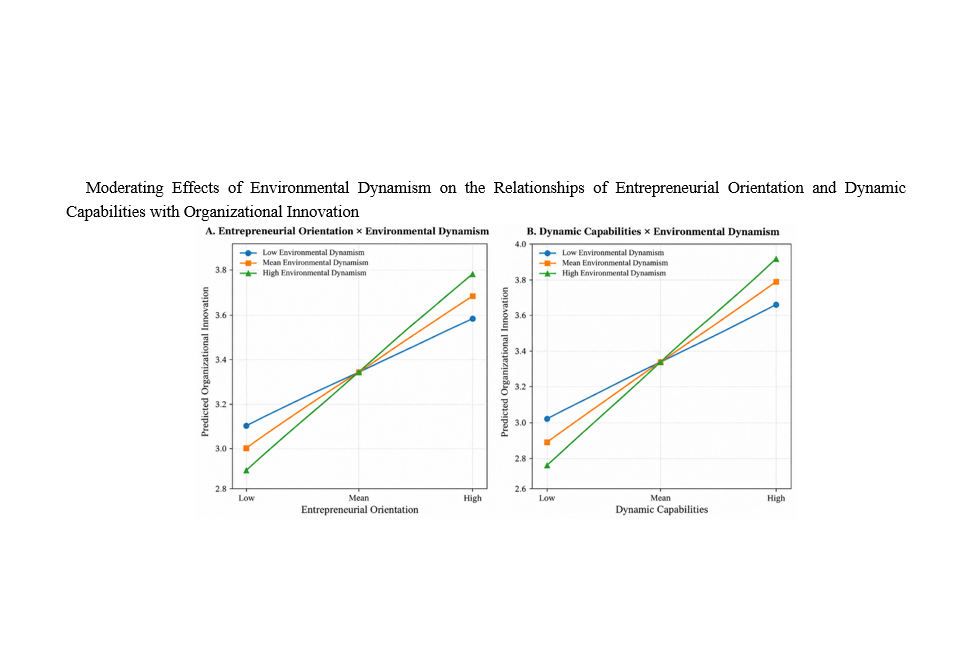
Findings: Entrepreneurial orientation significantly predicted organizational innovation (B = 0.36, SE = 0.04, β = .35, t = 8.47, p < .001), while dynamic capabilities showed the strongest direct effect (B = 0.48, SE = 0.05, β = .44, t = 10.19, p < .001). Environmental dynamism also had a significant positive effect on organizational innovation (B = 0.12, SE = 0.04, β = .12, t = 3.12, p = .002). The main-effects model explained 56% of the variance in organizational innovation. Environmental dynamism significantly moderated both the entrepreneurial orientation–innovation relationship (B = 0.15, SE = 0.04, β = .14, t = 3.79, p < .001) and the dynamic capabilities–innovation relationship (B = 0.19, SE = 0.04, β = .17, t = 4.62, p < .001), increasing the final explained variance to 61%.
Conclusion: Organizational innovation in Thai SMEs is strengthened by entrepreneurial orientation and dynamic capabilities, particularly under highly dynamic environmental conditions, indicating that firms benefit most when proactive strategic behavior is combined with strong adaptive and reconfiguration capabilities.
Downloads
References
Ahmed, T., Yousaf, A., Chávez, R., & Sanders, K. (2024). Entrepreneurial Pathways to Sustainability: A Theoretical Paper on Green Human Resource Management, Green Supply Chain Management, and Entrepreneurial Orientation. Sustainability, 16(15), 6357. https://doi.org/10.3390/su16156357
Bui, H., Vu, X. T. M., & Tran, A. D. (2025). The Moderating Role of Emotional Intelligence in the Relationship Between Transformational Leadership, Organizational Citizenship Behavior, Innovative Work Behavior, and Employee Performance in Commercial Banks in Vietnam. Human Systems Management, 45(3), 359-378. https://doi.org/10.1177/01672533251369706
Chaudhuri, R., Chatterjee, S., Kamble, S., Gupta, S., Ndubisi, N. O., & Belhadi, A. (2023). Corporate Entrepreneurial Leadership, Resources, Capabilities, and Sustainable Performance. Business Strategy and the Environment, 33(3), 2066-2083. https://doi.org/10.1002/bse.3585
Dewi, Y. K., Hanifah, H., & Ping, T. A. (2024). Enhancing the Performance of Indonesian E-Business Start-Ups: The Influence of Innovation Capability and Dynamic Capability. International Journal of Academic Research in Progressive Education and Development, 13(4). https://doi.org/10.6007/ijarped/v13-i4/23570
Fatoki, O. (2023). The Role of Perceived Organisational Support and Leader Humor in Participative Leadership and Innovative Work Behaviour in Small Firms. International Journal of Management and Sustainability, 12(3), 474-487. https://doi.org/10.18488/11.v12i3.3524
Fu, C., Indıran, L., Kohar, U. H. A., & Wiyata, W. (2024). Entrepreneurship Orientation (EO) and Innovation: A Systematic Review. Kne Social Sciences. https://doi.org/10.18502/kss.v9i11.15810
Gupta, R., Mejía, C., SadreGhazi, S., Sano, Y., Muchangos, L. S. d., Sekiguchi, T., Nakamura, H., & Kajikawa, Y. (2024). Traders as Ecosystem Orchestrators for Sustainable Foods Supply Chain Transformation. Business Strategy and the Environment, 33(5), 4024-4038. https://doi.org/10.1002/bse.3695
Istipliler, B., Ahsan, M., Mole, K., Adomako, S., Gyensare, M. A., & Tang, J. (2025). Entrepreneurial Alertness in Dynamic Environments: Mediating Pathways to Entrepreneurial Orientation and Performance. British Journal of Management, 36(4), 1425-1443. https://doi.org/10.1111/1467-8551.12907
Karan, A., Verma, J., & Verma, R. (2024). Examining the Relationship Between Organizational Capabilities and Business Sustainability Among Start-Ups: A Dynamic Capability View. Journal of Indian Business Research, 16(4), 410-433. https://doi.org/10.1108/jibr-04-2023-0124
Kusumastuti, R. D. (2023). Analysis of the Influence of Entrepreneurial Orientation, Learning Orientation, and Dynamic Capability on Strategic Flexibility and SMEs Performance. 308-326. https://doi.org/10.2991/978-94-6463-226-2_27
Kusumawijaya, I. K., & Astuti, P. D. (2025). Synergistic Impact of Entrepreneurial Orientation and Knowledge Creation on Dynamic Capabilities: Catalyzing Firm Performance. Human Systems Management, 45(2), 173-185. https://doi.org/10.1177/01672533251361378
Lissaneddine, A. (2026). Digital Transformation as a Mediator Between Entrepreneurial Orientation Dimensions and Organizational Resilience in Tourism Accommodation Firms: A Multi-Dimensional Approach. Tourism and Hospitality, 7(8), 235. https://doi.org/10.3390/tourhosp7080235
Maharjan, R., Danuwar, R. K., Kayestha, M., Dhakal, A., Baral, D. K., Rajopadhyaya, A., Koirala, A., & Timalsina, D. P. (2024). Measuring the Effects of Entrepreneurial Orientation on Social Media Adoption and SME’s Performance in Kathmandu Valley: Evidence From Structural Equation Modeling Using Smart PLS 4.0. Economic Journal of Development Issues, 37(1), 27-47. https://doi.org/10.3126/ejdi.v37i1.63914
Milovanović, B. M., Fabić, M. G., & Bratić, V. (2023). Strategic Approach to Configurational Analysis of Entrepreneurial Orientation, Strategic Networking, and SME Performance Within Emerging Markets of Selected Southeast European Countries. Administrative Sciences, 13(2), 52. https://doi.org/10.3390/admsci13020052
Mosonik, J. K., Maru, L., & Komen, J. (2024). ENTREPRENEURIAL ORIENTATION, GROWTH OF MSMEs AND THE MODERATED MEDIATION ROLE OF ENVIRONMENTAL FACTORS AND FIRM STRATEGIC CAPABILITIES IN THE MANUFACTURING SECTOR IN NAIROBI COUNTY, KENYA. Strategic Journal of Business & Change Management, 11(2). https://doi.org/10.61426/sjbcm.v11i2.2892
Naz, S., Haider, S. A., Khan, S., Nisar, Q. A., & Tehseen, S. (2023). Augmenting Hotel Performance In Malaysia Through Big Data Analytics Capability and Artificial Intelligence Capability. Journal of Hospitality and Tourism Insights, 7(4), 2055-2080. https://doi.org/10.1108/jhti-01-2023-0017
Nugroho, A., & Heykal, M. (2023). Could IT Adoption Capability and Digitalization Improve Firm Performance? The Necessity of Entrepreneurial Orientation and Transformational Leadership. Jurnal Ilmiah Mandala Education, 9(2). https://doi.org/10.58258/jime.v9i2.4895
Octasylva, A. R. P., Yuliati, L. N., Hartoyo, H., & Soehadi, A. W. (2023). Entrepreneur Orientation and Social Capital as a Key to Developing Dynamic Capability: A Conceptual Framework. Indonesian Journal of Business and Entrepreneurship, 9(2), 186. https://doi.org/10.17358/ijbe.9.2.186
Satar, M. S., Alharthi, S., Alarifi, G., & Omeish, F. (2024). Does Digital Capabilities Foster Social Innovation Performance in Social Enterprises? Mediation by Firm-Level Entrepreneurial Orientation. Sustainability, 16(6), 2464. https://doi.org/10.3390/su16062464
Schneider, A., Gerlich, C., Antonio, J. L., & Kanbach, D. K. (2026). From Potential to Impact: How Artificial Intelligence Drives Dynamic Capabilities for Sustainability. Business Strategy & Development, 9(2). https://doi.org/10.1002/bsd2.70327
Tessema, D. H., Yeşilada, F., & Şeşen, H. (2025). The Impact of Entrepreneurial Orientation on Competitive Advantage: The Mediating Role of Knowledge Sharing and Market Orientation. https://doi.org/10.21203/rs.3.rs-6769587/v1
Theodosiou, M., Katsikea, E., Alarape, O., & Hardy, P. (2024). International Entrepreneurial Orientation and International Performance: The Mediating Role of Dynamic Capabilities and Business Strategy. European Management Review, 22(3), 776-798. https://doi.org/10.1111/emre.12683
Tipu, S. A. A., & Fantazy, K. (2023). Linking Big Data Analytics Capability and Sustainable Supply Chain Performance: Mediating Role of Innovativeness, Proactiveness and Risk Taking. International Journal of Productivity and Performance Management, 73(5), 1587-1608. https://doi.org/10.1108/ijppm-11-2022-0576
Yu, X., Cao, N., & Ren, H. (2023). The Impact of Entrepreneurial Orientation on the Sustainable Innovation Capabilities of New Ventures: From the Perspective of Ambidextrous Learning. Sustainability, 15(11), 9026. https://doi.org/10.3390/su15119026
Zheng, X. (2024). How Does a Firm’s Digital Business Strategy Affect Its Innovation Performance? An Investigation Based on Knowledge-Based Dynamic Capability. Journal of Knowledge Management, 28(8), 2324-2356. https://doi.org/10.1108/jkm-05-2023-0410
Zreen, A., Farrukh, M., & Kanwal, N. (2021). Do HR Practices Facilitate Innovative Work Behaviour? Empirical Evidence From Higher Education Institutes. Human Systems Management, 40(5), 701-710. https://doi.org/10.3233/hsm-201001
Downloads
Additional Files
Publication Timeline
- Submitted
- Revised
- Accepted