Explainable XGBoost Prediction of Employee Turnover Intention Using Organizational Behavior and Human Resource Features
Keywords:
Employee Turnover Intention, XGBoost, Explainable Artificial Intelligence, SHAP, Organizational Behavior, Human Resource Management, Employee RetentionAbstract
Objective: This study aimed to develop and interpret an XGBoost-based machine-learning model for predicting employee turnover intention among employees in France using organizational behavior and human resource features.
Methods and Materials: This quantitative, cross-sectional predictive study included 684 employees working in public- and private-sector organizations in France. Participants completed a structured questionnaire assessing turnover intention together with organizational behavior and human resource variables, including job satisfaction, organizational commitment, perceived organizational support, work engagement, job autonomy, role clarity, role conflict, work-related stress, organizational justice, supervisor support, work–life balance, compensation satisfaction, career advancement opportunities, recognition and rewards, job security, leadership quality, perceived internal mobility, and HR fairness. The dataset was stratified into training and independent test subsets. An Extreme Gradient Boosting model was developed using stratified five-fold cross-validation and hyperparameter optimization. Predictive performance was evaluated using ROC-AUC, accuracy, precision, recall, specificity, F1 score, balanced accuracy, log loss, and Brier score. SHapley Additive exPlanations were applied to interpret global and individual feature contributions.
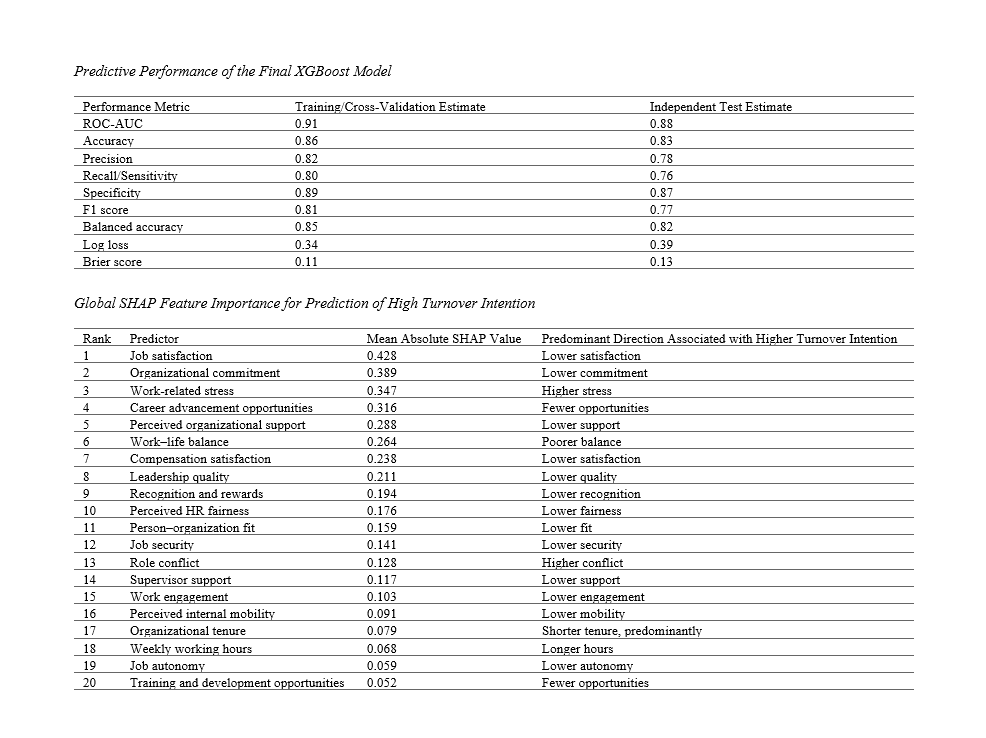
Findings: The final XGBoost model demonstrated strong discrimination in the independent test set, with an ROC-AUC of 0.88, accuracy of 0.83, precision of 0.78, recall of 0.76, specificity of 0.87, F1 score of 0.77, and balanced accuracy of 0.82. The test log loss and Brier score were 0.39 and 0.13, respectively. SHAP analysis identified job satisfaction as the most influential predictor, followed by organizational commitment, work-related stress, career advancement opportunities, perceived organizational support, work–life balance, compensation satisfaction, leadership quality, recognition and rewards, and perceived HR fairness. Lower satisfaction, weaker commitment and support, higher stress, and fewer career opportunities consistently increased predicted turnover intention.
Conclusion: Explainable XGBoost provided accurate and interpretable prediction of employee turnover intention, demonstrating that modifiable organizational and HR-related conditions were more influential than demographic characteristics and may therefore represent priority targets for evidence-based retention strategies.
Downloads
References
Aduda, B. O., Omondi, D. A., & K’Obonyo, P. P. (2022). Influence of Human Resource Management Practices on Employee Turnover Among Registered Private Security Firms in Kenya. strategicjournals.com, 9(4). https://doi.org/10.61426/sjbcm.v9i4.2514
Ahmed, R. R., Azam, M., Qureshi, J. A., E, A. R. H., Parmar, V., & Salleh, N. Z. M. (2022). The Relationship Between Internal Employer Branding and Talent Retention: A Theoretical Investigation for the Development of a Conceptual Framework. Frontiers in psychology, 13. https://doi.org/10.3389/fpsyg.2022.859614
Aimeur, M. (2024). Impact of HRM Practices on Employees’ Turnover Intention: The Mediating Role of Affective Commitment. Eatp, 919-928. https://doi.org/10.53555/kuey.v30i7.6899
Alhajaj, W. E., & Ahmad, S. Z. (2023). The Effectiveness of Human Resource Management Practices, Work Engagement and Self-Efficacy in Minimizing Talent turnover Intention. International Journal of Productivity and Performance Management, 73(8), 2414-2440. https://doi.org/10.1108/ijppm-02-2023-0090
Alkhamis, F. A. (2024). The Impacts of HRM Practices on Employee Outcomes: The Mediating Role of HRM Effectiveness. Revista De Gestão Social E Ambiental, 18(1), e6313. https://doi.org/10.24857/rgsa.v18n1-128
Alshehhi, R. (2024). Increasing Turnover Rate Among Emirati Employees in Private Sector in Ras Al Khaima. Journal of Human Resource and Leadership, 9(3), 19-32. https://doi.org/10.47604/jhrl.2649
Ashraf, H. A., Iqbal, J., & Shah, S. I. U. (2023). Connecting the Dots: How Organizational Commitment Mediates the HR Practices-Turnover Intention Link. International Journal of Management Research and Emerging Sciences, 13(3). https://doi.org/10.56536/ijmres.v13i3.515
Bawasa, S., Othman, A. J., & Idrus, Z. (2023). Preliminary Study on Islamic Human Resource Management (IHRM) Practices in Multi-National Corporations (MNCs): Identification of Turnover Intention. https://doi.org/10.4108/eai.4-11-2022.2329837
Berber, N., & Gašić, D. (2024). The Mediating Role of Employee Commitment in the Relationship Between Compensation System and Turnover Intentions. Employee Relations the International Journal, 46(4), 721-755. https://doi.org/10.1108/er-05-2023-0270
Berber, N., Gašić, D., Katić, I., & Borocki, J. (2022). The Mediating Role of Job Satisfaction in the Relationship Between FWAs and Turnover Intentions. Sustainability, 14(8), 4502. https://doi.org/10.3390/su14084502
Budin, D. K. A. (2024). Determinants of Employees’ Turnover Intention: A Conceptual Paper. International Student Conference on Business Education Economics Accounting and Management (Isc-Beam), 1(1), 937-947. https://doi.org/10.21009/isc-beam.011.65
Chen, Y.-L. (2024). Crossing the Great Divide: South Asia High-Performance Work Systems. International Journal of Business & Management Studies, 05(02), 38-44. https://doi.org/10.56734/ijbms.v5n2a6
Gautam, P., & Saud, S. (2024). Emerging Challenges of HRM in 21st Century: A Case of Nepalese Commercial Banks. Nepalese Journal of Finance, 11(2), 18-35. https://doi.org/10.3126/njf.v11i2.68815
Gomes, D. R., Ribeiro, N., & Santos, M. J. (2023). “Searching for Gold” With Sustainable Human Resources Management and Internal Communication: Evaluating the Mediating Role of Employer Attractiveness for Explaining Turnover Intention and Performance. Administrative Sciences, 13(1), 24. https://doi.org/10.3390/admsci13010024
Islam, M. S., Amin, M., Feranita, F., & Karatepe, O. M. (2023). High-Involvement Work Practices, Work Engagement and Their Effects on Bank Employees' Turnover Intentions: The Moderating Role of Functional Competence. International Journal of Bank Marketing, 41(6), 1360-1388. https://doi.org/10.1108/ijbm-04-2022-0157
Jing, G., Li, L., Kim, M. G., & Jeon, H. (2024). Relationship Between Perceived human Resource Management System Strength, Thriving at Work, and Employee's Turnover Intention in Chinese Hotels. International Journal of Tourism Research, 26(4). https://doi.org/10.1002/jtr.2682
Kim, P., Cho, W., & Yang, I. (2022). Workplace Disruption in the Public Sector and HRM Practices to Enhance Employee Resilience. Review of Public Personnel Administration, 44(1), 86-115. https://doi.org/10.1177/0734371x221095399
Llorens, L. S., Peñalver, J., & Salanova, M. (2024). Connecting the Organizational Incomes and Outcomes: A Systematic Review of the Relationship Between Talent Management, Employee Engagement, and Turnover Intention. Frontiers in psychology, 15. https://doi.org/10.3389/fpsyg.2024.1439127
Mughal, I., Doolah Darya Khan Mughal, D., Hira, H. R. S., & Bhatti, I. (2023). Human Resource Management Practices of Pakistani Public Sector Universities During the Pandemic. Nust Business Review, 3(2). https://doi.org/10.37435/nbr21042301
Nawaz, A., Ashraf, L., Shahid, F., & Muslim, B. (2023). Appraisal Performance and Training of HRM Practices on Employees’ Turnover Intention and Organizational Loyalty: The Mediating Role of Psychological Empowerment. Malaysian Business Management Journal, 2(1), 54-60. https://doi.org/10.26480/mbmj.01.2023.54.60
Obum, O. E., Kelana, B. W. Y., Rahim, N. S. A., Saidi, M. I., & Hishan, S. S. (2023). Testing Effects of Job Satisfaction and OCBs on the Relationship Between Talent Management and Talented Employee Turnover for Sustainable Human Resource Development in Healthcare. Migration Letters, 20(5), 648-666. https://doi.org/10.59670/ml.v20i5.4055
Rawshdeh, Z., Makhbul, Z. K. M., Rawshdeh, M., & Sinniah, S. (2023). Perceived Socially Responsible-HRM on Talent Retention: The Mediating Effect of Trust and Motivation and the Moderating Effect of Other-Regarding Value Orientation. Frontiers in psychology, 13. https://doi.org/10.3389/fpsyg.2022.1087065
Shahzad, M. F., Martins, J. M., Rita, J. X., Xu, S., & Mushtaq, H. M. (2024). Assessing the Impact of Strategic HR Practices on Talent Retention Through Job Satisfaction and Work Engagement: Moderating Role of Psychological Empowerment. Sage Open, 14(3). https://doi.org/10.1177/21582440241281836
Tafolli, F., & Hameli, K. (2024). How Should Companies Manage Their Employees’ Emigration Intentions? A Serial Mediation Model. Industrial and Commercial Training, 56(3), 129-147. https://doi.org/10.1108/ict-03-2024-0026
Tej, J., Vagaš, M., Taha, V. A., Škerháková, V., & Harničárová, M. (2021). Examining HRM Practices in Relation to the Retention and Commitment of Talented Employees. Sustainability, 13(24), 13923. https://doi.org/10.3390/su132413923
Wenyan, Y., Arshad, M. A., & Chenshu, Y. (2024). The Impact of Human Resource Management Practices on Turnover Intention: A Literature Review. International Journal of Academic Research in Economics and Management Sciences, 13(1). https://doi.org/10.6007/ijarems/v13-i1/20867
Yunikawati, N. A., Kurniawan, D. T., & Rakhmad, A. A. N. (2021). The Impact of HR Practices on Job Performance and Turnover Intention With Psychological Well-Being as a Mediator in Professional Workers at a Subcontractor Telecommunication Company in Indonesia. Kne Social Sciences. https://doi.org/10.18502/kss.v5i8.9348
Downloads
Additional Files
Publication Timeline
- Submitted
- Revised
- Accepted