Designing a Model for Enhancing the Skills of Primary School Principals with an Emphasis on STEAM Education
Keywords:
Principals’ Skills, STEAM Education, Primary Schools, Educational Administration, TehranAbstract
Objective: This study aimed to design a comprehensive model for enhancing the professional and managerial skills of primary school principals with an emphasis on the implementation of Science, Technology, Engineering, Arts, and Mathematics (STEAM) education.
Methods and Materials: This qualitative study employed a thematic analysis design. The study population consisted of primary school principals, experts in school management and STEAM education, university faculty members, educational administrators, and specialists working in the 22 education districts of Tehran, Iran. Fifteen participants were selected through purposive sampling, and recruitment continued until theoretical data saturation was achieved. Data were collected through in-depth, semi-structured interviews designed to explore participants’ experiences, perceptions, and recommendations regarding the competencies required by primary school principals for the successful implementation of STEAM education. The interview data were transcribed, coded, categorized, and analyzed using thematic network analysis. The credibility and consistency of the findings were supported through systematic coding, continuous comparison of the extracted concepts, expert review, and revision of the thematic structure.
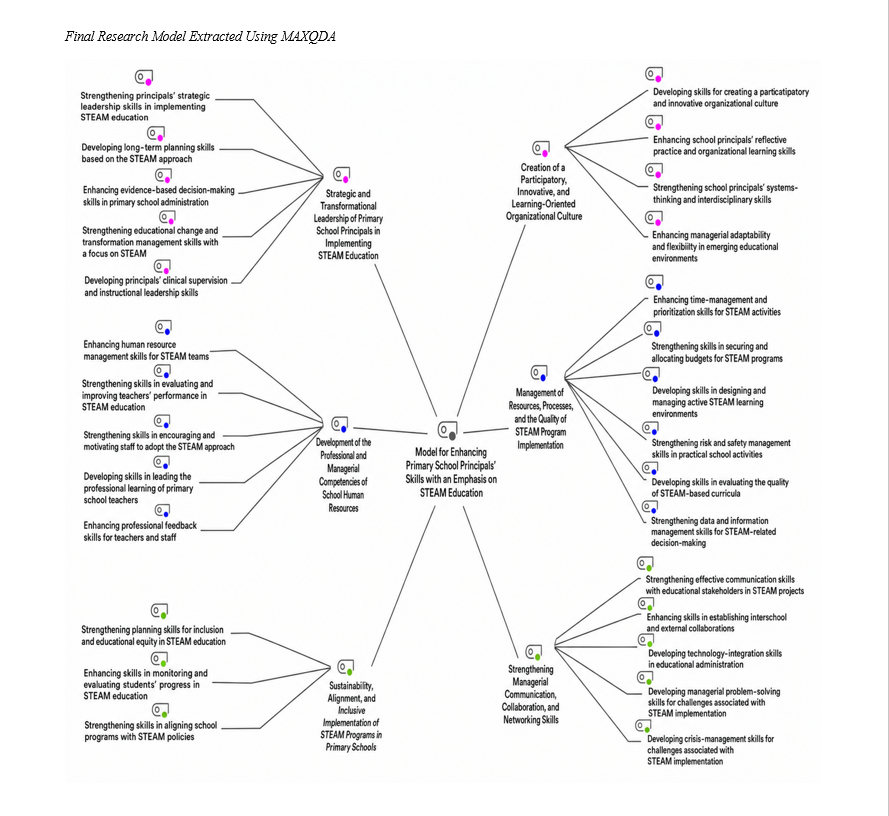
Findings: The thematic network analysis identified 155 initial codes, which were classified into 28 organizing themes and six global themes. The six principal dimensions of the proposed model were strategic and transformational leadership of primary school principals in implementing STEAM education; development of the professional and managerial competencies of school human resources; establishment of a participatory, innovative, and learning-oriented organizational culture; management of resources, processes, and the quality of STEAM program implementation; enhancement of managerial communication, collaboration, and networking skills; and sustainability, alignment, institutionalization, and inclusive implementation of STEAM programs in primary schools. These interconnected dimensions constituted the main structural components of the proposed skill-enhancement model.
Conclusion: The proposed model indicates that successful STEAM implementation requires primary school principals to possess integrated leadership, professional, communicative, organizational, and resource-management competencies.
Downloads
References
Abtahi, M. S., & Fathali Beigi, P. (2024). Investigating the Effect of STEAM-Based Educational Methods on Learning Programming through Scratch Software. Educational Research Quarterly(81), 156-170.
Ahmadi, S., Ezzatnia, F., Ahmadi, Z., & Esfandiari, M. (2023). The Correlation between Teachers' Work Engagement and Professional Performance with the Mediating Role of Their Communication Skills in Schools of Farashband County. New Ideas in Educational Research, 2(1), 68-87.
Akrami, F., Ahmadi, P., & Samadi, P. (2026). Teaching-Learning Strategies in Integrated STEAM Education: A Research Synthesis Study. Interdisciplinary Studies in Education, 5(1), 28-48.
Badreh, M., & Savaedi, A. (2024). Teaching with the STEAM Approach. Strategic Research in Teaching and Education(31), 273-286.
Darini, V. M., & Vafaei Yeganeh, M. (2024). Presenting a Model for Developing Educational Managers' Skills in the Era of the Fourth Industrial Revolution. Research in Educational Systems(66), 43-55.
Eskandari, M., Hosseinikhaah, A., & Zarghami Hamrah, S. (2024). Developing an Optimal Model of Education in Primary School Based on the Integrated STEAM Approach. Qualitative Research in Curriculum Planning(16), 85-111.
Gbebel, C., Halpin, K., & Carton, J. (2023). The Digitalisation of Finance Management Skills in Dementia since the COVID-19 Pandemic: A Qualitative Study. SAGE Journals, 2, 45-67. https://doi.org/10.1177/14713012231159156
Ghouti, M. H., & Sadoughi, M. (2025). The Role of STEAM-Based School Education in Reviving Skill-Based Commercial Capacities in Tourism Areas. Excellence in Education and Training(11), 1-18.
Manti, P., Safari, F., Rahimi, S., & Mansouri, F. (2023). The Effect of Primary School Principals' Skills on Performance Quality. New Research Approaches in Management and Accounting, 1(3), 76-84.
Nguyen, M., Ha, T., Mai, H., Vu, K., & Nguyen, M. (2025). Factors Affecting Preschool Teachers' Implementation of STEAM Activities: A Quantitative Study in Vietnam. Social Sciences & Humanities Open, 2, 55-76. https://doi.org/10.1016/j.ssaho.2024.101227
Pacheco, P. O., & Coello-Montecel, D. (2023). Does Psychological Empowerment Mediate the Relationship between Digital Competencies and Job Performance? Computers in human Behavior, 140, 107575. https://doi.org/10.1016/j.chb.2022.107575
Pourjamshidi, M., & Mozaffari, O. (2024). Application of Artificial Intelligence Technologies in the STEAM Curriculum. Educational Planning Studies(26), 37-56.
Ragique, U., Ashraf, E., & Anwar, Z. (2025). Learning Models for Enhancing Farmers' Water Management Skills in Rural Areas of Sargodha, Pakistan. Ciência Rural, 2, 102-129. https://doi.org/10.1590/0103-8478cr20230605
Rahmati Nejad, R. (2025). Comparison of STEM and STEAM Teaching Methods in Increasing Creativity and Problem Solving among Students. Journal of Psychological and Educational Sciences Studies(103), 249-265.
Shahbazi Dastjerdeh, B., Abedini, Y., Arizi, H., & Liaghatdar, M. J. (2024). A Comparative Study of the STEAM Curriculum in Selected Countries: A Step toward Practice. Management and Planning in Educational Systems(35), 11-30.
Shee, K., Nayak, B., Souza, S., & Siva, N. (2025). Emotional Intelligence and Parent-Child Relationship among Indian Adolescents: A Cross-Sectional Study. Journal of Pediatric Nursing, 2, 503-510. https://doi.org/10.1016/j.pedn.2025.08.018
Singh, S., & Bala, R. (2023). Employability Skills of Management Students: A Study of Teacher's Viewpoint. Materials Today, 80, 55-69. https://doi.org/10.1016/j.matpr.2021.05.473
Undiadi, U., & Muhammad, M. (2025). The Relationship between School Principals' Managerial Skills and Teacher Performance Quality. Jurnal Ilmiah Profesi Pendidikan, 10(1), 483-491. https://doi.org/10.29303/jipp.v10i1.2956
Viseu, F., Goncalves, S., & Martings, P. (2025). The Interconnection of STEAM Areas in the Study of Functions. International Journal of Educational Research Open, 9, 102-199. https://doi.org/10.1016/j.ijedro.2025.100537
Downloads
Additional Files
Publication Timeline
- Submitted
- Revised
- Accepted