Exploring the Causal, Contextual, and Intervening Conditions of Organizational Anxiety in Iranian State-Owned Banks and Its Consequences for Job Burnout and Employee Silence
Keywords:
Organizational Anxiety, Job Burnout, Defensive Silence, State-Owned Banks, Grounded Theory, Structural Equation ModelingAbstract
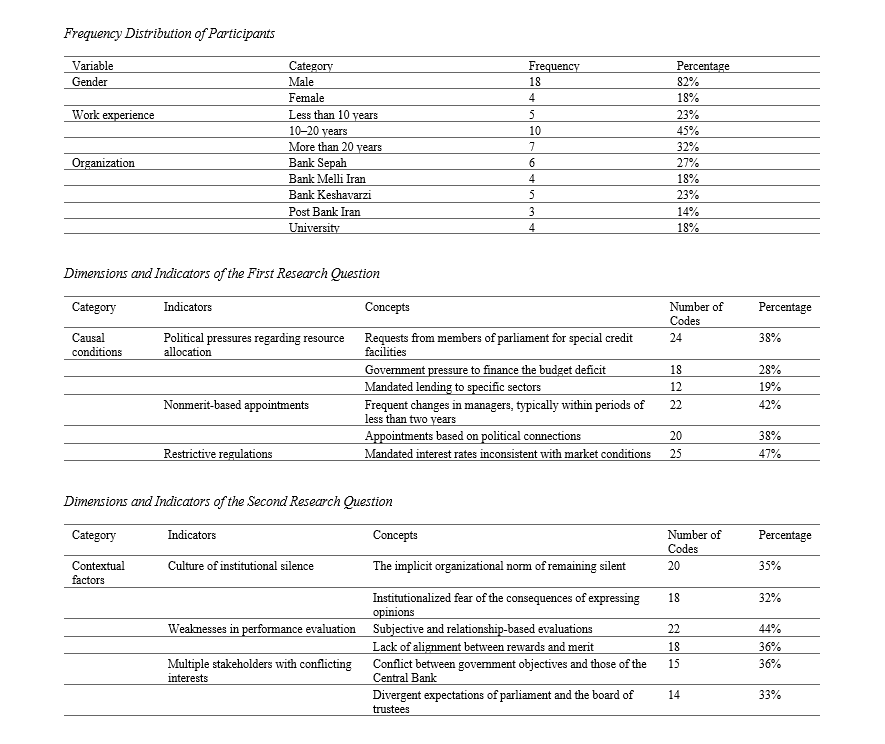
Objective: This study aimed to explore the causal, contextual, and intervening conditions shaping organizational anxiety in Iranian state-owned banks and to examine its consequences for employee job burnout and organizational silence.
Methods and Materials: The study employed an exploratory mixed-methods design informed by the grounded theory approach of Strauss and Corbin. In the qualitative phase, data were collected through semi-structured interviews with knowledgeable experts and banking professionals and were analyzed through open, axial, and selective coding to identify the components of the paradigmatic model. The reliability of the qualitative coding was assessed through interview reliability procedures. In the quantitative phase, a questionnaire derived from the qualitative findings was administered to employees of Iranian state-owned banks. Instrument validity was evaluated using quantitative content validity indices, while internal consistency was assessed using Cronbach’s alpha. The normality of the data was examined using the Kolmogorov–Smirnov test. The proposed structural model was subsequently tested through partial least squares structural equation modeling using PLS software, while SPSS was used for preliminary statistical analyses.
Findings: The inferential findings supported the proposed paradigmatic model and indicated that organizational anxiety in state-owned banks is a multidimensional phenomenon influenced by interacting structural, managerial, political, economic, and occupational pressures. Causal conditions significantly contributed to the emergence of organizational anxiety, whereas contextual and intervening conditions strengthened or weakened the effects of these pressures. Organizational anxiety exerted significant positive effects on job burnout and employee silence. The model further indicated that employees exposed to persistent organizational anxiety were more likely to experience emotional exhaustion, reduced occupational effectiveness, defensive withdrawal, reluctance to express concerns, and avoidance of participation in organizational decision-making. Overall, the structural model demonstrated acceptable explanatory and predictive validity.
Conclusion: Organizational anxiety in Iranian state-owned banks should be understood as a systemic organizational condition rather than merely an individual psychological response. Its development is embedded in governance structures, environmental uncertainty, managerial practices, and workplace relationships, and it can generate serious consequences for employee well-being and organizational communication. Redesigning governance mechanisms, reducing political and administrative pressures, strengthening managerial support, improving procedural transparency, and establishing safe channels for employee voice may reduce organizational anxiety, job burnout, and defensive silence.
Downloads
References
Abbaspour, J., Hakkak, M., Vahdati, H., & Nazaripour, O. (2024). Presenting a Model of Defensive Silence Formation among Employees in State-Owned Banks: An Analysis of Antecedent and Consequent Elements Using Fuzzy Cognitive Mapping. Management Research in Iran, 28(4), 1-32.
Aftab, S., Saleem, I., & Abu Mansor, N. N. (2024). How and When Does Witnessing Incivility Lead to Psychological Distress in Family-Owned Bank Employees? Asia-Pacific Journal of Business Administration. https://doi.org/10.1108/APJBA-06-2023-0279
Alipour, M., & Rezaei, N. (2021). Job Burnout and Turnover Intention in State-Owned Banks: The Mediating Role of Organizational Silence. Human Resource Management in the Banking Industry, 8(29), 33-58.
Alvani, S. M. (2020). Public Administration (7th ed.). Ney Publishing.
Baghernajad, S., Iranzadeh, S., & Bagherzadeh Khajeh, M. (2023). Designing and Analyzing an Organizational Resilience Model in the Banking Industry: A Case Study of Bank Melli Iran. International Quarterly of New Political Economy, 4(1), 155-184.
Bahramzadeh, H., & Jalaei, H. (2026). Conceptual Development of the Consequences of the Anxious Organization in Iran's State Banking System. International Conference on Management, Social Sciences, and Economics, Tehran.
Biran, H., & Biran, I. (2020). We Can't Help Feeding the Monster: The Social Handling of Uncertainty in an Environment of High Risk and Fast-Paced Change. Organisational and Social Dynamics, 20(1), 65-87. https://doi.org/10.33212/osd.v20n1.2020.79
Hosseini, S. H., & Tadbiri, S. (2023). Designing an Organizational Resilience Model for State-Owned Banks with Emphasis on a Grounded Theory Approach. Public Administration, 14(4), 521-548.
Nazaripour, O., Hakkak, M., Vahdati, H., & Abbaspour, J. (2026). Examining the Effect of Vigilant Silence on the Formation of Defensive Silence with Emphasis on the Mediating Roles of Perceived Job Insecurity and Employee Self-Censorship in State-Owned Banks of Tehran Province. Psychological Research in Management, 11(3), 33-63.
Robbins, S. P. (2020). Organizational Behavior (S. M. Alvani & G. Memarzadeh, Trans.; 18th ed.). Doran Publishing.
Sharifzadeh, F., Aslipour, H., & Shakiba, A. (2019). The Mediating Role of Organizational Silence in the Effect of Job Burnout on Organizational Decision-Making: A Study of Maskan Bank in Tehran Province. Human Resources Studies, 9(3), 103-127.
Yazdi, M., Abdollahi, B., & Daneshfar, K. (2023). Designing an Organizational Fear Management Model for Employees in Financial Organizations. Human Resources Studies, 13(2), 107-130.
Downloads
Additional Files
Publication Timeline
- Submitted
- Revised
- Accepted