The Relationship Between Leadership Style and Organizational Commitment Among Employees of the Iraqi Ministry of Sport: The Mediating Role of Organizational Justice
Keywords:
Leadership Style, Organizational Commitment, Organizational Justice, Transformational Leadership, Transactional Leadership, Iraqi Ministry of SportAbstract
Objective: This study aimed to examine the relationship between leadership style and organizational commitment among employees of the Iraqi Ministry of Sport, with organizational justice considered as a mediating variable.
Methods and Materials: This applied, quantitative, descriptive-correlational study was conducted among 300 employees of the Iraqi Ministry of Sport. Data were collected using standardized questionnaires assessing leadership style, organizational justice, and organizational commitment. Leadership style was measured through transformational, transactional, and laissez-faire dimensions, organizational justice through distributive, procedural, and interactional dimensions, and organizational commitment through affective, continuance, and normative dimensions. Data were analyzed using SPSS for preliminary analyses and SmartPLS for partial least squares structural equation modeling. The measurement model was evaluated using factor loadings, average variance extracted, composite reliability, and discriminant validity, while the structural model was assessed through path coefficients, bootstrapping with 5,000 resamples, coefficients of determination, SRMR, and NFI.
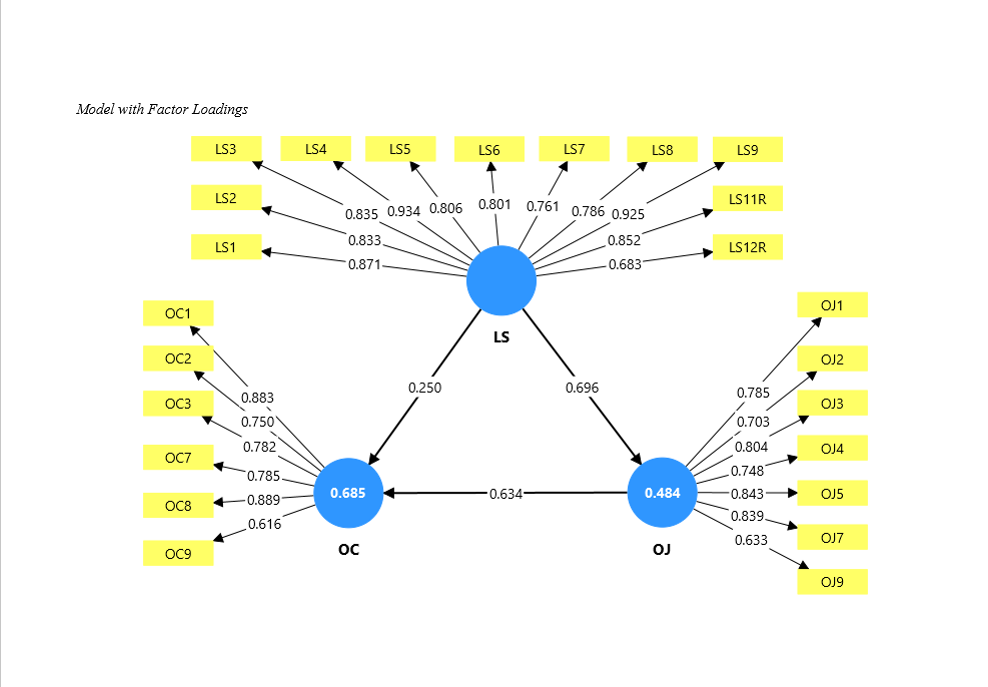
Findings: Leadership style had a significant effect on organizational justice (p < .001), and organizational justice had a significant effect on organizational commitment (p = .004). However, the direct effect of leadership style on organizational commitment was not statistically significant (p = .277). The model explained 48.4% of the variance in organizational justice and 68.5% of the variance in organizational commitment. The SRMR value was .082 and the NFI was .91, indicating acceptable overall model fit. The pattern of significant indirect relationships and nonsignificant direct effects supported the full mediating role of organizational justice in the relationship between leadership style and organizational commitment.
Conclusion: The findings indicate that leadership style contributes to employees’ organizational commitment primarily through its influence on perceptions of organizational justice, suggesting that fair procedures, equitable treatment, and respectful managerial interactions are essential mechanisms through which leadership can strengthen commitment among employees of the Iraqi Ministry of Sport.
Downloads
References
Amin, S., Shahnaz, M., & Mukminin, A. (2024). The Impacts of Servant Leadership on the Innovative Work Behaviors: Looking at the Role of Public Service Motivation and Employee Engagement. Journal of Chinese Human Resources Management, 15(2), 41-54. https://doi.org/10.47297/wspchrmWSP2040-800502.20241502
Cai, X., & Zhang, C. (2025). An Innovative Differentiated Creative Search Based on Collaborative Development and Population Evaluation. Biomimetics, 10(5), 260. https://doi.org/10.3390/biomimetics10050260
Chen, C., Wang, B., & An, H. (2024). Organizational Justice Perception and Employees’ Social Loafing in the Context of the COVID-19 Epidemic: The Mediating Role of Organizational Commitment. Humanities and Social Sciences Communications, 11, 176. https://doi.org/10.1057/s41599-024-02612-6
Çivit, S., & Göncü-Köse, A. (2024). Relationships of Transformational and Paternalistic Leadership Styles with Follower Needs, Multidimensional Work Motivations, and Organizational Commitment: A Mediated Model. Psychological Reports. https://doi.org/10.1177/00332941241226905
Gao, H., Hsu, P., & Zhang, J. (2025). Pay Transparency and Inventor Productivity: Evidence from State-Level Pay Secrecy Laws. The RAND Journal of Economics. https://doi.org/10.1111/1756-2171.70005
Gavya, V., & Subashini, R. (2024). The Role of Leadership Styles in Fostering Organizational Commitment among Nurses. Sage Open, 14(2), 1-11. https://doi.org/10.1177/21582440241242531
Gazi, M. A. I., Masud, A. A., Alhebri, A., Amin, M. B., Islam, M. T., Hasan, M. M., Senathirajah, A. R. B. S., & Oláh, J. (2025). The Mediating Role of Organizational Commitment and Corporate Social Responsibility in the Relationship between Leadership Style and Job Performance: An Empirical Study. Acta Psychologica, 260, 105656. https://doi.org/10.1016/j.actpsy.2025.105656
Godbersen, H., Dudek, B., & Ruiz Fernández, S. (2024). The Relationship between Organizational Commitment, Commitment to Supervisor and Servant Leadership. Frontiers in Organizational Psychology, 2. https://doi.org/10.3389/forgp.2024.1353959
González-Cánovas, A., Trillo, A., Bretones, F. D., & Fernández-Millán, J. M. (2024). Trust in Leadership and Perceptions of Justice in Fostering Employee Commitment. Frontiers in psychology, 15. https://doi.org/10.3389/fpsyg.2024.1359581
Khan, I. U., Gan, G. G. G., Khan, M. T. I., & Saif, N. (2023). Role of Organizational Justice in Linking Leadership Styles and Academics’ Performance in Higher Education. Administrative Sciences, 13(4), 101. https://doi.org/10.3390/admsci13040101
Kim, Y., & Youn, C. (2024). A Study on the Effect of Organizational Justice on Organizational Commitment: The Mediation Effect of Flourish and Moderated Mediation Effect of Authentic Leadership. Industry Promotion Research, 9(4), 1-15. https://doi.org/10.21186/IPR.2024.9.4.001
Lee, C. C., Yeh, W. C., Yu, Z., & Lin, X. C. (2023). The Relationships between Leader Emotional Intelligence, Transformational Leadership, and Transactional Leadership and Job Performance: A Mediator Model of Trust. Heliyon, 9(8), e18007. https://doi.org/10.1016/j.heliyon.2023.e18007
Li, Y., Zhang, Y., & Liu, S. (2025). The Myths of Successful Expatriation: Does Higher Emotional Intelligence Lead to Better Cultural Intelligence? International Business Review, 34(5), 102464. https://doi.org/10.1016/j.ibusrev.2025.102464
Lo, Y. C., Lu, C., Chang, Y., & Wu, S. F. (2024). Examining the Influence of Organizational Commitment on Service Quality through the Lens of Job Involvement as a Mediator and Emotional Labor and Organizational Climate as Moderators. Heliyon, 10, e24130. https://doi.org/10.1016/j.heliyon.2024.e24130
Manshor, R., Ahmad, N. L., Samsudin, N., Kamaruzaman, K. N., & Sobry, S. C. (2024). The Impact of Transformational and Transactional Leadership on Organisational Commitment in Small and Medium Enterprises (SMEs). Information Management and Business Review, 16(3(S)), 740-752. https://doi.org/10.22610/IMBR.V16I3(I)S.4104
Morais, C., Queirós, F., Couto, S., & Gomes, A. R. (2024). Explaining Organizational Commitment and Job Satisfaction: The Role of Leadership and Seniority. Humanities and Social Sciences Communications, 11. https://doi.org/10.1057/s41599-024-03855-z
Nanjundeswaraswamy, T. S., Bharath, S., & Nagesh, P. (2025). Leadership Dynamics: Unveiling the Nexus amid Employee Commitment and Leadership Styles. Journal of Management Development, 44(2), 279-307. https://doi.org/10.1108/JMD-08-2024-0260
Oyewobi, L. O. (2024). Leadership Styles and Employees Commitment: The Mediating Role of Job Satisfaction. Journal of Facilities Management, 22(5), 737-757. https://doi.org/10.1108/JFM-06-2022-0069
Sahar, N. E., Zawawi, D., Jaharuddin, N. S., & Abbasi, M. A. (2025). Responsible Leadership and Organisational Citizenship Behaviour for the Environment: Mediated by Environmental Corporate Social Responsibility. International Journal of Ethics and Systems, 41(2), 353-371.
Salajegheh, A., & Bostan Pira, M. (2025). Examining the Relationship between Components of Organizational Commitment and Happiness in the Performance of Employees of the Kerman Provincial Physical Education Department. Personal Development and Organizational Transformation, 3(1), 1-12. https://doi.org/10.61838/kman.jpdot.3.1.4
Susanto, O. W. N., Riyadi, S., & Halik, A. H. (2023). The Influence of Transformational and Transactional Leadership on Employee Performance with Discipline and Integrity as Intervening Variables at Telkom Group South Surabaya. International Journal of Social Science and Human Research, 06(01). https://doi.org/10.47191/ijsshr/v6-i1-74
Yang, X., Chen, J., Li, D., & Li, R. (2024). Functional-Coefficient Quantile Regression for Panel Data with Latent Group Structure. Journal of Business & Economic Statistics, 42(3), 1026-1040. https://doi.org/10.1080/07350015.2023.2277172
Yongsheng, X., & Yingquan, L. (2025). Global Sustainable Supply Chain Governance, Effectiveness of Social Responsibility, and Performance in Emergent Markets: An Exploratory Multiple Case Study. RAE - Revista de Administração de Empresas, 65(6), e2024-e2587. https://doi.org/10.1590/S0034-759020250602
Downloads
Additional Files
Publication Timeline
- Submitted
- Revised
- Accepted