Validation of a Crisis Management Training Model Based on Reducing Air Traffic Control Challenges in Iran
Keywords:
Crisis Management Training; Air Traffic Control; Operational Preparedness; Crisis Response; Structural Equation Modeling; Aviation Safety; IranAbstract
Objective: This study aimed to validate a crisis management training model developed to reduce air traffic control challenges in Iran.
Methods and Materials: This applied quantitative study employed a descriptive-survey design. The statistical population comprised 430 air traffic control personnel, including employees of Mehrabad Airport Control Tower, Tehran Approach Control Unit, and the national Area Control Center. Using Cochran’s formula and stratified random sampling, 203 participants were selected. Data were collected using a researcher-made questionnaire developed from findings of the preceding qualitative phase. Face, content, and construct validity were assessed, while reliability was examined using Cronbach’s alpha. Average variance extracted, composite reliability, maximum shared variance, and average shared variance were also evaluated. Data were analyzed using SPSS and AMOS through confirmatory factor analysis and structural equation modeling.
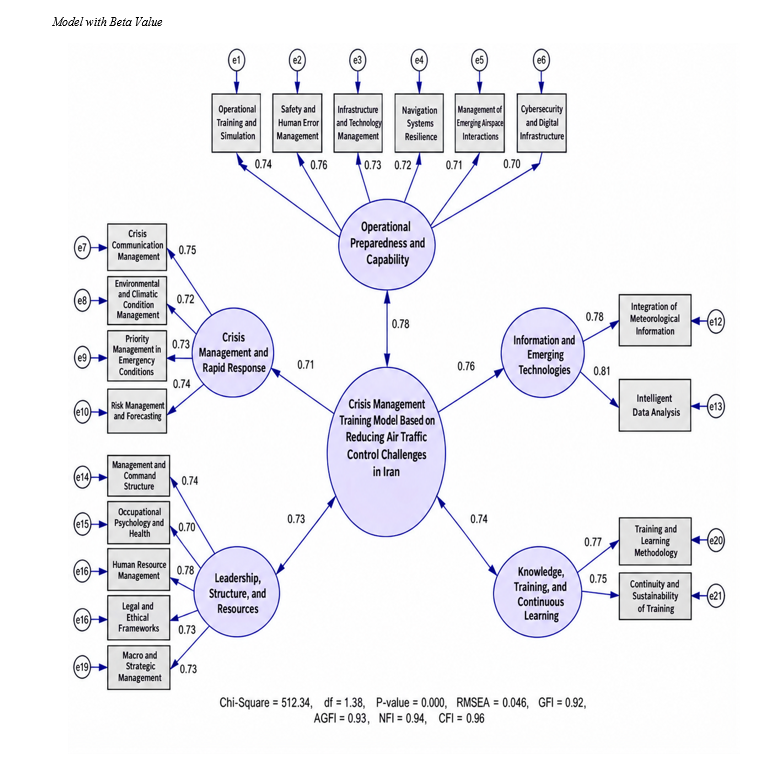
Findings: The Kaiser–Meyer–Olkin coefficient was 0.892, and Bartlett’s test of sphericity was significant (χ² = 636789.058, df = 203, p = .001), confirming suitability for factor analysis. All standardized component loadings were significant and ranged from 0.70 to 0.81, while the relationships between the main model and its five dimensions ranged from 0.71 to 0.78. The measurement model demonstrated satisfactory convergent and discriminant validity. Model fit indices indicated an acceptable fit to the data, with GFI = 0.92, AGFI = 0.93, CFI = 0.96, CMIN/df = 1.38, and RMSEA = 0.046. Thus, the five-dimensional structure comprising Operational Preparedness and Capability, Crisis Management and Rapid Response, Leadership, Structure, and Resources, Knowledge, Training, and Continuous Learning, and Information and Emerging Technologies was empirically supported.
Conclusion: The validated model provides a coherent and empirically supported framework for crisis management training in Iranian air traffic control and can guide the development of integrated training programs addressing operational, technological, organizational, human, and continuous-learning requirements.
Downloads
References
Björnqvist, A., Jonson, C. O., Prytz, E., Johansson, B. J. E., & Berggren, P. (2025). Assessing the Impact of Evaluations of Crisis Management Efforts. International Journal of Disaster Risk Reduction, 118(15), 1-12. https://doi.org/10.1016/j.ijdrr.2025.105226
Chen, X., Li, S., & Li, M. (2025). A Hybrid Centralized-Decentralized Traffic Control Framework for Unmanned Aerial Vehicles in Urban Low-Altitude Airspace. Communications in Transportation Research, 5(5), 100-195. https://doi.org/10.1016/j.commtr.2025.100195
Cook, D., Mayer, R., & Doy, G. (2024). Crises and the Resilience of the Aviation Industry: A Literature Review of Crises and Airline Responses. Transportation Research Procedia, 75(3), 33-42. https://doi.org/10.1016/j.trpro.2023.12.005
Gyles, D., & Bearman, C. (2025). Co-Constructing Safety: How Air Traffic Controllers Change Goals from Efficiency to Safety. Cognition, Technology & Work, 27, 449-465. https://doi.org/10.1007/s10111-025-00805-w
Ignjatović, D., Karagiannis, V., Chettakattu, A., Havlik, D., & Neubauer, G. (2024). Crisis Management in the Era of the IoT, Edge Computing, and LLMs. Malmo.
Kabra, G., Ghosh, V., & Mukherjee, R. (2024). Discovering Latent Topics and Trends in Digital Technologies and Disaster Management Research: A Structural Topic Modeling Approach. Engineering Management Journal, 1-17. https://doi.org/10.1080/10429247.2024.2345526
Kale, U., Jankovics, I., Nagy, A., & Rohács, D. (2021). Towards Sustainability in Air Traffic Management. Sustainability, 13, 5451. https://doi.org/10.3390/su13105451
Moharekpour, N., Habibpour, V., & Shamsi, D. (2022). Examining Factors Affecting the Development of Crisis Management Mechanisms in Hospitals in Arak. Journal of Arak University of Medical Sciences, 25(2), 324-377.
Mousavi, K., Valizadeh, R., & Ahmadzad, H. (2024). Analysis of Factors Affecting the Realization of Crisis Management at the Local Scale: A Case Study of Tabriz Metropolis. Urban Structure and Function Studies, 11(38), 244-266.
Raziq, O., Khaili, M. E., Nhaila, H., & Khiat, A. (2025). Improving Air Traffic Control by Combining Centralized and Decentralized Solutions. Edelweiss Applied Science and Technology, 9(8), 1122-1138.
Renkhoff, J., Ternus, S., & Guleria, Y. (2025). A Survey on Personalized Conflict Resolution Approaches in Air Traffic Control. Aerospace, 12, 751. https://doi.org/10.3390/aerospace12090751
Shirini, M., Ahmadzadeh, H., & Panahi, A. (2026). Explaining the Role and Position of Integrated Urban Management in Crisis Management with a Passive Defense Approach in the Karaj Metropolis. Urban Economics and Planning, 7(1), 86-103.
Taylor, F. (2026). Crisis Management for Airports and Airlines. (Vol. 27, pp. 1619-2400).
Wu, F. (2024). Mixed Integer Programming Algorithm in the Optimization of Air Traffic Control Flight Scheduling.
Zhao, T., Macias, J. E., Zhang, M., Fu, S., Feng, Y., Elhajj, M., Majumdar, A., Angeloudis, P., & Ochieng, W. Y. (2024). Enhancing Air Traffic Operational Efficiency by Reducing Network Scale. Aerospace Traffic and Safety, 1(1), 10-19. https://doi.org/10.1016/j.aets.2024.06.001
Downloads
Additional Files
Publication Timeline
- Submitted
- Revised
- Accepted