The Effect of Digital Literacy on Perceived Interactivity in Learner–Artificial Intelligence Interaction: The Moderating Role of Digital Stress
Keywords:
digital literacy, perceived interactivity in learner–artificial intelligence interaction, digital stressAbstract
Objective: This study aimed to investigate the effect of digital literacy on perceived interactivity in learner–artificial intelligence interaction and to examine the moderating role of digital stress among elementary school teachers.
Methods and Materials: This applied study employed a descriptive-survey design. The statistical population consisted of all elementary school teachers employed by the Department of Education in Rudsar during the 2025–2026 academic year. Based on the Krejcie and Morgan sample size table, 234 teachers were selected using stratified random sampling. Data were collected using the standardized questionnaire developed by Ren et al. (2025), comprising perceived interactivity in learner–AI interaction, digital literacy, and digital stress constructs. The instrument was scored on a five-point Likert scale. Content validity was confirmed by experts, while Cronbach’s alpha, composite reliability, and average variance extracted supported the reliability and convergent validity of the measurement model. Data were analyzed using SPSS and SmartPLS. The Kolmogorov–Smirnov test was used to assess normality, and partial least squares structural equation modeling was applied to test the research hypotheses and moderation effect.
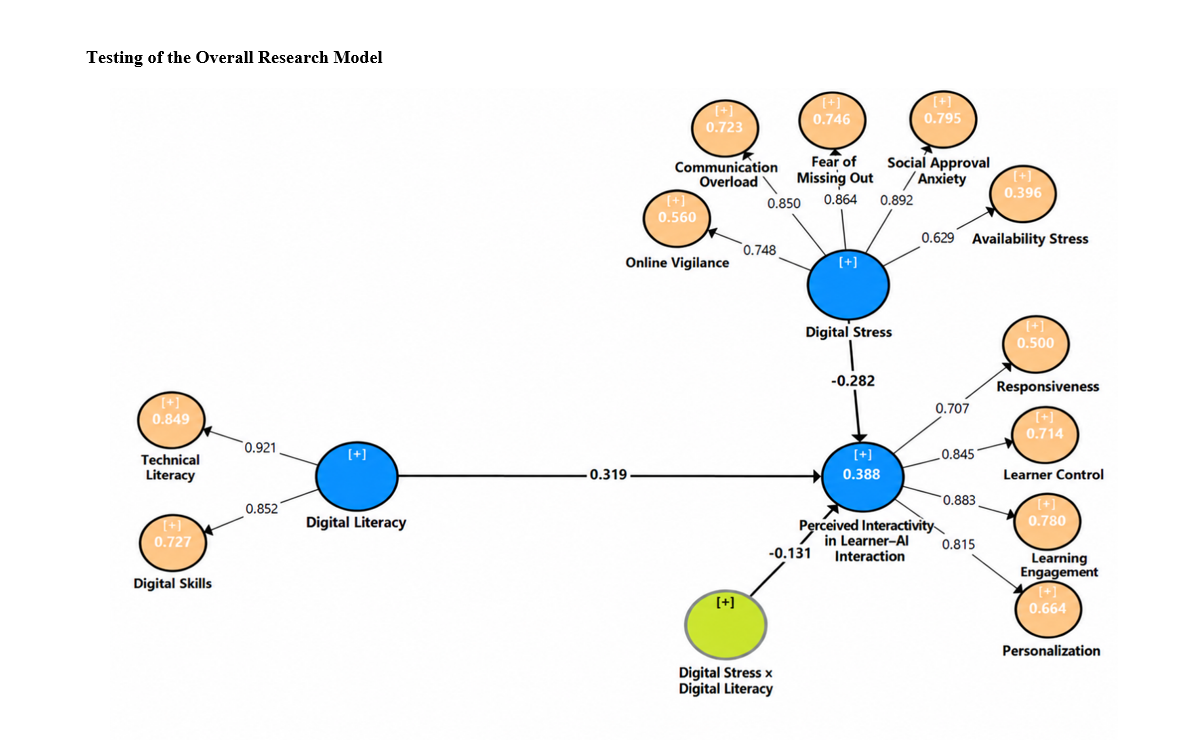
Findings: Digital literacy had a positive and statistically significant effect on perceived interactivity in learner–AI interaction (β = 0.319, t = 5.135, p < .05). In addition, the interaction effect of digital stress and digital literacy on perceived interactivity was negative and statistically significant (β = −0.131, t = 2.660, p < .05), confirming the moderating role of digital stress. The model explained 38.8% of the variance in perceived interactivity (R² = 0.388), and the Q² value of 0.237 indicated satisfactory predictive relevance.
Conclusion: Higher digital literacy enhances teachers’ perceived interactivity with AI by improving their ability to experience AI-supported learning as more responsive, controllable, engaging, and personalized; however, elevated digital stress weakens this positive effect.
Downloads
References
Bhullar, P. S., Joshi, M., & Chugh, R. (2024). ChatGPT in higher education-a synthesis of the literature and a future research agenda. Education and Information Technologies, 29, 21501-21522. https://doi.org/10.1007/s10639-024-12723-x
Hajizadeh, A., Hassani, M., & Shirbagi, N. (2025). Artificial intelligence, digital literacy, and academic entrepreneurship: Examining the roles of self-efficacy and social support. Iranian Journal of Engineering Education, 28(107), 1-15.
Haroud, S., & Saqri, N. (2025). Generative AI in higher education: Teachers' and students' perspectives on support, replacement, and digital literacy. Education Sciences, 15, 396. https://doi.org/10.3390/educsci15040396
Hosseini, N. (2025). Explaining the role of artificial intelligence literacy in strengthening student teachers' higher-order thinking skills through the mediation of behavioral engagement and peer interaction. Technology and Scholarship in Education, 5(2), 55-75.
Ipinnaiye, O., & Risquez, A. (2024). Exploring adaptive learning, learner-content interaction and student performance in undergraduate economics classes. Computers & Education, 215, 105047. https://doi.org/10.1016/j.compedu.2024.105047
Kasneci, E., Sessler, K., Küchemann, S., Bannert, M., Dementieva, D., & Fischer, F. (2023). ChatGPT for Good? On Opportunities and Challenges of Large Language Models for Education. Learning and Individual Differences, 103, 102274. https://doi.org/10.1016/j.lindif.2023.102274
Khadivi, A., Parvinzadeh, M., & Arefnejad, S. (2025). The mediating role of digital skills in the relationship between artificial intelligence literacy and the quality of educational services: A case study of Farhangian University. Scholarship Studies, 4(3), 1-16.
Kim, B. J., & Lee, J. (2024). The mental health implications of artificial intelligence adoption: The crucial role of self-efficacy. Humanities and Social Sciences Communications, 11, 1561. https://doi.org/10.1057/s41599-024-04018-w
Rahmanzadeh, E., Soheili, F., Arezi, S., & Ahmadi Garousi, A. (2024). The effect of media use on teachers' health literacy: The mediating role of self-efficacy. Digital and Smart Libraries Research, 11(3), 1-16.
Ren, J., Guo, J., & Li, H. (2025). Linking digital competence, self-efficacy, and digital stress to perceived interactivity in AI-supported learning contexts. Scientific reports, 15(1), 33182. https://doi.org/10.1038/s41598-025-18873-3
Shao, Z., & Chen, K. (2021). Understanding individuals' engagement and continuance intention of MOOCs: The effect of interactivity and the role of gender. Internet Research, 31, 1262-1289. https://doi.org/10.1108/INTR-10-2019-0416
Wang, K. Y., Chih, W. H., & Hsu, L. C. (2020). Building brand community relationships on Facebook fan pages: The role of perceived interactivity. International Journal of Electronic Commerce, 24, 211-231. https://doi.org/10.1080/10864415.2020.1715532
Yaseen, H., Mohammad, A. S., Ashal, N., Abusaimeh, H., Ali, A., & Sharabati, A. A. A. (2025). The Impact of Adaptive Learning Technologies, Personalized Feedback, and Interactive AI Tools on Student Engagement: The Moderating Role of Digital Literacy. Sustainability, 17(3), 1133. https://doi.org/10.3390/su17031133
Zhan, Y., Luo, L., & Hu, X. (2025). Digital stress and problematic social media use among college students: Exploring dual emotional pathways and the moderating role of cognitive reappraisal. BMC psychology, 13, 1311. https://doi.org/10.1186/s40359-025-03675-z
Downloads
Additional Files
Publication Timeline
- Submitted
- Revised
- Accepted