Digital Transformation and Changes in Corporate Governance Structures: A Qualitative Study of Leading Companies Listed on the Tehran Stock Exchange
Keywords:
Digital transformation; Corporate governance; Tehran Stock Exchange; Organizational structure; Information transparency; Leading companies.Abstract
Objective: This study aimed to explore and explain how digital transformation changes corporate governance structures, decision-making processes, monitoring mechanisms, accountability relationships, and governance capabilities in leading companies listed on the Tehran Stock Exchange.
Methods and Materials: This study employed an exploratory qualitative design. Participants consisted of 20 senior managers, board members, digital transformation and information technology managers, internal audit and risk-management executives, and financial and strategic management specialists from leading companies listed on the Tehran Stock Exchange. Participants were selected through purposive criterion-based sampling, and sampling continued until theoretical saturation was achieved. Data were collected through in-depth semi-structured interviews lasting approximately 45 to 70 minutes. Interviews were audio-recorded, transcribed verbatim, and analyzed using thematic analysis with the assistance of MAXQDA software. The analytical process included open coding, axial coding, selective integration, constant comparison, and the development of overarching themes. Credibility, dependability, confirmability, and transferability were strengthened through iterative analysis, member checking, documentation of coding decisions, and comparison of interpretations with the original transcripts.
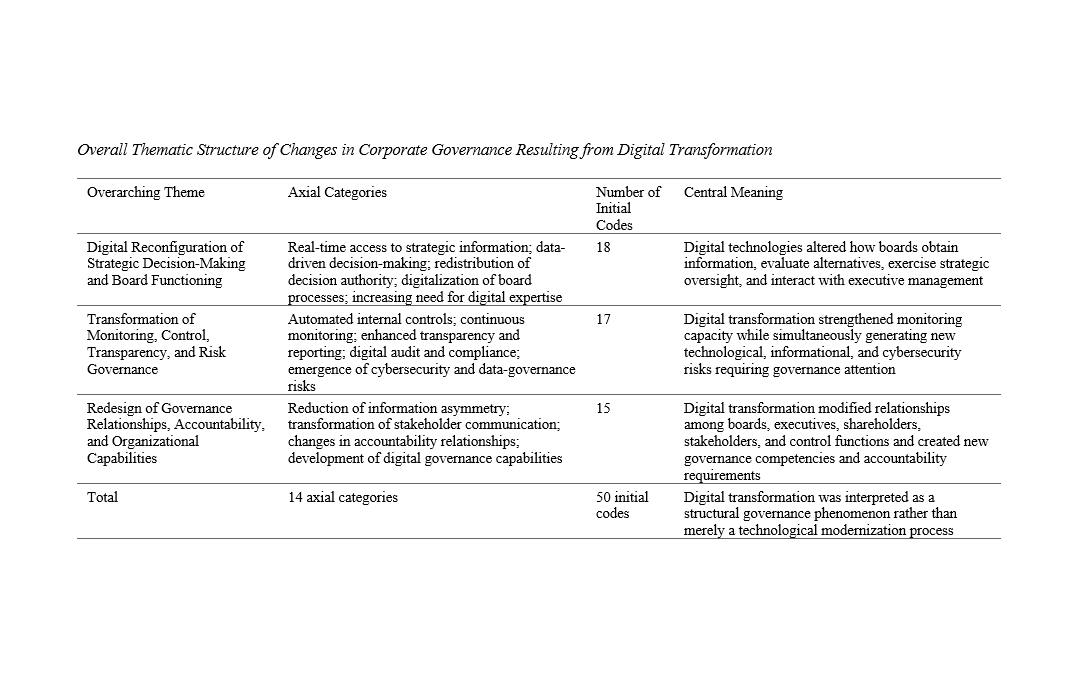
Findings: Analysis of the interviews generated 50 initial conceptual codes, which were consolidated into 14 axial categories and three overarching themes. The first theme, digital reconfiguration of strategic decision-making and board functioning, included real-time access to strategic information, data-driven decision-making, redistribution of decision authority, digitalization of board processes, and increasing demand for digital expertise. The second theme, transformation of monitoring, control, transparency, and risk governance, included automated internal controls, continuous monitoring, enhanced transparency, digital audit and compliance, and cybersecurity and data-governance risks. The third theme, redesign of governance relationships, accountability, and organizational capabilities, included reduced information asymmetry, transformation of stakeholder communication, changes in accountability relationships, and development of digital governance capabilities. Overall, the findings showed that digital transformation altered the distribution of information, authority, control, expertise, and responsibility within corporate governance systems.
Conclusion: Digital transformation should be understood as a governance transformation rather than merely a technological modernization process, because it simultaneously reshapes board functioning, strategic decision-making, monitoring, accountability, risk oversight, and governance competencies. Effective outcomes therefore depend on aligning technological adoption with board-level digital literacy, data governance, internal controls, cybersecurity oversight, and interdisciplinary governance capabilities.
Downloads
References
Ardhaoui, R., & Amar, A. B. (2026). Corporate Environmental Disclosure and Tax Avoidance? Does National Culture Matter? International Evidence. International Journal of Disclosure and Governance, 1-21.
Aslani, M., Ataei, M., Gholamzadeh, D., & Mohtashami, A. (2026). Effective Implementation of Corporate Governance: The Role of Committees and Member Competencies. Management Accounting and Auditing Knowledge, 14(55), 231-247.
Avinash, K., & Mahesh, R. (2026). Corporate Governance, Transparency, and Information Asymmetry: Evidence from Emerging Capital Markets. Journal of Emerging Market Finance, 25(1), 78-104.
Ben Ali, A. (2026). Does Audit Quality Moderate the Integrated Reporting Quality-Corporate Tax Avoidance Practices Relationship? A Cross-Country Analysis. Corporate Governance: The International Journal of Business in Society, 1-23. https://doi.org/10.1108/CG-11-2023-0488
Claassen, R. (2026). Corporate Purpose and Democratic Theory: A Governance Trilemma. Journal of Business Ethics, 205(1), 159-175. https://doi.org/10.1007/s10551-025-06127-1
Ding, M., Bai, Y., & Wang, C. (2026). Governance of corporate misconduct through employee whistleblowing: A tripartite evolutionary game analysis. BMC psychology, 14, 722. https://doi.org/10.1186/s40359-026-04374-z
Ding, T., & Yang, L. (2025). Intellectual property protection and corporate digital transformation: An empirical analysis from the perspectives of intellectual property protection and digital governance. International Review of Economics & Finance, 100, 104125. https://doi.org/10.1016/j.iref.2025.104125
Fahimnejad, Z., Gholamzadeh Ledari, M., Nikoomaram, H., & Talebnia, G. (2026). Evaluating the Effectiveness of Iran's Corporate Governance System Using a Grounded Theory Approach. Technology in Entrepreneurship and Strategic Management, 4(2), 5-28.
Farajzade-Zanjani, S., Nassirzadeh, F., & Askarany, D. (2026). Balancing Act: How Corporate Governance Shapes Investment Efficiency in Competitive Islamic Markets. Journal of Islamic Accounting and Business Research. https://doi.org/10.1108/JIABR-05-2025-0320
Iranbakhsh, R., Valian, H., Abdoli, M. R., & Shahri, M. (2026). Framing a Staggered Board Structure for Breaking Governance Entrenchment. Empirical Studies in Financial Accounting, 23(90), 105-144.
Morabit, M. E., Koleva, P., & Nejjar, L. (2026). Corporate Philanthropy as Institutional Co-Production: Domestic Firms, Soft Governance, and Morocco’s Regional Repositioning . https://doi.org/10.21203/rs.3.rs-9586962/v1
Siswanti, I., Riyadh, H. A., Nawangsari, L. C., Mohd Yusoff, Y., & Wibowo, M. W. (2024). The impact of digital transformation for sustainable business: The meditating role of corporate governance and financial performance. Cogent Bus. Manag., 11, 2316954. https://doi.org/10.1080/23311975.2024.2316954
Tan, Y. (2026). The Influence of Ownership Structure on Corporate Governance Mechanisms. Journal of Innovation and Development, 14(2), 554-563. https://doi.org/10.54097/62mn2f61
Van Hoang, T. H., Tran, T. T., & Vo, T. T. (2026). Corporate climate change and financial performance: The critical role of corporate governance. International Review of Economics & Finance, 112(3), 47-69. https://doi.org/10.1016/j.iref.2026.105872
Velte, P. (2026). Do CEO Characteristics Influence Corporate Carbon Disclosure and Performance? A Status Quo of Prior Studies and Research Recommendations. International Journal of Disclosure and Governance, 23(2), 145-168. https://doi.org/10.1057/s41310-026-00369-9
Wu, L., Wang, Q., Jin, H., & Li, D. (2026). How do digital entrants affect the digital transformation of incumbents? Differential effects of corporate governance factors. Information & Management, 63(1), 104269. https://doi.org/10.1016/j.im.2025.104269
Xu, J., Li, L., Liu, H., Hou, W., & Zhu, Q. (2026). Mitigating the Effects of CEO Overconfidence: A Group Information Processing Perspective. Corporate Governance: An International Review, 34(4), 897-921. https://doi.org/10.1111/corg.70044
Yang, Q., & Jin, S. (2024). Exploring the Impact of Digital Transformation on Manufacturing Environment, Social Responsibility, and Corporate Governance Performance: The Moderating Role of Top Management Teams. Sustainability, 16(11), 4342. https://doi.org/10.3390/su16114342
Zandi, A. (2025). The Effect of Corporate Digital Transformation on Firms' Stock Liquidity: The Role of Financing Constraints, Internal Control, and Information Disclosure. Accounting and Corporate Governance Research, 13, 121-141.
Downloads
Additional Files
Publication Timeline
- Submitted
- Revised
- Accepted