Designing a Contingency Model for Breaking Organizational Silence in Iranian Public Organizations
Keywords:
contingency model design, breaking organizational silence, grounded theory, Iranian public organizations.Abstract
Objective: The present study aimed to design a contingency model for breaking organizational silence in Iranian public organizations.
Methods and Materials: This study employed a qualitative research design grounded in the philosophical foundations of pragmatism. Initially, the researcher participated in various seminars and workshops held in public organizations and made observations that facilitated familiarity with the phenomenon of organizational silence in these organizations and with manifestations of unethical behavior. Subsequently, the interview questions were developed based on the research literature and the researcher’s observations. Thereafter, the study model was developed using grounded theory, specifically Glaser’s classical approach.
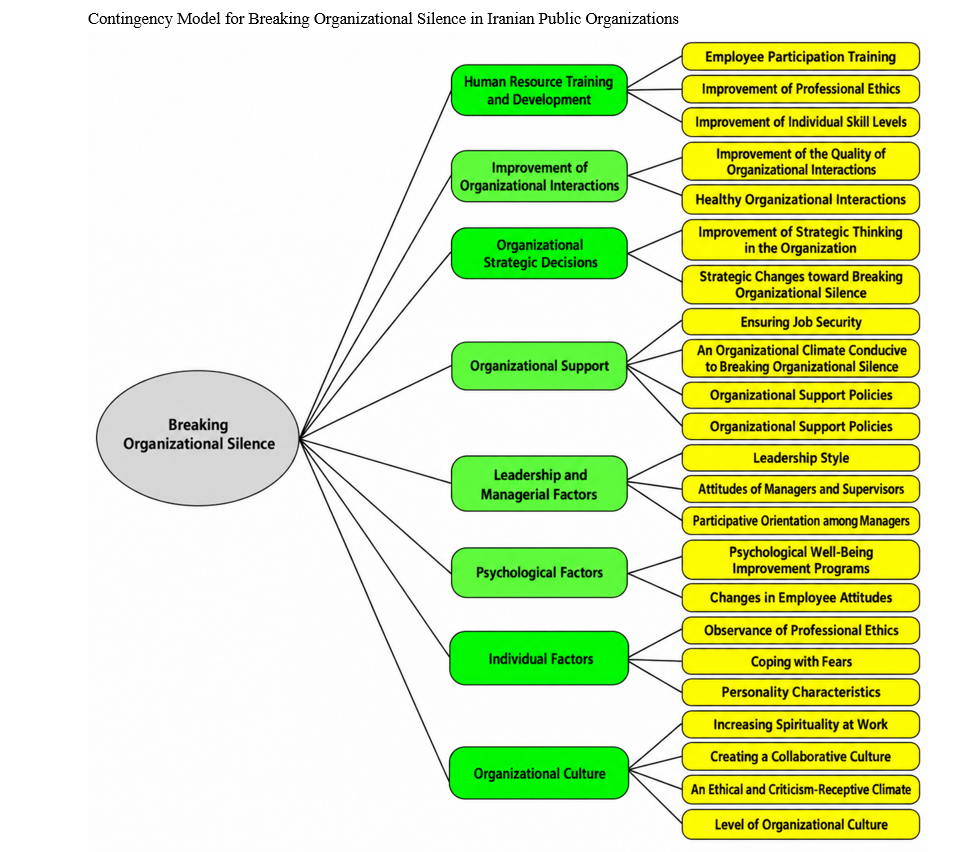
Findings: The findings yielded eight main categories for the model. The first category, “Human Resource Training and Development,” comprised three subcategories: “Employee Participation Training,” “Improvement of Professional Ethical Conduct,” and “Improvement of Individual Skill Levels.” The second category, “Improvement of Organizational Interactions,” included two subcategories: “Improvement of the Quality of Organizational Interactions” and “Healthiness of Organizational Interactions.” The third category, “Organizational Strategic Decisions,” consisted of two subcategories: “Improvement of Strategic Thinking in the Organization” and “Strategic Changes toward Breaking Organizational Silence.” The fourth category, “Organizational Support and Backing,” included four subcategories: “Ensuring Job Security,” “An Organizational Climate Conducive to Breaking Organizational Silence,” “Organizational Support Policies,” and “Job Motivational Factors.” The fifth category, “Leadership and Managerial Factors,” consisted of three subcategories: “Leadership Style,” “Attitudes of Managers and Supervisors,” and “Participative Orientation among Managers.” The sixth category, “Psychological and Mental Factors,” included two subcategories: “Psychological Well-Being Improvement Programs” and “Changes in Employee Attitudes.” The seventh category, “Individual Factors,” consisted of three subcategories: “Observance of Professional Ethics,” “Coping with Fears,” and “Personality Characteristics.” Finally, the eighth category, “Organizational Culture,” included four subcategories: “Increasing Spirituality at Work,” “Creating a Collaborative Culture,” “An Ethical and Criticism-Receptive Climate,” and “Level of Organizational Culture.”
Conclusion: The findings of the present study can assist managers and researchers in designing a contingency model for breaking organizational silence in Iranian public organizations and provide practical guidelines for overcoming organizational silence.
Downloads
References
Asselineau, A., Grolleau, G., & Mzoughi, N. (2024). Quiet environments and the intentional practice of silence: Toward a new perspective in the analysis of silence in organizations. Industrial and Organizational Psychology, 17(3), 326-340. https://doi.org/10.1017/iop.2024.9
Dehghani Far, S., & Seydi, K. (2024). Explaining the relationship between organizational conflict and procrastination considering the mediating role of organizational silence among staff employees of the General Department of Education of Ilam Province. Monthly Journal of New Advances in Psychology, 7(71).
Duarte, M., Conceição, O., & Pinto, S. O. C. (2024). What Does Employee Silence Mean? The Role of Organizational Climate and Burnout. Ecmlg, 20(1), 486-494. https://doi.org/10.34190/ecmlg.20.1.2913
Efthymiopoulos, A., Γούλα, Α., & Psychogios, A. (2024). Organizational Silence and Organizational Commitment: Empirical Evidence From the Greek Public Sector. Journal of Applied Social Science, 18(3), 346-363. https://doi.org/10.1177/19367244241263576
El‐Sayed, A. A. I., Ali, M. S. S., Abdel Razek, N. M. F., Abdelaliem, S. M. F., & Asal, M. G. R. (2024). The effect of organizational silence on the relationship between workplace ostracism and nurses' procrastination behavior: A structural equation modeling. International Nursing Review. https://doi.org/10.1111/inr.13050
Gelevardi, Z. Y., Anjomshoaa, Z., Salajeghe, S., Nazari, A., & Pourrashidi, R. (2024). The Phenomenology of Experiences of Managers and Deputies in Antecedents and Consequences of Organizational Silence (Case Study: Managers and Deputies of the Six District Offices of the Court of Accounts). International Journal of Innovation Management and Organizational Behavior (IJIMOB), 4(1), 73-81. https://doi.org/10.61838/kman.ijimob.4.1.9
Jian, Z., Zhu, X., Fu, X., Zong, X., Tang, J., Chi, C., & Jiang, J. (2025). The Experiences of Organizational Silence Among Nurses: A Qualitative Meta-Synthesis. BMC Nursing, 24(1). https://doi.org/10.1186/s12912-024-02636-y
Jing, S., Zeng, Y., Xu, T., Yin, Q., Ogbu, K. O., & Huang, J. (2024). Will career plateau lead to employee silence? A moderated mediation model. Nankai Business Review International, 15(1), 1-20. https://doi.org/10.1108/NBRI-04-2022-0036
Katıtaş, S. (2026). Unpacking the Effect of Organizational Silence on Teachers’ Turnover Intention: The Mediating Role of Work Alienation. Sage Open, 16(1). https://doi.org/10.1177/21582440251414812
Kettaf, R. (2024). Investigating the Impact of Organizational Climate on Organizational Silence in Higher Education Institutions. Socioeconomic Challenges, 8(1), 170-182. https://doi.org/10.61093/sec.8(1).170-182.2024
Khosravi, A., Khalili, K., & Mohammadi, E. (2024). Designing a Model for Breaking Defensive Silence of Creative Employees in Organizations. Quarterly Journal of Management and Education Outlook, 6(2), 68-93.
Kızrak, M., & Yeloğlu, H. O. (2024). How can prosocial silence be golden? The roles of commitment to learning and organizational support. The Learning Organization, 31(2), 250-267. https://doi.org/10.1108/TLO-03-2023-0040
Mehter Gharadaghi, V., Maleki, M. H., & Soltani, M. (2024). Designing a Model of Organizational Silence for Public Sector Employees Using a Systematic Literature Review and Meta-synthesis. Management, Education, and Development in the Digital Age, 1(4), 163-178. https://doi.org/10.61838/medda.1.4.11
Panagiotounis, F. (2026). The Sound of Silence: Examining the Mediating Roles of Management Support and Interpersonal Trust on Organizational Commitment in Greek Higher Education Institutions. https://doi.org/10.21203/rs.3.rs-8853984/v1
Panagiotounis, F., & Saiti, A. (2026). The Silent Path to Cynicism: Knowledge Donating and Collecting as Mediators Linking Organizational Silence to Cynicism in Higher Education. https://doi.org/10.21203/rs.3.rs-8854007/v1
Shirin, H., & Nazarzadeh, M. (2024). A Study of the Relationship between Organizational Bullying and Teacher Burnout through Organizational Silence. Applied Educational Leadership, 5(1), 81-97.
Sulphey, M. M., & Jasim, K. M. (2025). Perceived Anomie, Organizational Silence, Compulsory Organization Citizenship Behavior, and Workplace Alienation as Antecedents of Knowledge Hiding. Knowledge and Process Management, 32(4), 174-189. https://doi.org/10.1002/kpm.70001
Yazdani, F., Noori, H., & Khalaf, M. (2024). The relationship between organizational trust and organizational resilience with the perception of organizational silence among secondary school art teachers in Karbala. Educational Leadership Research, 8(29), 114-192. https://jrlat.atu.ac.ir/article_17265.html?lang=en
Downloads
Additional Files
Publication Timeline
- Submitted
- Revised
- Accepted