Examining the Effects of Quality and Psychological Dimensions on Industrial Customers’ Acceptance of Emerging Nanotechnology
Keywords:
nanotechnology, technology acceptance, quality dimensions, perceived risk, trust, industrial customers, structural equation modelingAbstract
Objective: This study examines the effects of Garvin’s eight dimensions of quality and two psychological dimensions—perceived risk and trust—on industrial customers’ acceptance of nanotechnology in an ethylene nano-adsorbent system used for fruit and vegetable preservation.
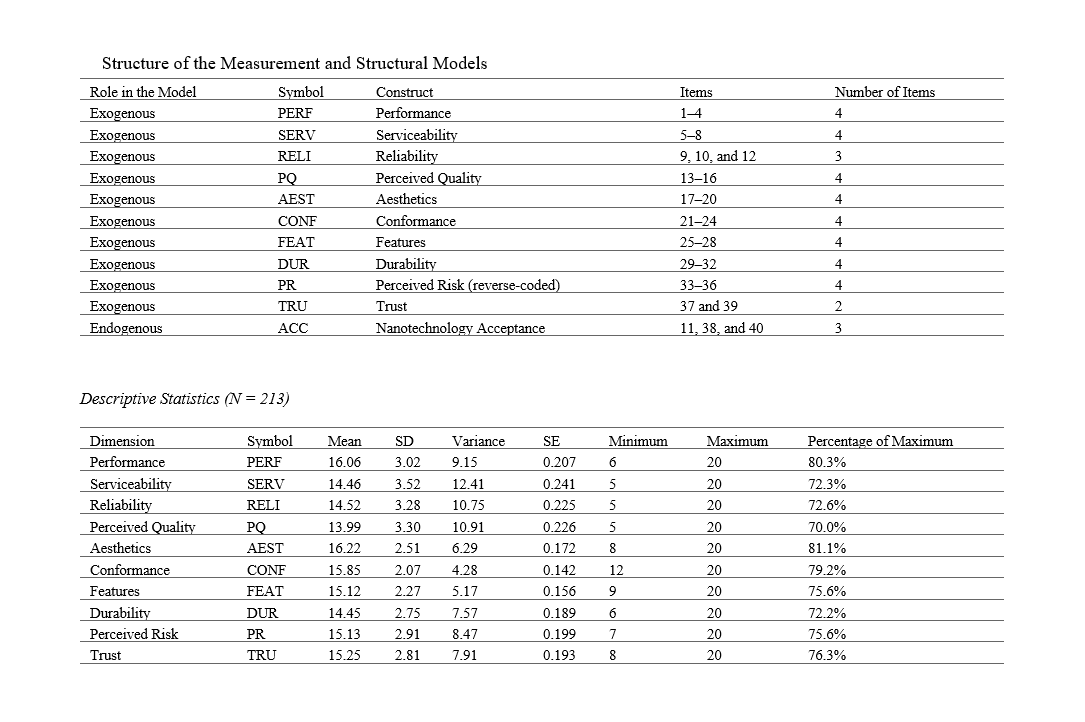
Methods and Materials: This applied, cross-sectional survey study employed a 40-item questionnaire using a five-point Likert scale. A total of 213 respondents (71 owners, 71 sales managers, and 71 quality managers) from 100 companies operating in Iran’s fruit supply chain were included in the analysis. Following preliminary analyses, including descriptive statistics, one-sample t tests against the scale midpoint of 12, one-way analysis of variance, and Tukey’s HSD post hoc test, the structural model was estimated using partial least squares structural equation modeling (PLS-SEM) with 5,000 bootstrap resamples. The robustness of the results was additionally assessed using company-level cluster bootstrapping. Differences across organizational roles were examined through multigroup analysis using the measurement invariance of composites (MICOM) procedure and permutation tests.
Findings: The mean score for all ten dimensions was significantly higher than the scale midpoint (all p < .001; Cohen’s d = 0.60–1.86). The highest perceptions were observed for aesthetics (16.22 out of 20), performance (16.06), and conformance (15.85), whereas the lowest were observed for perceived quality (13.99), durability (14.45), and serviceability (14.46). Significant differences among the three organizational roles were found for nine dimensions (η² = 0.085–0.296); perceived risk was the only dimension that showed no significant difference (p = .213). Quality managers scored higher than owners on all dimensions except perceived risk. In the structural model, six paths were significant: trust (β = 0.28), perceived quality (β = 0.21), perceived risk (β = 0.19), performance (β = 0.18), reliability (β = 0.15), and conformance (β = 0.12). The paths for serviceability, aesthetics, features, and durability were nonsignificant; therefore, H1b, H1e, H1g, and H1h were rejected. The model explained 58% of the variance in acceptance (R² = 0.58; Q² = 0.41; SRMR = 0.061) and demonstrated satisfactory out-of-sample predictive power. In the multigroup analysis, differences in path coefficients across organizational roles were generally nonsignificant. Only the perceived quality path differed between owners and quality managers at the Bonferroni-adjusted significance level of .0167. The difference in the perceived risk path between these two groups (p = .030) was significant only at the unadjusted .05 level.
Conclusion: The structural findings indicate that trust, perceived quality, and perceived risk are the most important predictors of acceptance. Accordingly, vendors should simultaneously emphasize transparency and trust building, improve perceived quality, and reduce safety-related concerns.
Downloads
References
Aagerup, U., Andersson, S., & Awuah, G. B. (2022). Building a Warm and Competent B2B Brand Personality. European Journal of Marketing, 56(13), 167-193. https://doi.org/10.1108/ejm-06-2019-0528
Akbar, N. B., & Prasetio, E. A. (2023). Business Model Innovation to Optimize Revenue Growth in the B2C Sector of Research Service Providing Institution: Case Study at Nano Riset Indonesia. International Journal of Current Science Research and Review, 06(12). https://doi.org/10.47191/ijcsrr/v6-i12-84
Anand, A., Bowen, M., Spivack, A. J., Vessal, S. R., & Rangarajan, D. (2023). The Role of Ethics in Business-to-Business Marketing: An Exploratory Review and Research Agenda. Industrial Marketing Management, 115, 421-438. https://doi.org/10.1016/j.indmarman.2023.10.013
Bag, S., Rahman, M. S., Choi, T. M., Srivastava, G., Kilbourn, P., & Pisa, N. (2023). How COVID-19 Pandemic Has Shaped Buyer-Supplier Relationships in Engineering Companies With Ethical Perception Considerations: A Multi-Methodological Study. Journal of Business Research, 158, 113598. https://doi.org/10.1016/j.jbusres.2022.113598
Bilro, R. G., Loureiro, S. M. C., & Pedro Henrique Pais Corrêa, S. (2023). A Systematic Review of Customer Behavior in Business-to-Business Markets and Agenda for Future Research. Journal of Business and Industrial Marketing, 38(13), 122-142. https://doi.org/10.1108/jbim-07-2022-0313
Cheng, Z., Plangger, K. A., & Pitt, L. F. (2022). Charting Value Creation Strategies B2B Salespeople Use Throughout the Sales Process: Learning From Social Media Influencers. European Journal of Marketing, 57(3), 718-744. https://doi.org/10.1108/ejm-11-2021-0922
Dung, T. Q., & Tu, T. T. N. (2023). The Effects of Tour Operator’s Service Quality on Travel Agents’s Customer Value, Satisfaction and Loyalty in Vietnam. Tạp Chí Nghiên Cứu Tài Chính - Marketing, 72-84. https://doi.org/10.52932/jfm.vi6.441
Dwivedi, Y. K., Ismagilova, E., Rana, N. P., & Raman, R. (2021). Social Media Adoption, Usage and Impact in Business-to-Business (B2B) Context: A State-of-the-Art Literature Review. Information Systems Frontiers, 25(3), 971-993. https://doi.org/10.1007/s10796-021-10106-y
Fagundes, L., Christian Gomes e Souza, M., & Crescitelli, E. (2022). The Influence of Social Media and Brand Equity on Business-to-Business Marketing. Revista De Gestão, 30(3), 299-313. https://doi.org/10.1108/rege-07-2021-0114
Falkenreck, C., Leszczyński, G., & Zieliński, M. (2023). What Drives the Successful Launch of IoT-related Business Models? Journal of Business and Industrial Marketing, 38(13), 180-194. https://doi.org/10.1108/jbim-09-2022-0421
Fergurson, J. R., Marshall, G. W., & Pelton, L. E. (2024). Toward Addressing Customer Migration: Measuring B2B Salespersons’ Perceptions of Customer Ownership. Journal of Business and Industrial Marketing, 39(10), 2057-2069. https://doi.org/10.1108/jbim-03-2023-0136
Ferreira, J. J., Veiga, P. M., Fernandes, C., & Kraus, S. (2021). B2B Marketing Strategies in Healthcare Management: Intellectual Structure and Research Trends. Journal of Business and Industrial Marketing, 37(8), 1580-1593. https://doi.org/10.1108/jbim-07-2020-0339
Gelderman, C. J., Schijns, J. M. C., Lambrechts, W., & Vijgen, S. (2021). Green Marketing as an Environmental Practice: The Impact on Green Satisfaction and Green Loyalty in a Business‐to‐business Context. Business Strategy and the Environment, 30(4), 2061-2076. https://doi.org/10.1002/bse.2732
Ishii, R., & Kikumori, M. (2023). Word-of-Mouth in Business-to-Business Marketing: A Systematic Review and Future Research Directions. Journal of Business and Industrial Marketing, 38(13), 45-62. https://doi.org/10.1108/jbim-02-2022-0099
Itani, O. S., Badrinarayanan, V. A., & Rangarajan, D. (2022). The Impact of Business-to-Business Salespeople’s Social Media Use on Value Co-Creation and Cross/Up-Selling: The Role of Social Capital. European Journal of Marketing, 57(3), 683-717. https://doi.org/10.1108/ejm-11-2021-0916
Jha, A. (2021). The Value in Doing Good: Perspective From the Indian Manufacturing Sector. Social Responsibility Journal, 18(4), 787-805. https://doi.org/10.1108/srj-09-2020-0352
Keegan, B. J., Dennehy, D., & Naudé, P. (2022). Implementing Artificial Intelligence in Traditional B2B Marketing Practices: An Activity Theory Perspective. Information Systems Frontiers, 26(3), 1025-1039. https://doi.org/10.1007/s10796-022-10294-1
Kittur, P., & Chatterjee, S. (2023). Role of B2B Reliance and Brand Image in Reducing Risk Perceptions: A Serial Mediation Model. European Journal of Marketing, 57(4), 1068-1098. https://doi.org/10.1108/ejm-05-2022-0362
Lasrado, F., Thaichon, P., & Nyadzayo, M. W. (2022). Exploring the Role of Relationship Management and Relationship Quality in B2B: Empirical Insights and Future Research Directions. Journal of Business and Industrial Marketing, 38(5), 1055-1086. https://doi.org/10.1108/jbim-05-2021-0267
Lee, C. J., Lee, S.-M., Iyer, R., & Lee, Y. K. (2022). Do Relational Benefits Influence Commitments and Loyalty in A non-Contract Mechanism? Asia Pacific Journal of Marketing and Logistics, 35(8), 2012-2028. https://doi.org/10.1108/apjml-11-2021-0835
Lin, Y. (2026). When Servitization Backfires: Aftermarket Revenue Dependence, Service Fairness, and Customer Repurchase Intention. https://doi.org/10.21203/rs.3.rs-9886860/v1
Maga, S., & Bodlaj, M. (2024). Drivers and Outcomes of Chatbot Use in the Business-to-Business Context: Exploring Business Customers’ Perspectives. Journal of Business and Industrial Marketing, 40(1), 250-264. https://doi.org/10.1108/jbim-11-2023-0694
Mahmoud, A. B., Kumar, P. V., Fuxman, L., & Mohr, I. (2023). Climate Change Risks, Sustainability and Luxury Branding: Friend or a Foe. Industrial Marketing Management, 115, 57-68. https://doi.org/10.1016/j.indmarman.2023.09.008
Mai, E. S., & Liao, Y. (2021). The Interplay of Word-of-Mouth and Customer Value on B2B Sales Performance in a Digital Platform: An Expectancy Value Theory Perspective. Journal of Business and Industrial Marketing, 37(7), 1389-1401. https://doi.org/10.1108/jbim-05-2021-0269
Nandankar, S., Sachan, A., Adhikari, A., & Mukherjee, A. (2023). Developing and Validating E-Marketplace Service Quality Model in B2G E-Commerce Settings: A Mixed-Methods Approach. International Journal of Operations & Production Management, 43(12), 1809-1840. https://doi.org/10.1108/ijopm-05-2022-0333
Nyadzayo, M. W., Casidy, R., & Thaichon, P. (2020). B2B Purchase Engagement: Examining the Key Drivers and Outcomes in Professional Services. Industrial Marketing Management, 85, 197-208. https://doi.org/10.1016/j.indmarman.2019.11.007
Oflaç, B. S., Sullivan, U. Y., & Aslan, Z. (2021). Examining the Impact of Locus and Justice Perception on B2B Service Recovery. Journal of Business and Industrial Marketing, 36(8), 1403-1414. https://doi.org/10.1108/jbim-11-2019-0467
Pandya, D., Kumar, G., & Singh, S. (2023). Aligning Sustainability Goals of Industrial Operations and Marketing in Industry 4.0 Environment for MSMEs in an Emerging Economy. Journal of Business and Industrial Marketing, 39(3), 581-602. https://doi.org/10.1108/jbim-04-2022-0183
Rineggo, A., Hussein, A. S., Sudiro, A., & Sunaryo, S. (2023). The Effect of Trust in Suppliers on Loyalty Is Influenced by Perceived Value in the Business-to-Business (B2B) Healthcare Industry. 72-80. https://doi.org/10.2991/978-94-6463-214-9_8
Rungsithong, R., & Meyer, K. E. (2024). Affect-Based Dimensions of Trust: A Study of Buyer-Supplier Relationships in Thai Manufacturing. Journal of Business and Industrial Marketing, 39(6), 1259-1281. https://doi.org/10.1108/jbim-10-2022-0443
Saragih, H. S. (2024). Beyond the Transaction: Exploring Resources Stewardship, Relational Connectedness and Co-Creation in B2B Marketing. Journal of Business and Industrial Marketing, 40(1), 173-187. https://doi.org/10.1108/jbim-04-2023-0201
Sheeri, S. N., & Sujaya, H. (2023). Review of Literature on Factors Affecting Long-Term Business-to-Business Relationship – A Special Reference to Micro Manufacturing Units. International Journal of Case Studies in Business It and Education, 477-505. https://doi.org/10.47992/ijcsbe.2581.6942.0284
Thanabodypath, W., Chandrachai, A., Chaiyo, S., & Chailapakul, O. (2021). Industrial Buyer Innovation Adoption Model: A Focus on a Smartphone-Based Electrochemical Analytical Device for Toxic Heavy Metal Detection. Sustainability, 13(21), 11718. https://doi.org/10.3390/su132111718
Tjandra, N. C., Ensor, J., Omar, M., & Thomson, J. R. (2020). Independent Financial Adviser (IFA)-based Brand Equity Pyramid. Journal of Financial Services Marketing, 25(3-4), 53-64. https://doi.org/10.1057/s41264-020-00073-x
Wisnujati, N. S., Sangadji, S. S., & Handriana, T. (2024). Understanding the Mediating Role of Perceived Risk in the Relationship Between Price, Product Quality, and Copra Repurchase Intention in North Maluku Province. International Journal of Applied Economics Finance and Accounting, 19(1), 97-106. https://doi.org/10.33094/ijaefa.v19i1.1517
Zhang, J., & Du, M. (2020). Utilization and Effectiveness of Social Media Message Strategy: How B2B Brands Differ From B2C Brands. Journal of Business and Industrial Marketing, 35(4), 721-740. https://doi.org/10.1108/jbim-06-2018-0190
Zou, W., Brax, S., & Rajala, R. (2021). The Effects of Competence-Based, Expressive and Collaborative Service Performance on the B2B Service Relationship. Technology Innovation Management Review, 11(5), 17-31. https://doi.org/10.22215/timreview/1439
Downloads
Additional Files
Publication Timeline
- Submitted
- Revised
- Accepted