Strategic Flexibility and Social Networks in the Effect of High-Performance Work Systems on Organizational Performance
Keywords:
High-Performance Work Systems; Organizational Performance; Strategic Flexibility; Social Networks; Structural Equation Modeling.Abstract
Objective: This study aimed to investigate the effect of high-performance work systems on organizational performance through the mediating role of strategic flexibility and the moderating role of social networks among engineers working in construction and urban development projects in District 4 of Isfahan Municipality.
Methods and Materials: This applied study employed a descriptive-survey and cross-sectional design. The statistical population consisted of 250 civil and urban development engineers and engineers employed by construction companies undertaking projects within District 4 of Isfahan Municipality. Based on the Morgan and Krejcie sample-size table, a minimum sample of 148 participants was determined, and data from 151 completed questionnaires were ultimately included in the analysis. Data were collected using a structured questionnaire measuring high-performance work systems, organizational performance, strategic flexibility, and social networks. Construct validity was assessed through factor analysis. The measurement and structural models were evaluated using structural equation modeling. Statistical analyses were conducted using SPSS version 24 and SmartPLS version 4.
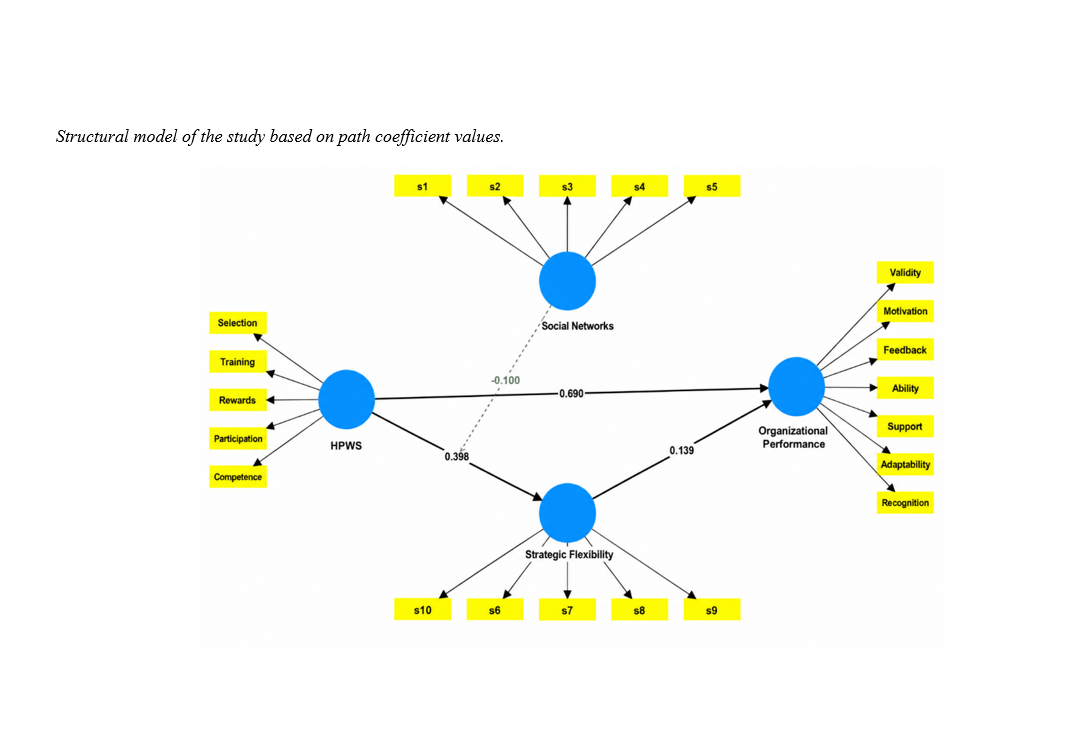
Findings: The inferential analyses supported all proposed hypotheses. High-performance work systems had a positive and statistically significant direct effect on organizational performance. High-performance work systems also exerted a positive and significant effect on strategic flexibility, while strategic flexibility demonstrated a positive and significant effect on organizational performance. The mediation analysis further indicated that strategic flexibility significantly mediated the relationship between high-performance work systems and organizational performance, demonstrating that part of the organizational performance benefits associated with high-performance work practices operates through enhanced strategic adaptability and responsiveness. Moreover, the moderation analysis confirmed that social networks significantly moderated the effect of high-performance work systems on strategic flexibility, indicating that stronger social networks reinforced the capacity of high-performance work systems to promote strategic flexibility.
Conclusion: The findings demonstrate that high-performance work systems can enhance organizational performance both directly and indirectly by strengthening strategic flexibility. Strategic flexibility therefore constitutes an important organizational mechanism through which integrated high-performance human resource practices are translated into improved performance outcomes. Furthermore, the significant moderating role of social networks suggests that relational and social resources can strengthen the contribution of high-performance work systems to organizational adaptability. Organizations, particularly those operating in dynamic construction and municipal environments, may therefore improve performance by integrating high-performance work practices with initiatives that enhance strategic flexibility and foster effective professional and organizational networks.
Downloads
References
Akbarzadeh Kakhki, E., Khayat Moghaddam, S., & Erfanian Khanzadeh, H. (2016). Examining the Impact of High-Performance Work Systems on Organizational Performance with Emphasis on the Moderating Role of Social Capital: A Case Study of Employees of Mashhad Municipality District Samen First National Conference on New Approaches in Accounting and Management,
Arabi, A., Karim Zandi, M., & Torabian, M. (2025). The Effect of Entrepreneurial Leadership on Employee Organizational Performance Considering the Mediating Role of Strategic Flexibility and the Moderating Role of Organizational Culture: A Case Study of the Deputy for Management Development and Resources of Iran University of Medical Sciences Eleventh National Conference on Modern Studies and Research in Humanities, Management and Entrepreneurship in Iran,
Asayesh, F., Rousta, A., & Motamedi, S. (2017). The Effect of Strategic Flexibility and Organizational Agility on Organizational Performance with Emphasis on the Moderating Role of Strategic Leadership: A Case Study of Pars Khodro Company National Conference on Modern Research in Accounting and Management in the Third Millennium, Karaj.
Dorta-Afonso, D., Malik, N., & Cuéllar-Molina, D. (2025). Enhancing Employee Performance and Retention: The Mediating Role of Job Satisfaction in High-Performance Work Systems. Employee Relations: The International Journal, 47(8), 1330-1350. https://doi.org/10.1108/ER-04-2025-0257
Han, C., & Gao, S. X. (2017). Research on the Relationship between Strategic Flexibility, Strategic Innovation and Management Innovation. Manag. Sci., 30, 16-26.
Hataminia, Y., & Abbaszadeh, H. (2016). Examining the Impact of Strategic Flexibility on Organizational Performance with Emphasis on the Mediating Role of Product Innovation: A Case Study of Small and Medium-Sized Enterprises in Marivan County European Conference on Modern Management,
Hosseini, S., Ranaei Kordshouli, H., & Amini, A. (2022). Identifying the Characteristics of High-Performance Work Systems Using a Systematic Review Method Fifth Annual International Conference on New Developments in Management, Economics and Accounting, Tehran.
Keshavarzi, M. (2020). Examining the Impact of High-Performance Work Systems on Organizational Performance with the Mediating Role of Organizational Ambidexterity and Human Resource Flexibility in Tehran Shahr Bank Branches Third International Conference on Psychology, Educational Sciences, Social Sciences and Humanities,
Liu, L., & Zhang, C. (2026). The Effect of High-Performance Work Systems on Employee Work-Related AI Use: A Stimulus-Organism-Response Framework. International Journal of Hospitality Management, 133, 104521. https://doi.org/10.1016/j.ijhm.2025.104521
Matlabi Varkani, A., Nazem, A., & Nazem, F. (2022). Examining the Relationship between High-Performance Work Systems and Innovative Organizational Climate with Organizational Commitment at Imam Khomeini Naval Sciences University in Nowshahr to Present an Appropriate Model. Marine Sciences Education, 9(3), 208-221.
Nazem, A. (2022). Validation of a Scale for Measuring High-Performance Work Systems at the University of Marine Sciences. Marine Sciences Education, 9(1), 219-229.
Pirasteh Majd, M. (2025). Examining the Impact of Strategic Flexibility on Organizational Performance through Organizational Innovation in Nilper Company Fourth International Congress on Management, Economics, Humanities and Business Development,
Sarfarazi, M., Pourzarei, N., & Pourzarei, A. (2025). Measuring the Effectiveness of Organizational Learning Strategies on Organizational Agility in the Third Millennium. Scientific Journal of New Research Approaches in Management and Accounting, 9(35), 854-878.
Sheikhi, E., Peyvasteh, A., & Bahloli, N. (2026). Designing a Human Resources Regeneration Model in Relief Organizations. Defense Human Capital Management Quarterly, 6(22), 25-44. https://doi.org/10.22034/jdhcm.2026.2072085.1223
Shekari, H., & Hosseini, H. (2020). Investigating the Effect of Jihadi Management on Employees Social Undermining with Considering the Mediating Role of Leader Member Exchange in Youth and Sport Office in Yazd Province. Organizational Behavior Management in Sport Studies, 7(25), 137-148.
Shekari, H., Hosseini, H., & Jalalian, N. (2025). Developing a Model of the Impact of Knowledge Risk Management on Organizational Sustainability Considering the Mediating Role of Employees’ Innovative Behavior. Dynamic Management and Business Analysis, 4(3), 278-295.
Shekari, H., Jalalian, N., & Hezardastan, M. (2026). Structural Model of the Impact of Employees’ Digital Experience and Digital Literacy on Sustainable Human Resource Performance Considering the Mediating Role of Human Resource Agility. Study and Innovation in Education and Development, 6(2), 1-21.
Shekari, H., & Kamanchi, S. (2026). The Effect of Artificial Intelligence–Induced Stress on Employees’ Individual Creativity: Examining the Roles of Stress-Coping Strategies and Management Commitment. International Journal of Innovation Management and Organizational Behavior, 1-13. https://journals.kmanpub.com/index.php/ijimob/article/view/5815
Tahmasbi, M., & Farhadi Mahalli, A. (2018). The Impact of High-Performance Work Systems on Organizational Performance through the Mediation of Human Resource Flexibility and Organizational Efficiency: A Study of the General Directorate of Technical and Vocational Training of Golestan Province Fifth National Conference on Applied Research in Management and Accounting, Tehran.
Teece, D., Peteraf, M., & Leih, S. (2016). Dynamic Capabilities and Organizational Agility: Risk, Uncertainty, and Strategy in the Innovation Economy. California Management Review, 58(4), 13-35.
Wang, Y., Cao, Y., Xi, N., & Chen, H. (2021). High-Performance Work System, Strategic Flexibility and Organizational Performance: The Moderating Role of Social Network. Frontiers in psychology, 5045.
Xing, H., Gao, S. Y., Zhang, J., & Yu, H. (2015). High-Performance Work System and Organizational Performance—The Mediating Effect of Human Resource Flexibility. Sci. Technol. Manag. Res., 35, 160-166.
Zami, I. N. Z., Fajri, A., & Alim, M. R. S. (2026). High-Performance Work System and Self-Efficacy on Academic Performance: Work-Life Balance as Mediator. Research Horizon, 6(1), 99-110. https://doi.org/10.54518/rh.6.1.2026.981
Zhang, J., Su, M., Ding, C., & Zhao, S. (2025). The Impact of High-Performance Work Systems on Proactive Career Behaviour: Empirical Evidence from China. Asia Pacific Business Review, 1-21. https://doi.org/10.1080/13602381.2025.2586755
Zhu, J., & Lee, H. (2026). High-Performance Work Systems and Innovative Work Behavior: The Mediating Role of Knowledge Hiding and the Moderating Role of Performance Goal Orientation. Frontiers in psychology, 17, 1871686. https://doi.org/10.3389/fpsyg.2026.1871686
Downloads
Additional Files
Publication Timeline
- Submitted
- Revised
- Accepted