Identifying the Components of Artificial Intelligence–Based Organizational Behavior in Iranian Sports Federations from the Perspective of Psychological Capital
Keywords:
Artificial Intelligence, Organizational Behavior, Psychological Capital, Sports Federations, Intelligent Leadership, Organizational InnovationAbstract
Objective: This study aimed to identify and conceptualize the components of artificial intelligence–based organizational behavior in Iranian sports federations from the perspective of psychological capital.
Methods and Materials: This qualitative exploratory study was conducted among experts in sports management, organizational behavior, psychological capital, artificial intelligence, human resource management, and industrial and organizational psychology. Participants were selected through purposive and snowball sampling, and data collection continued until theoretical saturation was achieved after 18 semi-structured interviews. Each interview lasted approximately 45–75 minutes and was audio-recorded with participants’ consent and transcribed verbatim. Data were analyzed using MAXQDA through open, axial, and selective coding. Trustworthiness was enhanced through peer review, participant checking, reflective note-taking, systematic documentation of the analytical process, and continuous comparison of emerging categories with the original interview data.
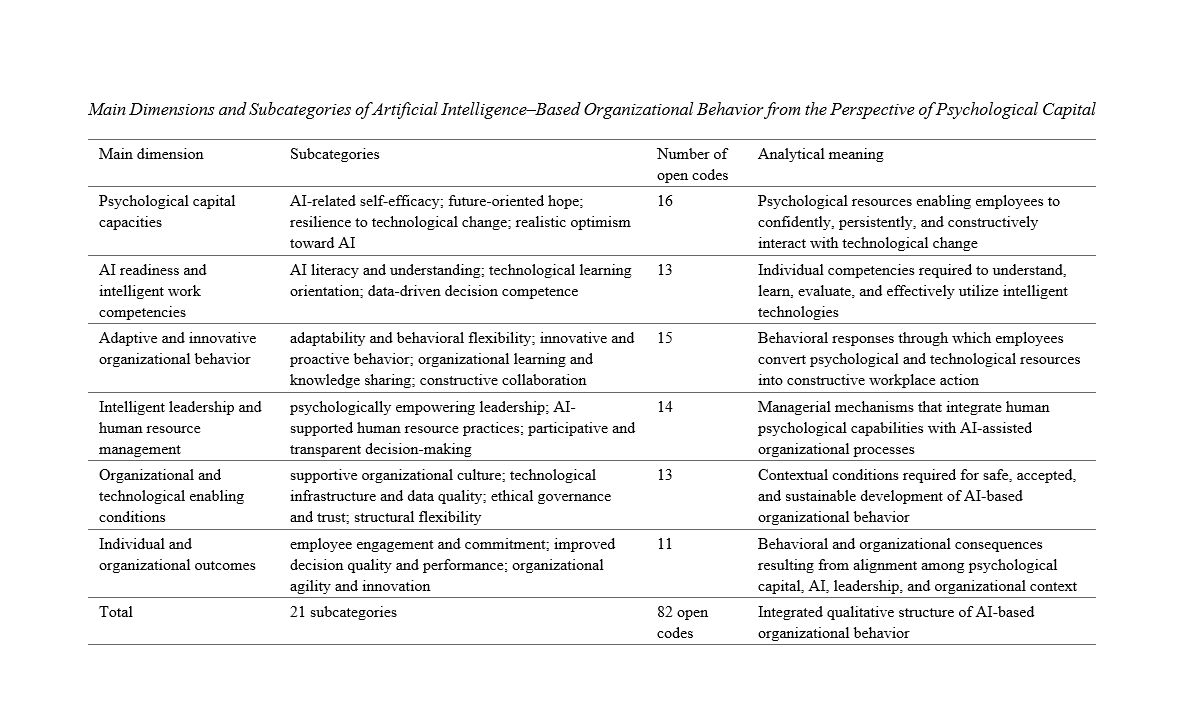
Findings: Analysis of the interviews generated 341 initial codes, which were reduced to 82 open codes after eliminating duplication and merging conceptually similar items. These codes were organized into 21 subcategories and six overarching dimensions: psychological capital capacities, AI readiness and intelligent work competencies, adaptive and innovative organizational behavior, intelligent leadership and human resource management, organizational and technological enabling conditions, and individual and organizational outcomes. The central category emerging from the analysis was the development of psychologically empowered intelligent organizational behavior through the integration of psychological capital and artificial intelligence. The findings indicated that self-efficacy, hope, resilience, and realistic optimism provide the psychological foundation for constructive engagement with AI, while AI literacy, continuous technological learning, data competence, supportive leadership, ethical governance, organizational culture, technological infrastructure, and structural flexibility facilitate the translation of these capacities into adaptive, innovative, collaborative, and performance-enhancing organizational behavior.
Conclusion: Artificial intelligence–based organizational behavior in Iranian sports federations is a multidimensional, human-centered phenomenon in which psychological capital interacts with technological competencies, leadership practices, organizational conditions, and ethical governance to shape employee adaptation, innovation, engagement, decision quality, performance, and organizational agility.
Downloads
References
Adekanmbi, F. P., & Ukpere, W. I. (2022). Sustaining Organizational Performance and Employee Wellbeing in the 4IR: The Impact of Leadership 4.0, PSYCAP, and High-Performance HR Practices. Eureka Social and Humanities(3), 24-39. https://doi.org/10.21303/2504-5571.2022.002403
Alifuddin, M., & Widodo, W. (2022). How Is Cultural Intelligence Related to Human Behavior? Journal of Intelligence, 10(1), 3. https://doi.org/10.3390/jintelligence10010003
Bandara, C., Dissanayake, K., & Adikaram, A. S. (2024). Synergizing Organizational Values and Psychological Capital for Wellbeing: Insights From Sri Lankan Public Administration. Journal of Management Matters, 11(1), 19-39. https://doi.org/10.4038/jmm.v11i1.65
Behl, A., Gupta, M., Gunasekaran, A., & Luo, Z. (2022). Guest Editorial: Theoretical Advancements in Business: Past, Present and Future. International Journal of Organizational Analysis, 30(4), 833-835. https://doi.org/10.1108/ijoa-07-2022-006
Bhukya, U. S. R. (2026). AI Anxiety, Digital Overload, and Technostress in a Polycrisis Context: A Moderated Mediation Study of Emotional Exhaustion and Psychological Well-Being Across Four Industry Sectors. https://doi.org/10.21203/rs.3.rs-11253139/v1
Bisschoff, Z. S., & Massyn, L. (2024). A Conceptual Soft Skills Competency Framework for Enhancing Graduate Intern Employability. Higher Education Skills and Work-Based Learning, 15(7), 66-81. https://doi.org/10.1108/heswbl-08-2023-0239
BozdoĞAn, S. C. (2023). The Mediating Role of Psychological Capital in the Effect of Emotional Intelligence on Resistance to Change. İstanbul Gelişim Üniversitesi Sosyal Bilimler Dergisi, 10(2), 817-832. https://doi.org/10.17336/igusbd.1067133
Chaibi, Y., Siragi, F. E., & Abbadi, B. E. (2026). Psychological Capital and Entrepreneurial Behavior: A Scoping Review and Co-Word Analysis From a Positive Psychology Perspective. Psychology International, 8(2), 31. https://doi.org/10.3390/psycholint8020031
Chen, C.-F., & Hu, H.-L. (2025). Social Capital and Job Performance: A Moderated Mediation Model of Organizational Citizenship Behaviors and Psychological Capital. Behavioral Sciences, 15(6), 714. https://doi.org/10.3390/bs15060714
Dholariya, P. (2025). Psychological Capital in Remote Work Settings: A Case Study-Based Inquiry on Optimism, Efficacy, Resilience, and Hope. https://doi.org/10.21203/rs.3.rs-6850692/v1
Donaldson, S. I., & Zyl, L. E. v. (2022). PERMA+4: A Framework for Work-Related Wellbeing, Performance and Positive Organizational Psychology 2.0. Frontiers in psychology, 12. https://doi.org/10.3389/fpsyg.2021.817244
Erden, A. (2025). The Influence of Teachers’ Psychological Capital on the Quality of Work Life: Exploring the Mediating Impact of Emotions. Frontiers in psychology, 16. https://doi.org/10.3389/fpsyg.2025.1557030
Galanakis, M. D. (2026). Positive Psychology in the Workplace: Psychological Capital, Flourishing, Leadership, and Employee Well-Being in Contemporary Organizations. Administrative Sciences, 16(7), 325. https://doi.org/10.3390/admsci16070325
George, O. J., Okon, S. E., & Akaighe, G. O. (2021). Emotional Intelligence and Work Engagement: A Serial Mediation Model. Journal of Organizational Effectiveness People and Performance, 9(2), 193-211. https://doi.org/10.1108/joepp-02-2021-0025
Gojny-Zbierowska, M. (2024). When There Is No Justice, We Need an Old HERO. The Trickle-Down Effect of Psychological Capital: The Moderating Role of Organizational Justice and Leaders’ Age. Frontiers in psychology, 15. https://doi.org/10.3389/fpsyg.2024.1256721
Gom, D., Lew, T. Y., Jiony, M. M., Tanakinjal, G. H., & Sondoh, S. L. (2021). The Role of Transformational Leadership and Psychological Capital in the Hotel Industry: A Sustainable Approach to Reducing Turnover Intention. Sustainability, 13(19), 10799. https://doi.org/10.3390/su131910799
Jahagirdar, R. (2022). A Conceptual Proposition of Intangible Assets and Organizational Citizenship Behavior. https://doi.org/10.57030/23364890.cemj.30.4.256
Jiony, M. M., Lew, T. Y., Gom, D., Tanakinjal, G. H., & Sondoh, S. L. (2021). Influence of Cultural Intelligence and Psychological Capital on Service Quality: A Study of the Hotel Industry in Sabah, Malaysia. Sustainability, 13(19), 10809. https://doi.org/10.3390/su131910809
Kang, J. W., Coughlan, D., Kang, J. Y., & Beck, K. (2025). Cross-Cultural Management in International Sports Federations: Communication and Decision-Making Frameworks. Research Journal of Business Management, 19, 1-10. https://doi.org/10.3923/rjbm.2025.1.10
Khorshidi Paji, M., Nemati, N., & Baggedpour, T. (2026). Professional Competency Model for Presidents of Sports Federations. Transformations in Human Science, 4(4), 71-94. https://www.thbaj.ir/article_244013.html?lang=en
Lathabhavan, R., & Bharadwaja, M. (2026). From Job Insecurity to Wellbeing in an Uncertain Era of Indian Job Market: Role of Psychological Capital and Digital Culture in Determining Positive Outcomes. Australian Journal of Career Development, 35(3), 420-431. https://doi.org/10.1177/10384162261486200
Liu, Y., Tian, Q., & Chen, J. (2026). When Artificial Intelligence Becomes a Job Resource: How Psychological Capital Fuels Innovation in Algorithm-Driven Workplaces. Frontiers in psychology, 17. https://doi.org/10.3389/fpsyg.2026.1740508
Long, H. C., An, H. M., & Dung, P. T. P. (2025). Mindfulness Practice and Work Performance: The Mediating Role of Emotional Intelligence and Psychological Capital. Brain and Behavior, 15(1). https://doi.org/10.1002/brb3.70291
Luthans, F., & Broad, J. D. (2022). Positive Psychological Capital to Help Combat the Mental Health Fallout From the Pandemic and VUCA Environment. Organizational Dynamics, 51(2), 100817. https://doi.org/10.1016/j.orgdyn.2020.100817
Malik, P. (2022). Exploring the Role of Individual-Focused Transformational Leadership in Facilitating Taking Charge: Mediating Mechanism of Psychological Capital and Thriving at Work. International Journal of Productivity and Performance Management, 73(2), 435-455. https://doi.org/10.1108/ijppm-02-2022-0077
Moorthy, K., Kamarudin, A. A., Govindarajo, N. S., & T’ing, L. C. (2023). Emotional Intelligence on Job Performance: A Study on Malaysian Employees. Work a Journal of Prevention Assessment & Rehabilitation, 76(3), 1145-1156. https://doi.org/10.3233/wor-220418
Mutonyi, B. R., Slåtten, T., & Lien, G. (2021). Fostering Innovative Behavior in Health Organizations: A PLS-SEM Analysis of Norwegian Hospital Employees. BMC Health Services Research, 21(1). https://doi.org/10.1186/s12913-021-06505-1
Perinelli, E., Stella, M., Bizzego, A., & Fraccaroli, F. (2025). Lagged Predictors of Psychological Capital in Junior High School Students: A Supervised Machine Learning Approach. International Journal of Behavioral Development, 50(5), 654-668. https://doi.org/10.1177/01650254251368793
Prasad, K. D. V., Singh, S. C., Srinivas, V., & Vaidya, R. (2024). Nexus Between Organizational Citizenship Behavior and Psychological Wellbeing: Emotional Intelligence as a Pathway. Frontiers in psychology, 15. https://doi.org/10.3389/fpsyg.2024.1389253
Qamar, F., & Soomro, S. A. (2023). Investigating the Impact of Servant Leadership on Service Excellence: The Mediating Role of PsyCap as a Personal Resource and Buffering Role of Conscientiousness. Global Knowledge Memory and Communication, 74(1/2), 515-532. https://doi.org/10.1108/gkmc-11-2022-0259
Rodrigues, R., & Silva, A. J. (2024). Harmonizing Emotions in the Workplace: Exploring the Interaction Between Emotional Intelligence, Positive Psychological Capital, and Flourishing. Frontiers in psychology, 14. https://doi.org/10.3389/fpsyg.2023.1343043
Saeed, I., Khan, S. U., Qadir, G., & Khattak, Q. (2021). Effect of Psychological Capital and Emotional Intelligence on Employee’s Job Performance. Journal of Business & Tourism, 3(2), 109-126. https://doi.org/10.34260/jbt.v3i2.76
Sarkar, A., Garg, N., & Palo, S. (2022). Workplace Spirituality and Psychological Capital (PsyCap) of the Employees: A Cross-Sectional Study. Global Business Review, 27(3), 577-594. https://doi.org/10.1177/09721509221111445
Shaheen, M., Gupta, R., & Zeba, F. (2023). Psychological Capital and Multifaceted Nature of Job Performance: Mediation by Intrinsic Motivation and Goal-Commitment. International Journal of Productivity and Performance Management, 73(6), 1970-1995. https://doi.org/10.1108/ijppm-06-2022-0274
Shahid, H., Ather, M. A., Shahid, S., & Imran, Z. (2023). Psychological Capital and Work Engagement: A Mediated Moderation Model of Positive Emotions and Emotional Intelligence. Journal of Social Sciences Review, 3(2), 562. https://doi.org/10.54183/jssr.v3i2.239
Soleimani, M., Aziziankohan, N., Emanzadeh, M., & Moharamzadeh, M. (2024). The impact of leadership styles on the attitudes of sports federation managers toward change with the mediating role of ethical intelligence. Human Resource Management in Sports, 10(1), 213-229. https://www.nature.com/articles/s41598-024-81788-y
Sung, M.-S., & Lee, Y. E. (2025). Examining How Preschool Teachers’ Positive Psychological Capital Impacts Digital Education Innovation: A Moderated Moderation Analysis of Effort Expectancy and Behavioral Intention. Behavioral Sciences, 15(7), 952. https://doi.org/10.3390/bs15070952
Tjimuku, M., & Atiku, S. O. (2024). Mapping Emotional Intelligence and Psychological Capital Research: A Bibliometric Analysis and Future Research Agenda. Businesses, 4(2), 132-155. https://doi.org/10.3390/businesses4020010
Wuttaphan, N. (2022). Factors Influencing the Work Behavior of Village Health Volunteers During the COVID-19 Pandemic in Thailand: A Cross-Sectional Study. Journal of Population and Social Studies, 30, 816-833. https://doi.org/10.25133/jpssv302022.045
Downloads
Additional Files
Publication Timeline
- Submitted
- Revised
- Accepted