A Model of Green Human Resource Management with Emphasis on Environmental and Energy Factors in Mashhad Municipality
DOI:
https://doi.org/10.61838/kman.ijimob.5.3.10Keywords:
Green Human Resources, Energy, Environment, Municipality, Model, Policy LineAbstract
Objective: The aim of this study is to present a model for energy and environmental policy-making in GHRM for Mashhad Municipality.
Methodology: This research is applied in terms of its purpose and descriptive-survey in terms of data collection methodology. The statistical population of this study consists of experts and managers of Mashhad Municipality, totaling 240 individuals. The sample size, calculated based on Cochran’s formula, is 143 participants. Data collection tools in the library method included note-taking, information databases, documents, and the internet. In the field method, qualitative questions were derived from review articles, and quantitative questions were collected using a questionnaire. To develop the questionnaire, various related articles were reviewed to explore green human resource management policy-making. After three stages of checklist compilation, an initial 34-item questionnaire was prepared. This questionnaire was then distributed among university professors. Using exploratory factor analysis, more significant factors were identified, and less important ones were eliminated from the questionnaire. The final questionnaire was prepared after responses were collected and was distributed among the study sample. Data analysis was conducted using structural equation modeling, exploratory factor analysis, and confirmatory factor analysis with AMOS software.
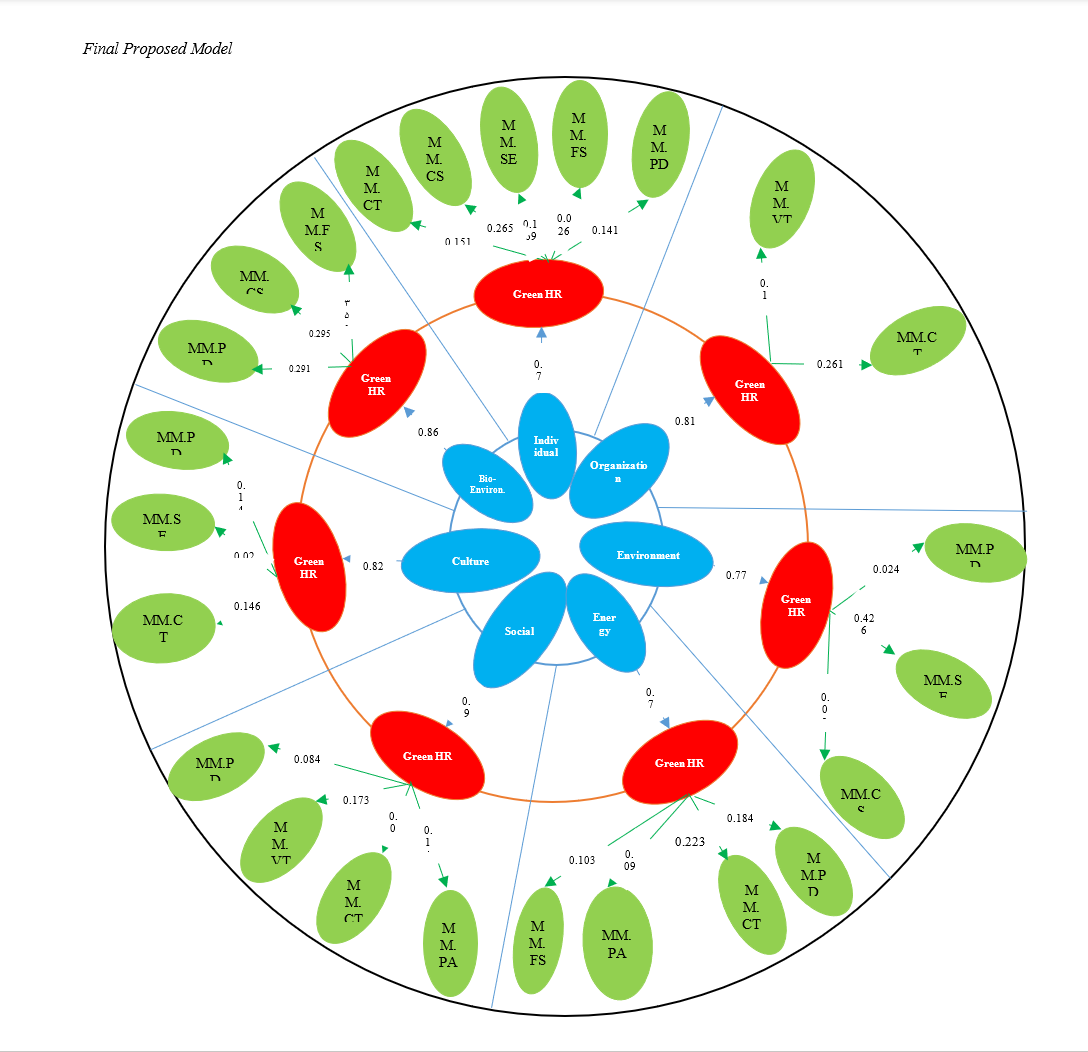
Findings: The research findings, while validating the proposed model, revealed that the components of GHRM encompass individual, social, cultural, energy, environmental, organizational, and ecological dimensions.
Conclusion: The results demonstrated the impact of energy, environmental, and ecological components of GHRM on the managerial components of the municipality, including the Deputy of Planning and Development, the Deputy of Finance and Support, the Deputy of Urban Services and Environment, the Deputy of Transportation and Traffic, the Cultural and Social Organization, the Deputy of Technical and Civil Affairs, and the Deputy of Urban Planning and Architecture.
Downloads
References
Amouzad Mahdiraji, H., & Rezaei Rad, M. (2021). Examining the Relationship between Information Technology and Green Human Resource Management with the Mediating Role of HRM Subsystems. Green Management Quarterly, 1(1), 108-129. https://sanad.iau.ir/en/Journal/jgm/Article/689723?jid=689723
Ansari, I., & Sadeghi-Moghadam, M. (2014). Identification, Relationship Determination, and Leveling of Green Supply Chain Management Drivers with an Interpretive Structural Modeling Approach. Journal of Industrial Management Studies, 12(53), 123-150. https://jims.atu.ac.ir/article_823.html?lang=en
Cohen, E., Taylor, S., & Muller-Camen, M. (2012). HRM's Role in Corporate Social and Environmental Sustainability. SHRM Foundation's Effective Practice Guidelines Series. http://transitioningtogreen.com/wordpress/wp-content/uploads/2015/02/4-12-csr-report-final-for-web.pdf
Elfat, L. y., Khatami Firouzabadi, A., & Khodavardi, R. (2011). Requirements for Achieving Green Supply Chain Management in Iran's Automotive Industry. Iranian journal of management sciences, 6(21), 123-140. https://journal.iams.ir/article_97.html?lang=en
Ghaedamini Harouni, A., Sadeghi Deh Cheshmeh, M., Moshref Ghahfarokhi, E., & Kaldani, S. (2023). The Impact of Green Knowledge Management on Green Innovation and Sustainable Development with the Mediating Role of Organizational Green Culture. Green Management Quarterly, 3(3), 104-126. https://en.civilica.com/doc/1839507/
Hashemi, S. K., & Eskandari, K. (2022). Examining the Relationship between Green Human Resource Management and Environmental Collaborations with the Moderating Role of Green Internal Supply Chain Management among Employees of Zamzam Company in Tabriz. Green Management Quarterly, 2(1), 1-16. https://www.magiran.com/paper/2608879/investigating-the-relationship-between-green-human-resource-management-and-environmental-cooperation-with-the-moderating-role-of-domestic-green-supply-chain-management-of-zamzam-iran-employees-in-tabriz?lang=en
Kim, Y. J., Kim, W. G., Choi, H., & Phetvaroon, K. (2019). The effect of green human resource management on hotel employees' ecofriendly behavior and environmental performance. The International Journal of Hospitality Management, 76(2), 83-93. https://doi.org/10.1016/j.ijhm.2018.04.007
Mazidi, A., & Mazidi, M. (2023). Green Human Resource Management and Environmental Performance Behavior with the Role of Environmental Awareness and Servant Leadership. Green Management Quarterly, 3(3), 146-166. https://sanad.iau.ir/en/Journal/jgm/Article/992594
Mehdi Zadeh, H., Omidi, N., Azizi, M., & Eslam Panah, M. (2011). Podcast and its Impact on Environmental Awareness of Middle School Students. Quarterly Journal of Information and Communication Technology in Educational Sciences, 4(2), 5-20. https://sanad.iau.ir/en/Journal/ictedu/Article/1006439
Rasouli, M., Tari, G., & Baghaei, H. (2024). Structural Modeling of School Managers' Competencies as a Driver for Sustainable Development [Research Article]. Iranian Journal of Educational Sociology, 7(2), 124-131. https://doi.org/10.61838/kman.ijes.7.2.15
Ren, S., Tang, G., & Jackson, S. E. (2018). Green human resource management research in emergence: A review and future directions. Asia Pacific Journal of Management, 35, 769-803. https://doi.org/10.1007/s10490-017-9532-1
Safary, M., & Onaq, B. A. (2023). Examining the Relationship between Human Resource Management and Green Behaviors Considering the Mediating Role of Environmental Awareness and the Moderating Role of Servant Leadership. Green Management Quarterly, 3(2), 122-139. https://www.magiran.com/paper/2608788/examining-the-relationship-between-green-human-resource-management-and-green-behaviors-considering-the-mediating-role-of-environmental-awareness-and-the-moderating-role-of-servant-leadership?lang=en
Samadiyeh, S. (2024). The Impact of Green Financing on the Green Transformation of the Economy. Seventh International Conference on New Ideas in Management, Economics, Accounting, and Banking,
Sousarai, A., Nasiri, M., Samiei, R., & Gorji, M. (2022). Analysis of Factors Influencing Organizational Entrepreneurial Behavior for Social Sustainable Development. Green Management Quarterly, 2(4), 176-195. https://en.civilica.com/doc/1625034/
V, A. H. (2024). A Review on Green Accounting Practices and Sustainable Financial Performance. Journal of Business Management and Information Systems, 11, 82-88. https://doi.org/10.48001/jbmis.2024.si1015
Downloads
Additional Files
Publication Timeline
- Submitted
- Revised
- Accepted
Issue
Section
License
Copyright (c) 2025 Hossein Hesami (Author); Changiz Mohammadizadeh (Corresponding Author); Mahsa Gholamhoseinzadeh (Author)

This work is licensed under a Creative Commons Attribution-NonCommercial 4.0 International License.