Integrating Market-Oriented Social Responsibility into the Mining Sector: Enhancing Stakeholder Trust, Brand Equity, and Sustainable Development
DOI:
https://doi.org/10.61838/kman.ijimob.5.4.11Keywords:
Market-Oriented Social Responsibility, Stakeholder Trust, Brand Equity, Sustainable Development, Economic SustainabilityAbstract
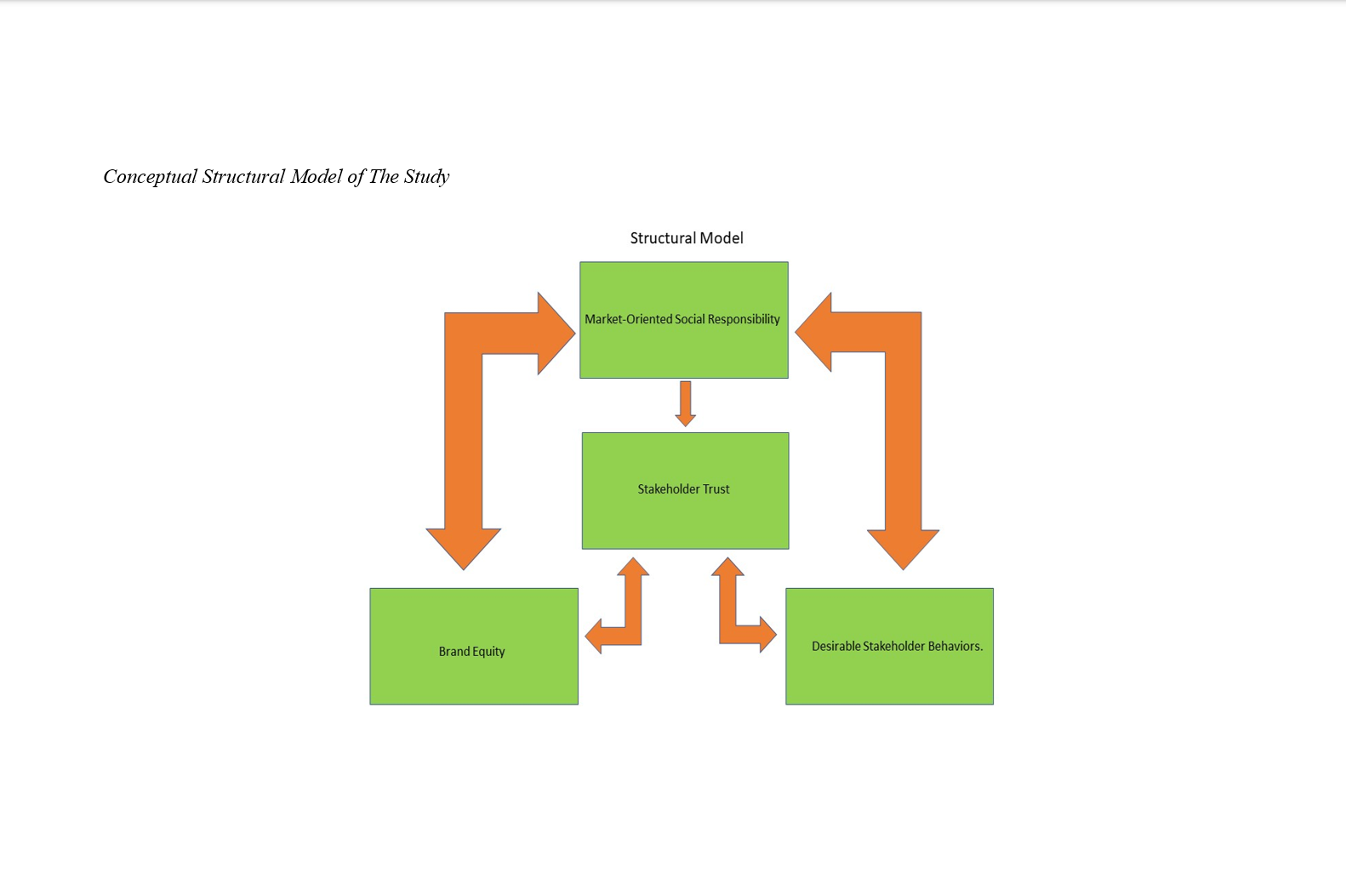
Objective: This study aims to explore the integration of market-oriented social responsibility (MOSR) within the mining sector and its impact on stakeholder trust, brand equity, and sustainable development.
Methodology: A mixed-methods approach was employed, utilizing data from mining stakeholders analyzed through structural equation modeling to examine how MOSR dimensions (economic, social, and environmental) contribute to stakeholder trust, loyalty, and corporate reputation.
Findings: MOSR significantly influences brand equity and stakeholder advocacy, with stakeholder trust acting as a critical mediating factor. Transparent communication and stakeholder engagement amplify the effects of MOSR initiatives.
Conclusion: Integrating MOSR into mining operations can enhance brand equity and stakeholder trust, fostering sustainable development. The study highlights the need for community-focused projects and innovative sustainability reporting. Practical recommendations include designing integrated MOSR strategies to align corporate objectives with societal and market needs.
Downloads
References
Abdi, M., Kordestani, G., & Rezazade, J. (2019). Designing of Corporates’ Coherent Sustainability Reporting Model. Financial Accounting Research, 11(4), 23-44. https://doi.org/10.22108/far.2019.118585.1498
Batat, W., & Khochman, I. (2021). Is Luxury Compatible With Corporate Social Responsibility (CSR)?: Models for Sustainable Marketing Strategies. In Developing Successful Global Strategies for Marketing Luxury Brands (pp. 179-196). IGI Global. https://www.igi-global.com/chapter/is-luxury-compatible-with-corporate-social-responsibility-csr/274586
Boudlaie, H., Keshavarz Nik, B., & Kenarroodi, M. (2021). The Impact of Corporate Social Responsibility and Internal Marketing on Employee Turnover Intentions with the Mediating Role of Organizational Commitment. Technium Social Sciences Journal, 4(1), 121-134. https://doi.org/10.47577/tssj.v4i1.104
Cuesta-Valiño, P., Gutiérrez-Rodríguez, P., García-Henche, B., & Núñez-Barriopedro, E. (2023). The impact of corporate social responsibility on consumer brand engagement and purchase intention at fashion retailers. Psychology and Marketing, November 2023, 649-664. https://doi.org/10.1002/mar.21940
De Oliveira Santini, F., Lugo, D. B., Junior Ladeira, W., Akhtar, S., Rocha, L. d. S., & Sott, M. K. (2024). Corporate social responsibility as a moderator of loyalty antecedents in the Brazilian banking context. International Journal of Bank Marketing, ahead-of-print(ahead-of-print). https://doi.org/10.1108/IJBM-12-2023-0667
Douvis, J., & Kyriakis, V. (2022). Corporate Social Responsibility, Governance, and Sport Marketing: An International Review. In Corporate Social Responsibility and Governance (pp. 224-249). https://doi.org/10.4324/9781003152750-15
Ebrahim, R. S. (2020). The Role of Trust in Understanding the Impact of Social Media Marketing on Brand Equity and Brand Loyalty. Journal of Relationship Marketing, 19(4), 287-308. https://doi.org/10.1080/15332667.2019.1705742
Fatma, M., Rahman, Z., & Khan, I. (2015). Building company reputation and brand equity through CSR: the mediating role of trust. International Journal of Bank Marketing, 33(6), 840-856. https://doi.org/10.1108/IJBM-11-2014-0166
Ghayour, S. M., Rojoyi, M., Valizadeh, T., & Rayisosadat, F. (2019). Relationship between Social Responsibility with Ethical Reputation and Brand Equity; Mediating Role of Trust. Journal of Ethics in Scince and Technology, 14(2), 127-134. https://www.magiran.com/paper/2025819
Hussain, I., Mu, S., Mohiuddin, M., Danish, R. Q., & Sair, S. A. (2020). Effects of Sustainable Brand Equity and Marketing Innovation on Market Performance in Hospitality Industry: Mediating Effects of Sustainable Competitive Advantage. Sustainability, 12(7), 2939. https://www.mdpi.com/2071-1050/12/7/2939
Jha, M. K., & Rangarajan, K. (2020). Analysis of corporate sustainability performance and corporate financial performance causal linkage in the Indian context. Asian Journal of Sustainability and Social Responsibility, 5(1), 10. https://doi.org/10.1186/s41180-020-00038-z
Karimzadeh, N., Esmaeilpour, M., & Bahrainizad, M. (2021). The Impact of the Corporate Social Responsibility on Customer Satisfaction through the Awareness and Reputation of Brands and Trust in them. Journal of Busines Administration Researches, 13(25), 235-260. https://www.magiran.com/paper/2347377
Luo, J., & Liu, Q. (2020). Corporate social responsibility disclosure in China: Do managerial professional connections and social attention matter? Emerging Markets Review, 43, 100679. https://doi.org/10.1016/j.ememar.2020.100679
Mashayekhi, B., Mashayekhi, B., & Zare, S. (2021). Corporate Sustainability Reporting in the Petrochemical Industry: A Case Study of Morvarid Petrochemical Company. Journal of Management Accounting and Auditing Knowledge, 10(39), 115-135. https://www.jmaak.ir/article_17996.html
https://www.jmaak.ir/article_17996_9aee65a9f1a2b8c5a187efb2e1c31cf2.pdf
Miller, D. (2024). Impact of Social Media Marketing on Brand Equity in the United States. International Journal of Marketing Strategies, 6(1), 36-47. https://doi.org/10.47672/ijms.1834
Velte, P. (2020). Do CEO incentives and characteristics influence corporate social responsibility (CSR) and vice versa? A literature review. Social Responsibility Journal, 16(8), 1293-1323. https://doi.org/10.1108/SRJ-04-2019-0145
Widyastuti, S., Said, M. I., Siswono, S., & Dian. (2019). Customer Trust Through Green Corporate Image, Green Marketing Staretgy and Social Responsibility: A Case Study. European Research Studies Journal. https://doi.org/10.35808/ersj/1476
Zollo, L., Filieri, R., Rialti, R., & Yoon, S. (2020). Unpacking the relationship between social media marketing and brand equity: The mediating role of consumers’ benefits and experience. Journal of Business Research, 117, 256-267. https://doi.org/10.1016/j.jbusres.2020.05.001
Downloads
Additional Files
Publication Timeline
- Submitted
- Revised
- Accepted
Issue
Section
License
Copyright (c) 2024 Saeid Iranmanesh (Author); Amir Khanlari (Corresponding Author)

This work is licensed under a Creative Commons Attribution-NonCommercial 4.0 International License.