Developing a Model for Empowering Educational System Managers to Enhance Social Security in Tourism Areas
DOI:
https://doi.org/10.61838/kman.ijimob.5.5.9Keywords:
social security, empowerment, educational system managers, tourism areasAbstract
Objective: The aim of the present study was to develop a model for empowering educational system managers to enhance social security in tourism areas.
Methodology: This study employed an exploratory research method with a qualitative approach. Using grounded theory and conducting interviews, the components of the empowerment model for educational system managers aimed at enhancing social security in tourism areas were identified. The research population included executive officials from the Ministry of Education (with at least seven years of experience in various administrative and executive positions from the ministry level to schools), directors of the Mazandaran Province Department of Education involved in planning and empowering educational system managers, and tourism managers of Mazandaran Province active during 2023–2024. The sampling method was purposive, and based on theoretical saturation, 12 participants were included in the qualitative phase of this study.
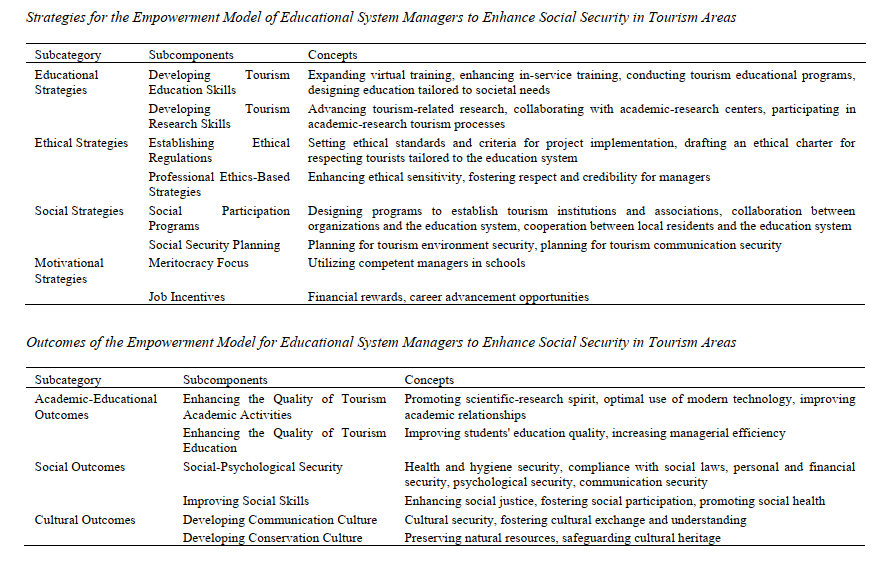
Findings: The findings revealed that the causal conditions for empowering educational system managers to enhance social security in tourism areas included psychological-emotional empowerment, ethical empowerment, professional empowerment, social empowerment, and cultural empowerment. Contextual conditions encompassed economic infrastructure, supportive infrastructure, educational infrastructure, and cultural infrastructure. Intervening conditions involved organizational barriers, human barriers, socio-cultural barriers, and economic barriers. Outcomes included academic-educational outcomes, social outcomes, and cultural outcomes. Strategies were categorized into educational strategies, social strategies, ethical strategies, and motivational strategies. The results of the fuzzy Delphi method indicated that all the concepts related to the paradigm model for empowering educational system managers to enhance social security in tourism areas had an acceptance threshold above 0.7, confirming the identified components of the paradigm model.
Conclusion: Implementation of this empowerment model can promote effective managerial performance, secure tourism development, and reinforce the education system’s capacity to cultivate cultural awareness, greater social well-being, and sustainable tourism practices.
Downloads
Downloads
Additional Files
Publication Timeline
- Submitted
- Revised
- Accepted
Issue
Section
License
Copyright (c) 2025 Kazem Solouki (Author); Mitra Sadoughi (Corresponding Author); Samira Pali (Author)

This work is licensed under a Creative Commons Attribution-NonCommercial 4.0 International License.