Sensory Marketing Model Based on Consumer Nostalgic Preferences in the Retail Industry
DOI:
https://doi.org/10.61838/kman.ijimob.5.5.10Keywords:
Sensory marketing, nostalgia, retail industryAbstract
Objective: The objective of this study is to design a sensory marketing model based on consumer nostalgic preferences in the retail industry.
Methodology: To achieve this, a qualitative research method, specifically grounded theory (Strauss & Corbin), was employed. The research population consists of experts and faculty members in business and management (e.g., branding, marketing, and management), from whom interviews were conducted. To collect data, in-depth interviews were utilized.
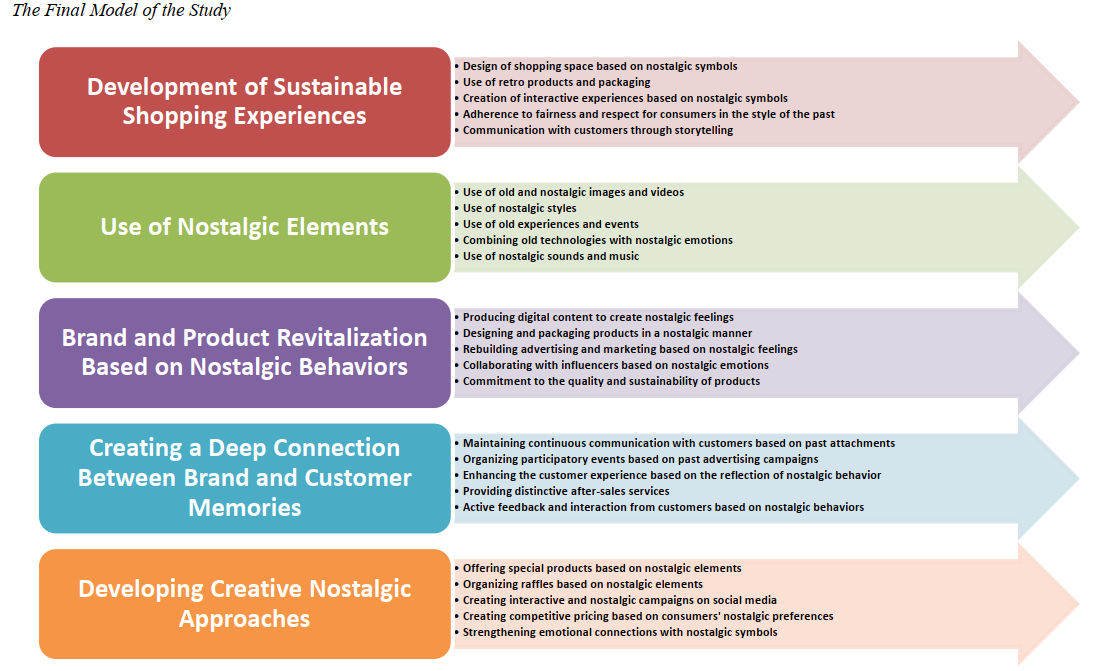
Findings: The findings of the research revealed five main dimensions: 1) Developing lasting shopping experiences (designing retail spaces based on nostalgic symbols, using retro products and packaging, creating interactive experiences based on nostalgic symbols, maintaining fairness and respect toward consumers in an old-fashioned manner, and connecting with customers through storytelling), 2) Utilizing nostalgic elements (using old and nostalgic images and videos, incorporating nostalgic styles, leveraging old experiences and events, combining old technologies with nostalgic feelings, and using nostalgic sounds and music), 3) Rebuilding brands and products based on nostalgic behaviors (producing digital content to evoke nostalgic feelings, designing and packaging products in a nostalgic manner, reconstructing advertising and marketing based on nostalgic feelings, collaborating with influencers based on nostalgic feelings, and committing to product quality and sustainability), 4) Creating a deep connection between the brand and customer memories (maintaining continuous relationships with customers based on past attachments, organizing participatory events based on past promotions, enhancing customer experience through nostalgic behavior reflections, providing differentiated after-sales services, and obtaining active feedback and interaction from customers based on nostalgic behaviors), and 5) Developing creative nostalgic approaches (offering special products based on nostalgic elements, organizing nostalgic-themed raffles, creating interactive and nostalgic campaigns on social media, developing competitive pricing based on consumers' nostalgic preferences, and strengthening emotional connections with nostalgic symbols).
Conclusion: In conclusion, this study highlights the significant role of nostalgic elements in shaping sensory marketing strategies in the retail industry. By identifying key dimensions such as the development of sustainable shopping experiences and brand revitalization based on nostalgic behaviors, the research underscores the importance of creating deep emotional connections with consumers.
Downloads
References
Ashfaq, S., Hosseini, S. H. K., & Mansouri, F. (2019). The Impact of Nostalgia and Experiential Marketing on Customer Satisfaction Through Experiential Values: A Study of Tourist Attractions in Isfahan. Urban Tourism Quarterly, 2(6), 1-32. https://jut.ut.ac.ir/article_72079.html
Ashouri, M., & Saeednia, H. (2022). The Impact of Financial and Physical Rewards and Internal Marketing on Work Engagement and Turnover Intention with the Mediating Role of Job Satisfaction. First National Conference on Applied Research in Modern Management and Accounting Sciences, Alborz.
Bahrami, M., Khani, N., & Rahimi, L. (2023). Analyzing the Impact of Key Factors of Entertainment-Based Retail Marketing on Customer Repurchase Intention (Case Study: Isfahan City Center). New Trends in Marketing, 1(1), 22-42. https://www.jntm.ir/article_246018.html
Beyari, H., Hashem, T. N., & Alrusaini, O. (2024). Neuromarketing: Understanding the effect of emotion and memory on consumer behavior. Journal of Project Management, 9(4), 323-336. https://doi.org/10.5267/j.jpm.2024.9.001
Chandrasekaran, S., & Chandrasekar, K. (2016). Consumer psychology with sensory marketing effect from canonical correlation analysis. International Journal of Advanced Research in Management and Social Sciences, 5(1), 157-172. https://www.tjaes.org/index.php/tjaes/article/view/1599
Garrido, S. (2019). The influence of personality and coping style on the affective outcomes of nostalgia: Is nostalgia a healthy coping mechanism or rumination? Personality and individual differences, 125, 1-6. https://spsyj.ssrc.ac.ir/m/article_2760.html?lang=en
Ghaedi, A., Seyed Amiri, N., & Faroudi, P. (2022). The Impact of Multisensory Marketing on Advertising Effectiveness with the Mediating Role of Consumer Attitude Toward Advertising (Case Study: Online Retail Industry). Consumer Behavior Studies, 9(4), 110-136. https://cbs.uok.ac.ir/article_62397.html
Ghaedy, A., Seyyedamiri, A., & Foroudi, P. (2023). The Impact of Multi-sensory Marketing on Advertising Effectiveness Mediated by Consumer Attitude towards Advertising (Studied Case: Online Retail Industry). Consumer Behavior Studies Journal, 9(4), 110-136. https://doi.org/10.34785/j018.2022.011
Ghazvini, N. S., Nazari, E., Salleh, N. Z. M., & Baharun, R. (2024). The Role and Application of Artificial Intelligence in Neuromarketing Research Based on Electroencephalography (EEG). International Journal of Academic Research in Business and Social Sciences, 14(12), 1556-1567. https://doi.org/http://dx.doi.org/10.6007/IJARBSS/v14-i12/24111
Hamacher, K., & Buchkremer, R. (2022). Measuring Online Sensory Consumer Experience: Introducing the Online Sensory Marketing Index (OSMI) as a Structural Modeling Approach. Journal of Theoretical and Applied Electronic Commerce Research, 17(2), 751-772. https://doi.org/10.3390/jtaer17020039
Holton, B., Braus, N., & Van Dyke, M. (2012). Sensory Marketing. Commercial Printing and Publishing Company. https://www.researchgate.net/publication/295478713_Sensory_Marketing
Kabiri, S., Vazifehdoust, H., Saeidi, P., & Paghah, A. (2020). Providing a Customer Purchase Decision Model with Sensory and Experiential Marketing Approaches. Iranian journal of management sciences, 15(59), 96-124. https://journal.iams.ir/article_337.html
Kazemi, R., Iman Khan, N., & Fattahi, M. (2021). The Role of Sensory Marketing in Enhancing Customer Experience and Purchase Intention (Case Study: Ofogh Kourosh Chain Stores). Business Management, 20(50), 416-435. https://civilica.com/doc/1251432/
Mokhdoumi Gharehbolagh, M. (2012). Developing a Consumer Loyalty Model: Investigating the Impact of Sensory Marketing Tarbiat Modares University, Faculty of Management and Economics, Tehran]. https://elmnet.ir/article/10608546-81202/%D8%AA%D9%88%D8%B3%D8%B9%D9%87-%D9%85%D8%AF%D9%84-%D9%88%D9%81%D8%A7%D8%AF%D8%A7%D8%B1%DB%8C-%D9%85%D8%B5%D8%B1%D9%81-%DA%A9%D9%86%D9%86%D8%AF%D9%87-_-%D8%A8%D8%B1%D8%B1%D8%B3%DB%8C-%D8%AA%D8%A7%D8%AB%DB%8C%D8%B1-%D8%A8%D8%A7%D8%B2%D8%A7%D8%B1%DB%8C%D8%A7%D8%A8%DB%8C-%D8%AD%D8%B3%DB%8C
Norouzi, H., & Darvish, F. (2022). Investigating the Impact of Sensory Marketing on Brand Equity in the Tourism Industry (Case Study: Four and Five-Star Hotels in Tehran Province). Tourism and Leisure, 18(14), 133-150. https://tlj.usc.ac.ir/article_169590.html
Saeidi, P., Paghah, A., Kabiri, S., & Vazifehdoust, H. (2020). Providing a Customer Purchase Decision Model with Sensory and Experiential Marketing Approaches. Iranian journal of management sciences, 12(59), 95-124. https://journal.iams.ir/article_337.html
Shahid, S., Paul, J., Gilal, F. G., & Ansari, S. (2022). The role of sensory marketing and brand experience in building emotional attachment and brand loyalty in luxury retail stores. Psychology & Marketing. https://doi.org/10.1002/mar.21661
Tajfar, A. H., & Masoumi, A. (2022). The Impact of Sensory Marketing on Customer Loyalty and Brand Equity of Hakoupian Stores. Management, Accounting, and Law Studies, 16(3), 226-241. https://civilica.com/doc/1480595/
Valipouri, Z., Jalali, S. M., & Tabrizian, B. (2022). Designing a Sensory Marketing Model: Antecedents and Strategies in the Fast-Moving Consumer Goods Industry. Strategic Management Studies, 23(51), 265-287. https://www.smsjournal.ir/article_125230.html
Young, J., Kim Mark, J., Chang, J., & Bluck, S. (2022). Nostalgic marketing, perceived self-continuity, and consumer decisions. Management Decision, 54(8), 1-40. https://www.researchgate.net/publication/260104287_Missing_Ingredients_in_Metaphor_Advertising_The_Right_Formula_of_Metaphor_Type_Product_Type_and_Need_for_Cognition
Downloads
Additional Files
Publication Timeline
- Submitted
- Revised
- Accepted
Issue
Section
License
Copyright (c) 2025 Vahid Sadeghitabar (Author); Mohammadreza Rostami (Corresponding Author); Seyyed Hossein Hosseini, Mehdi Sanei (Author)

This work is licensed under a Creative Commons Attribution-NonCommercial 4.0 International License.