Identification of Indicators for Personalized Marketing with an Artificial Intelligence Approach in the Fourth Industrial Revolution
DOI:
https://doi.org/10.61838/kman.ijimob.5.5.13Keywords:
Artificial Intelligence, Personalized Marketing, Customer Experience, Data Management, Consumer Behavior, Ethical Considerations, Fourth Industrial Revolution, Marketing Strategies, AI in MarketingAbstract
Objective: This study aims to explore the role of artificial intelligence (AI) in personalized marketing within the context of the Fourth Industrial Revolution.
Methodology: A qualitative research design was employed to gather in-depth insights from 11 professionals with expertise in marketing, AI, and the Fourth Industrial Revolution. Semi-structured interviews were conducted to explore participants' perspectives on AI-driven personalized marketing. Thematic analysis was used to identify key patterns and themes related to AI's role in enhancing customer interactions, data management, and marketing effectiveness.
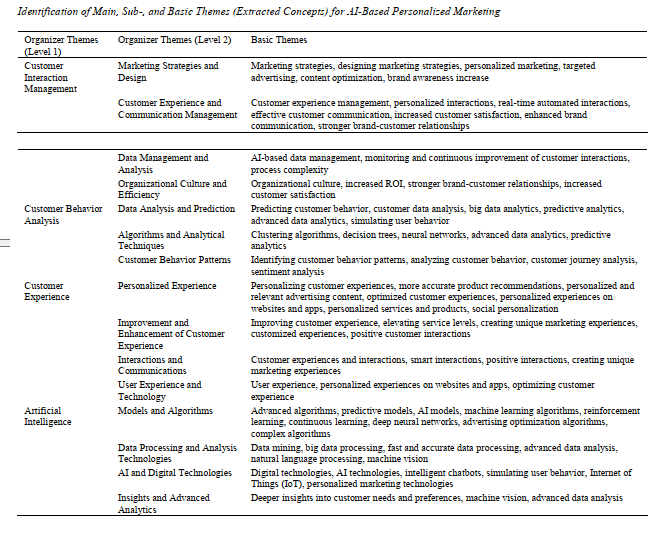
Findings: The study revealed several key themes: (1) the critical importance of data management and real-time analytics in enabling AI-driven personalization, (2) AI's transformative impact on customer experience through personalized content, recommendation systems, and real-time interactions, (3) the role of AI in improving customer engagement and retention through targeted, relevant marketing messages, and (4) ethical concerns regarding data privacy and the transparent use of customer data in AI applications. AI was found to significantly enhance customer experiences, but ethical challenges must be addressed to ensure trust and loyalty.
Conclusion: AI-driven personalized marketing holds substantial promise for improving customer engagement and satisfaction. However, businesses must balance the benefits of personalization with ethical considerations, ensuring transparency in data usage and maintaining consumer trust. Future research should explore the long-term impact of AI on customer loyalty, consumer perceptions, and regulatory frameworks to guide ethical AI implementation in marketing.
Downloads
References
Almuraqab, N. A. S. (2024). Exploring Determinants That Influence the Usage Intention of AI-Based Customer Services in the UAE. Journal of Global Information Management, 32(1), 1-16. https://doi.org/10.4018/jgim.343308
Behera, R. K. (2024). Empowering Co-Creation of Services With Artificial Intelligence: An Empirical Analysis to Examine Adoption Intention. Marketing Intelligence & Planning, 42(6), 941-975. https://doi.org/10.1108/mip-08-2023-0412
Bhuiyan, M. S. (2024). The Role of AI-Enhanced Personalization in Customer Experiences. Journal of Computer Science and Technology Studies, 6(1), 162-169. https://doi.org/10.32996/jcsts.2024.6.1.17
Blümel, J. H. (2023). Personal Touch in Digital Customer Service: A Conceptual Framework Of relational Personalization For conversational AI. Journal of Service Theory and Practice, 34(1), 33-65. https://doi.org/10.1108/jstp-03-2023-0098
Ekechi, C. C. (2024). Ai-Infused Chatbots for Customer Support: A Cross-Country Evaluation of User Satisfaction in the Usa and the Uk. International Journal of Management & Entrepreneurship Research, 6(4), 1259-1272. https://doi.org/10.51594/ijmer.v6i4.1057
Ghesh, N. (2023). The Artificial Intelligence-Enabled Customer Experience in Tourism: A Systematic Literature Review. Tourism Review, 79(5), 1017-1037. https://doi.org/10.1108/tr-04-2023-0255
Ghosh, S. (2024). The Role of AI Enabled Chatbots in Omnichannel Customer Service. Journal of Engineering Research and Reports, 26(6), 327-345. https://doi.org/10.9734/jerr/2024/v26i61184
Ho, S. P. S., & Chow, M. Y. C. (2023). The Role of Artificial Intelligence in Consumers’ Brand Preference for Retail Banks in Hong Kong. Journal of Financial Services Marketing, 29(2), 292-305. https://doi.org/10.1057/s41264-022-00207-3
Idian, M. J. I., Hassan, M. K., & Terzungwe, A. S. (2023). Artificial Intelligence, Blockchain, Machine Learning, and Customer Relationship Management. Bincang Sains Dan Teknologi, 2(01), 16-20. https://doi.org/10.56741/bst.v2i01.276
James, B. (2024). Transforming Banking Services: AI-Driven E-Loyalty Strategies and Case Study Insights on Customer Satisfaction and Loyalty Enhancement. https://doi.org/10.4108/eai.23-11-2023.2343232
Khana, A. (2023). Effectiveness of Artificial Intelligence in Building Customer Loyalty: Investigating the Mediating Role of Chatbot in the Tourism Sector of Pakistan. International Journal of Academic Research in Business and Social Sciences, 13(9). https://doi.org/10.6007/ijarbss/v13-i9/18422
Kim, M. (2023). Connecting Artificial Intelligence to Value Creation in Services: Mechanism and Implications. Service Business, 17(4), 851-878. https://doi.org/10.1007/s11628-023-00547-7
Liu‐Thompkins, Y., Okazaki, S., & Li, H. (2022). Artificial Empathy in Marketing Interactions: Bridging the Human-Ai Gap in Affective and Social Customer Experience. Journal of the Academy of Marketing Science, 50(6), 1198-1218. https://doi.org/10.1007/s11747-022-00892-5
Liu, S. Q. (2024). AI Concierge in the Customer Journey: What Is It and How Can It add Value to the Customer? Journal of Service Management, 35(6), 136-158. https://doi.org/10.1108/josm-12-2023-0523
Lopez, G. J. B. (2024). AI Chatbots: Elevating Customer Interactions Amidst Challenges. International Journal of Latest Technology in Engineering Management & Applied Science, 13(5), 152-156. https://doi.org/10.51583/ijltemas.2024.130515
Loureiro, S. M. C., Ferreira, M. M., Bilro, R. G., & Marquès, L. (2023). How Artificial Intelligence Tools Influence Customer Experience and Avoidance of Similarity. Global Fashion Management Conference, 646-649. https://doi.org/10.15444/gmc2023.07.07.04
Nair, P. N. (2024). Examining the Use of Ai-Powered Social Media Analytics for Target Customer Segmentation: A Systematic Review in Retail Industry. Eatp, 1798-1805. https://doi.org/10.53555/kuey.v30i4.1753
Sardesai, S. (2024). Analysing the Impacts of Artificial Intelligence Service Quality and Human Service Quality on Customer Satisfaction and Customer Loyalty in the Hospitality Sector. Turizam, 28(1), 37-48. https://doi.org/10.5937/turizam28-45450
Tula, S. T. (2024). Ai-Enabled Customer Experience Enhancement in Business. Computer Science & It Research Journal, 5(2), 365-389. https://doi.org/10.51594/csitrj.v5i2.789
Yang, X. (2023). The Effects of AI Service Quality and AI Function-Customer Ability Fit on Customer's Overall Co-Creation Experience. Industrial Management & Data Systems, 123(6), 1717-1735. https://doi.org/10.1108/imds-08-2022-0500
Downloads
Additional Files
Publication Timeline
- Submitted
- Revised
- Accepted
Issue
Section
License
Copyright (c) 2025 Seyed yasser Mousavian (Author); Mahmoud Ahmadisharif (Corresponding Author); Farzad Asayesh, Dariyoush Jamshidi (Author)

This work is licensed under a Creative Commons Attribution-NonCommercial 4.0 International License.