Expanding Competitive Advantage Through Knowledge Sharing, Collaboration, and Organizational Innovation (Case Study: Mojan Food Industries Company)
DOI:
https://doi.org/10.61838/kman.ijimob.3671Keywords:
Knowledge Sharing, Collaboration, Organizational Innovation, Competitive Advantage, Structural Equation Modeling, Mojan Food IndustriesAbstract
Objective: This study aims to examine the impact of knowledge sharing, collaboration, and organizational innovation on achieving a sustainable competitive advantage in the Mojan Food Industries Company.
Methodology: The research employed a quantitative approach using structural equation modeling (SEM) to analyze the relationships between key variables. Data were collected through a structured questionnaire distributed to employees of Mojan Food Industries, with a total sample size of 295 respondents. The study measured knowledge sharing, collaboration, organizational innovation, and competitive advantage using validated scales. Data analysis was conducted using Smart PLS software to assess reliability, validity, and path coefficients.
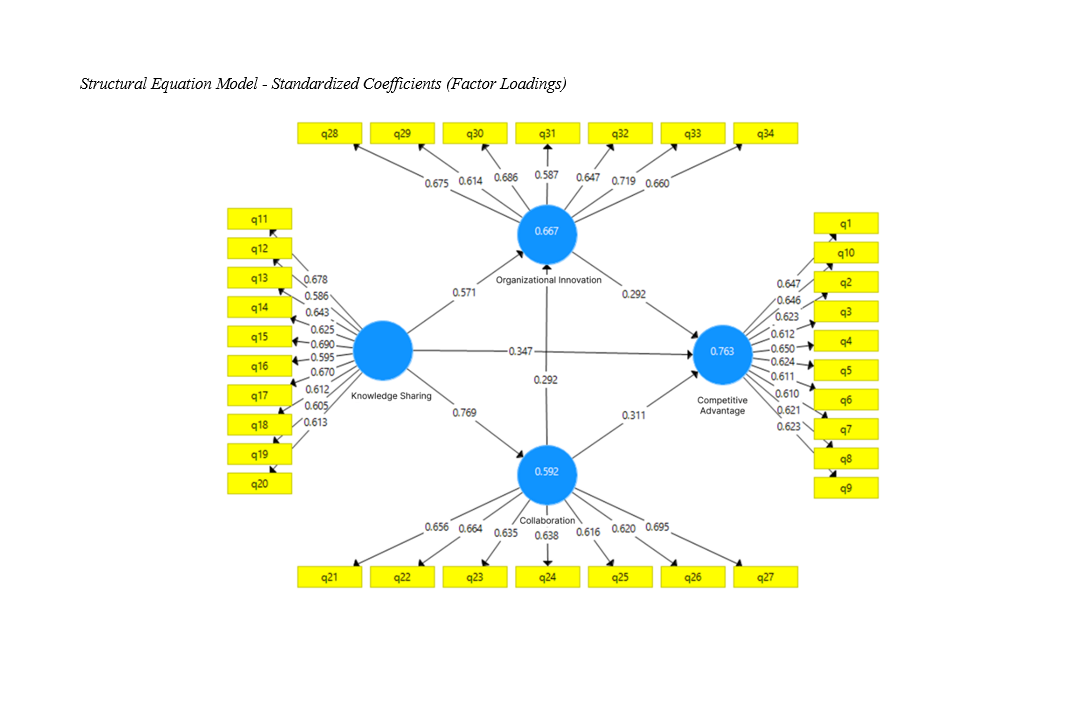
Findings: The results indicate a significant positive relationship between knowledge sharing and competitive advantage (β = 0.347, t = 8.273), knowledge sharing and organizational innovation (β = 0.571, t = 13.324), and knowledge sharing and collaboration (β = 0.769, t = 20.469). Additionally, organizational innovation positively influences competitive advantage (β = 0.292, t = 7.669), and collaboration enhances competitive advantage (β = 0.311, t = 7.116). These findings suggest that organizations can strengthen their competitive position by fostering a knowledge-sharing culture, encouraging collaborative practices, and prioritizing innovation. The model's R² values (0.763 for competitive advantage, 0.667 for innovation, and 0.592 for collaboration) confirm its strong explanatory power.
Conclusion: The study confirms that knowledge sharing, collaboration, and organizational innovation are essential drivers of competitive advantage. Organizations that invest in structured knowledge-sharing mechanisms, collaborative environments, and innovation initiatives are better positioned to sustain market leadership. The findings underscore the need for companies to integrate these factors into their strategic frameworks to achieve long-term success in competitive markets.
Downloads
References
Asheqi Oskouei, H. (2020). A Model for Achieving Sustainable Green Competitive Advantage in the Cement Industry. Strategic Management Studies, 41, 111-137. https://www.researchgate.net/publication/369692765_A_green_sustainable_competitive_advantage_model_in_cement_industry_in_Persian
Bahmani Rad, M. H. (2024). The Impact of Business Strategic Orientation on Organizational Performance with the Mediating Role of Innovation. Technology in Collaboration and Strategic Management, 7, 301-313. https://www.researchgate.net/publication/385677629_The_Impact_of_Business_Strategic_Orientation_on_Organizational_Performance_with_the_Mediating_Role_of_Innovation
Gheytarani, F. (2020). The Role of Organizational Human Resources in Transforming Strategies and Dynamic Capabilities into Competitive Advantage. Modern Research Approaches in Management and Accounting, 34, 57-73. https://majournal.ir/index.php/ma/article/view/403
Hoang, D. V., Hien, N. T., Thang, H. V., Phuong, P. T. L., & Duong, T. T. (2025). Digital Capabilities and Sustainable Competitive Advantages: The Case of Emerging Market Manufacturing SMEs. Sage Open, 15(2). https://doi.org/10.1177/21582440251329967
Kayanan, C. M. (2022). A critique of innovation districts: Entrepreneurial living and the burden of shouldering urban development. EPA: Economy and Space, 54(1), 50-66. https://doi.org/10.1177/0308518X211049445
Kemp, A. (2024). Competitive advantage through artificial intelligence: Toward a theory of situated AI. Academy of Management Review, 49(3), 618-635. https://doi.org/10.5465/amr.2020.0205
Mbaidin, H. O. (2024). The Striking Mechanisms of Innovation Theories to Create Collaborative Competitive Advantage Opportunities in Global Digital Marketing. Journal of Project Management, 9(4), 433-456. https://doi.org/10.5267/j.jpm.2024.7.004
Moradi, S., Abbasi, J., Radfar, R., & Abdolvand, M. A. (2024). Qualitative Identification of Intervening Factors Affecting Digital Marketing Strategies in Successful Iranian Startups. International Journal of Innovation Management and Organizational Behavior (IJIMOB), 4(2), 46-53. https://doi.org/10.61838/kman.ijimob.4.2.6
Nazneen, A. (2024). The Dynamics of Human Capital Development, Employee Commitment, and Sustainable Competitive Advantage: A Strategic Perspective. International Journal of Religion, 5(8), 391-405. https://doi.org/10.61707/ta9sbd71
Norvadewi, N., & Zaroni, A. N. (2024). Preserving MSMEs Competitive Advantage: Moderation by Business Size. Journal of Accounting and Strategic Finance, 7(1), 39-61. https://doi.org/10.33005/jasf.v7i1.468
Nosratpanah, R., Barani, S., Ashrafzadeh, A., & Atashi, G. (2024). The impact of dynamic service innovation capabilities on firm performance: The moderating role of perceived environmental dynamism and the mediating role of service innovation and competitive advantage. Business Management, 16(1), 137-166.
Nurcahyo, A. (2024). The Effect of Strategic Leadership and Environmental Management on Firm Performance Mediated by Competitive Advantage in the Mining Industry. Dinasti International Journal of Economics Finance & Accounting, 5(3), 1828-1838. https://doi.org/10.38035/dijefa.v5i3.3182
Ochuba, N. A. (2024). A Comprehensive Review of Strategic Management Practices in Satellite Telecommunications, Highlighting the Role of Data Analytics in Driving Operational Efficiency and Competitive Advantage. World Journal of Advanced Engineering Technology and Sciences, 11(2), 201-211. https://doi.org/10.30574/wjaets.2024.11.2.0099
Pasaribu, H., Ghozali, Z., Susilawati, M., & Masnoni, M. (2025). Transformation of Strategic Management Accounting to Support Innovation and Competitive Advantage in the Digitalization Era. Jurnal Nawala, 2(1), 213-225. https://doi.org/10.62872/y9x0ck85
Renalwin, R. (2025). The Influence of Learning Organizational Culture, Employee Engagement, Digital Transformation, and Esg on Sustainable Competitive Advantage: The Role of Transformational Leadership at Abc University, Indonesia. International Journal of Social Science Humanity & Management Research, 04(03). https://doi.org/10.58806/ijsshmr.2025.v4i3n08
Shafaat Takoldan, M., Jahanshad, A., & Pourzamani, Z. (2024). Explaining the model of intellectual capital and competitive advantage in startups. Dynamic Management and Business Analysis, 3(5), 332-350.
Shafiei, M., & Sarmast, P. (2024). The impact of supply chain management processes on competitive advantage and organizational performance (Sapco Company case study). Quantitative studies in management,
Shao, W. (2025). The Role of Digital Transformation in Enhancing Organizational Agility and Competitive Advantages: A Strategic Perspective. Advances in Economics Management and Political Sciences, 154(1), 115-120. https://doi.org/10.54254/2754-1169/2024.19552
Shokarriz, J., & Khadem Pour, M. (2024). The Impact of Knowledge Management and Organizational Innovation on Organizational Innovation Considering the Mediating Role of Digital Leadership Capability (A Case Study of Knowledge-Based Companies). Modern Research Approaches in Management and Accounting, 93, 1321-1329. https://www.majournal.ir/index.php/ma/article/view/2760
Solis, E., Karimi, K., Garcia, I., & Mohino, I. (2021). Knowledge Economy Clustering at the Intrametropolitan Level: Evidence from Madrid. Journal of the Knowledge Economy, 1(1), 1-43. https://link.springer.com/article/10.1007/s13132-021-00748-3
Tan, J., Gu, K., & Zheng, Y. (2023). Peri-urban planning: A landscape perspective. Planning Theory, 0(0), 1-22. https://doi.org/10.1177/14730952231178203
Van Nguyen, T. T. B. N. (2024). Service Quality as a Catalyst for Competitive Advantage and Business Performance in Hotel Industry: An Empirical Analysis by PLS-SEM Algorithm. International Journal of Analysis and Applications, 22, 141. https://doi.org/10.28924/2291-8639-22-2024-141
Zandiatashbar, A., & Hamidi, S. (2022). Exploring the microgeography and typology of U.S. high-tech clusters. Cities, 131, 103973. https://doi.org/10.1016/j.cities.2022.103973
Zhang, Z., Sun, C., Mikeska, M., & Vochozka, M. (2024). Does the competitive advantage of digital transformation influence comparability of accounting information? Journal of Competitiveness, 16(1).
Downloads
Additional Files
Publication Timeline
- Submitted
- Revised
- Accepted
Issue
Section
License
Copyright (c) 2025 Soroush Sardashti (Corresponding Author)

This work is licensed under a Creative Commons Attribution-NonCommercial 4.0 International License.