Investigating the Impact of COVID-19 Consequences on Supply Chain Integration and Performance with the Mediating Role of Organizational Strategic Flexibilities (Case Study: Iranian Airlines)
DOI:
https://doi.org/10.61838/kman.ijimob.4812Keywords:
COVID-19 consequences, supply chain integration, supply chain performance, strategic flexibilitiesAbstract
Objective: This study aims to investigate the effect of COVID-19 consequences on supply chain integration and supply chain performance, considering the mediating role of strategic flexibility in Iranian airline companies.
Methods and Materials: This applied, descriptive-correlational study examined employees of airline companies in Tehran as the statistical population (N = 3400). Using Cochran’s formula, a sample of 240 participants was selected through purposive sampling. Data were collected via a Likert-scale questionnaire whose reliability was confirmed through Cronbach’s alpha coefficients exceeding 0.70. Data analysis was conducted using SPSS and PLS software at both descriptive and inferential levels. Descriptive indicators such as mean, standard deviation, and frequency distribution were used, while structural equation modeling (SEM) and path analysis tested the research hypotheses. Additional indices such as CR, AVE, Q², SRMR, NIF, and GOF were used to evaluate model fit. The Sobel test was applied to assess the mediating role of strategic flexibility.
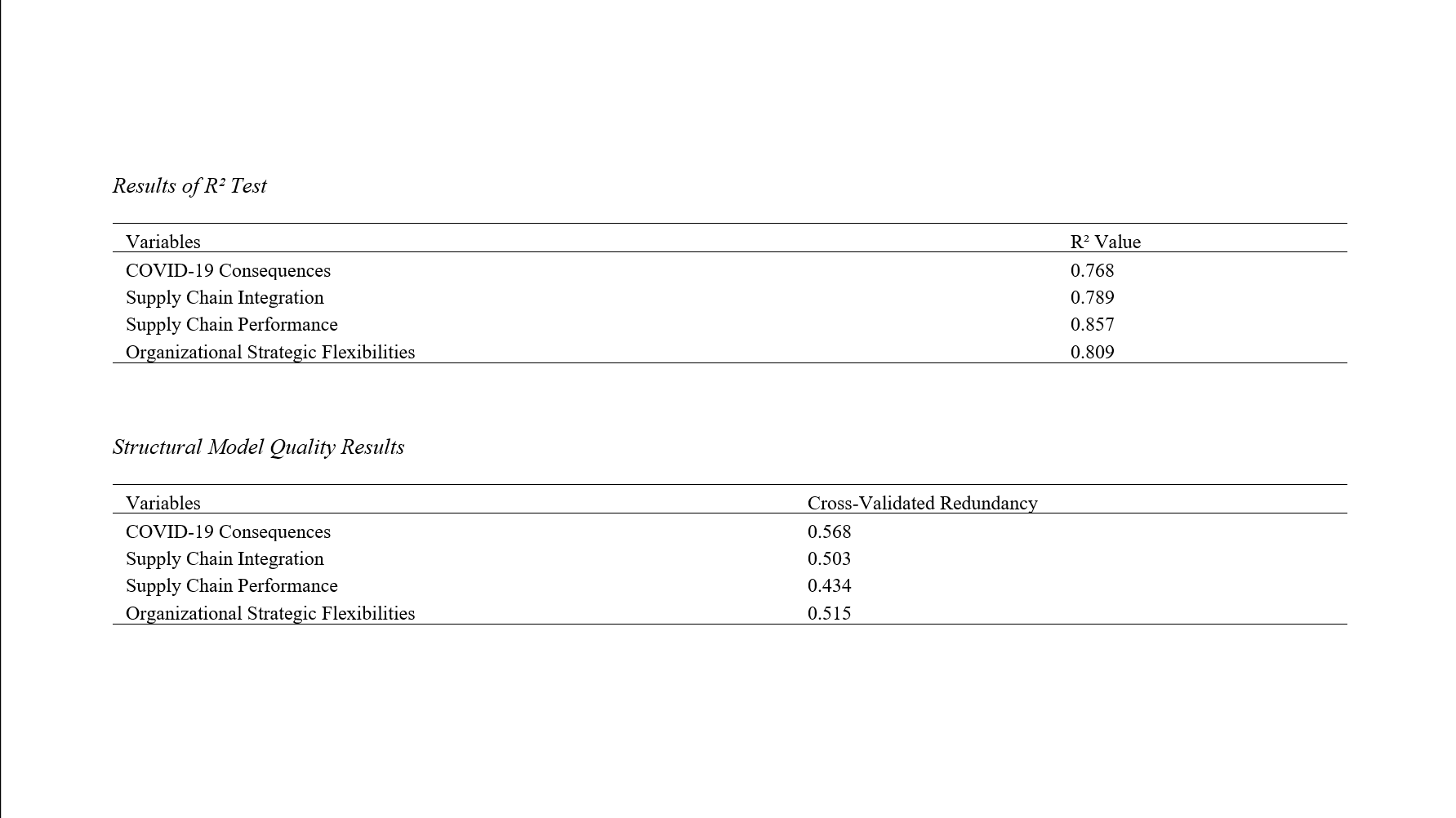
Findings: Results indicated that COVID-19 consequences significantly affected supply chain integration (β = 0.456, t = 10.100) and supply chain performance (β = 0.325, t = 10.222). COVID-19 also had a significant effect on strategic flexibility (β = 0.258, t = 7.455). Strategic flexibility significantly influenced supply chain integration (β = 0.459, t = 8.200) and supply chain performance (β = 0.369, t = 12.123). Sobel test results confirmed the mediating role of strategic flexibility, with indirect effects of 0.39 and 0.44, both with confidence intervals above zero. Model fit indices and R² values supported strong predictive power and high model adequacy.
Conclusion: The findings demonstrate that COVID-19 consequences significantly shape supply chain integration and performance, and strategic flexibility serves as a vital mediating mechanism that enhances organizational resilience and operational effectiveness within Iranian airline supply chains.
Downloads
References
Akbari Noghabi, M. S., Kafash Pour, A., & Pouya, A. (2020, 2020). Investigating the Impact of Strategic Leadership on Creating Sustainable Competitive Advantage with the Mediating Role of Strategic Flexibility. The 6th National Conference on Modern Research in Humanities, Economics and Accounting, Tehran.
Asare, B., Nuertey, D., & Poku, E. (2023). Innovation-oriented supply chain integration for structural flexibility and strategic business performance. Benchmarking: An International Journal, ahead-of-print(ahead-of-print).
Barlow, A., & Li, F. (2020). Online value network linkages: integration, information sharing and flexibility. https://www.sciencedirect.com/science/article/abs/pii/S1567422304000419
Bowersox, D. J., Closs, D. J., & Stank, T. P. (2019). Ten mega-trends that will revolutionize supply chain logistics. Journal of Business Logistics, 21(2), 1-16. https://www.researchgate.net/publication/248649433_Ten_Mega-Trends_That_Will_Revolutionize_Supply_Chain_Logistics
Chandra, C., Grabis, J., & Tumanyan, A. (2019). Problem taxonomy: a step towards effective information sharing in supply chain management. International Journal of Production Research, 45(11), 2507-2544. https://doi.org/10.1080/00207540601020486
Ghobakhloo, M., Iranmanesh, M., Foroughi, B., Tseng, M. L., Nikbin, D., & Khanfar, A. A. (2025). Industry 4.0 digital transformation and opportunities for supply chain resilience: a comprehensive review and a strategic roadmap. Production Planning & Control, 36(1), 61-91. https://doi.org/10.1080/09537287.2023.2252376
Huang, G. Q., Lau, J. S. K., & Mak, K. L. (2021). The Impacts Of Sharing Production Information On Supply Chain Dynamics. International Journal of Production Research, 41(7), 1483-1517. https://doi.org/10.1080/0020754031000069625
Li, S., & Lin, B. (2021). Accessing information sharing and information quality in supply chain management. Decision Support Systems, 42, 1641-1656. https://doi.org/10.1016/j.dss.2006.02.011
Lin, H. F. (2019). Knowledge sharing and firm innovation capability: an empirical study. International Journal of Manpower, 28(3/4), 315-332. https://doi.org/10.1108/01437720710755272
Madlberger, M. (2021). What drives firms to engage in interorganizational information sharing in supply chain management? International Journal of E-Collaboration, 5(2), 18-42. https://doi.org/10.4018/jec.2009040102
Maleki, H., & Maleki, H. (2021, 2021). Designing a Conceptual Framework for Blockchain Technology Applications in the Supply Chain: A Meta-Synthesis Approach. The 1st International Conference on Blockchain, Cryptocurrencies, and the Global Economy, Tehran.
Marvi, R. (2023). Resilience Model of the Supply Chain in the Promotion of Health Tourism Services in Tehran Province. Dynamic Management and Business Analysis, 2(1), 26-37. https://doi.org/10.61838/dmbaj.2.1.3
Masadeh, R., Al-Husban, D., & Al-Abbadi, L. (2023). The impact of strategic thinking and cognitive ability on competitive advantage: The mediating role of future foresight. Uncertain Supply Chain Management, 11(1), 253-260.
Mitchell, E. M., & Kovach, J. V. (2018). Improving supply chain information sharing using Design for Six Sigma. Investigaciones Europeas de Dirección y Economía de la Empresa. https://www.sciencedirect.com/science/article/pii/S1135252315000088
Mohammad Salahi, A. (2021, 2021). Investigating Information Sharing and Collaborative Behaviors with Supply Chain Performance (SCM) in Knowledge-Based Companies. The 1st International Conference on the Leap in Management Sciences, Economics, and Accounting, Sari.
Ofek, E., & Sarvary, M. (2018). Leveraging the customer base: creating competitive advantage through knowledge Management. https://www.jstor.org/stable/822533
Oyombe, G. G., Awino, Z. B., Ogutu, M., & Njihia, J. (2023). How Leagile Strategy and Strategic Partnership Affect Competitive Advantage of Construction Supply Chains. Journal of Business Strategy, Finance and Management, 04(02), 184-201. https://doi.org/10.12944/jbsfm.04.02.02
Pramono, A. J., Suwarno, S., Amyar, F., & Lisdiono, P. (2023). The effect of strategic management accounting on strategic supply chain through internal and external orientation.
Rahim, A., & Bushehri, A. (2019, 2019). Investigating the Role of Blockchain Technology in Improving the Performance of the Defense Industry Supply Chain. The 1st International Conference on Knowledge Management, Blockchain, and Economics, Tehran.
Seyed Nejad Fahim, S. R. (2024). Analyzing the Role of Strategic Management Accounting in Sustainable Supply Chain Management (Case Study: Food Manufacturing Companies in Gilan Province). Green Development Management Studies.
Shafiei Alavi, H., & Estakhrian Haghighi, A. R. (2021, 2021). Benefits and Limitations of Using Blockchain Technology in Supply Chain Management. The 4th International Annual Conference on Recent Developments in Management, Economics, and Accounting, Tehran.
Sun, S., & Yen, J. (2021). Information supply chain: A unified framework for information-sharing. ISI, LNCS 3495, 422-428. https://doi.org/10.1007/11427995_38
Tanhai, F., & Ahmadi Motlagh, S. D. (2022, 2022). Information Sharing and Quality in the Supply Chain and the Relationship between Information Sharing and Production Operations. The 4th National Conference on Knowledge Management and E-Business with a Resistive Economy Approach, Mashhad.
Tari, S. (2022, 2022). Investigating the Impact of Blockchain Adoption and Knowledge Sharing on Supply Chain Performance. The 12th International Conference on Recent Advances in Management and Industrial Engineering,
Varkiani Pour, N., & Sarhadi, S. B. (2024). The impact of strategic human resource management and artificial intelligence on determining supply chain agility and supply chain resilience.
Yamin, B. M., Almuteri, S. D., Bogari, K. J., & Ashi, A. K. (2024). The Influence of Strategic Human Resource Management and Artificial Intelligence in Determining Supply Chain Agility and Supply Chain Resilience. Sustainability, 16(7), 2688. https://doi.org/10.3390/su16072688
Zahedi, M. R., & Naghdi Khanehchah, S. (2020, 2020). Presenting a Model for Implementing Blockchain Technology in the Supply Chain and Partner Network of Project-Based Organizations. The 2nd International Conference on Knowledge Management, Blockchain, and Economics, Tehran.
Zhang, X., Li, Y., Zhu, J., & Zhou, X. (2023). Pricing Game Models of Hybrid Channel Supply Chain: A Strategic Consumer Behavior Perspective. Journal of Theoretical and Applied Electronic Commerce Research, 18(3), 1177-1195. https://doi.org/10.3390/jtaer18030060
Zhou, H., & Benton, W. C. (2020). Supply Chain Practice and Information Sharing. Journal of Operations Management, 25, 1348-1365. https://doi.org/10.1016/j.jom.2007.01.009
Zhou, J., Chen, Y., & Li, M. (2024). Supply chain diversification as a strategic response to environmental uncertainty: The role of AI. Journal of Supply Chain Management, 60(2), 22–38. https://doi.org/10.1111/jscm.12123
Downloads
Additional Files
Publication Timeline
- Submitted
- Revised
- Accepted