Artificial Intelligence in Strategic Management: A Quantitative Validation of the Proposed Framework in Iraqi Public Universities
DOI:
https://doi.org/10.61838/kman.ijimob.4971Keywords:
Artificial intelligence , Strategic management, PLS-SEMAbstract
Objective: This study aimed to empirically examine and validate the impact of artificial intelligence on strategic management, with particular emphasis on strategy formulation, strategy implementation, and strategic control.
Methods and Materials: The study adopted a quantitative, applied–developmental research design grounded in a descriptive–analytical approach. Data were collected using a structured questionnaire administered to senior managers and decision-makers within the target organizational context. The measurement instrument encompassed validated indicators of artificial intelligence capabilities and the three core dimensions of strategic management. Reliability and validity were assessed using Cronbach’s alpha, composite reliability, average variance extracted, exploratory factor analysis, and confirmatory factor analysis. Structural relationships among variables were tested using Partial Least Squares Structural Equation Modeling (PLS-SEM) with SmartPLS software, supported by inferential statistical analysis to evaluate correlations and causal paths among constructs.
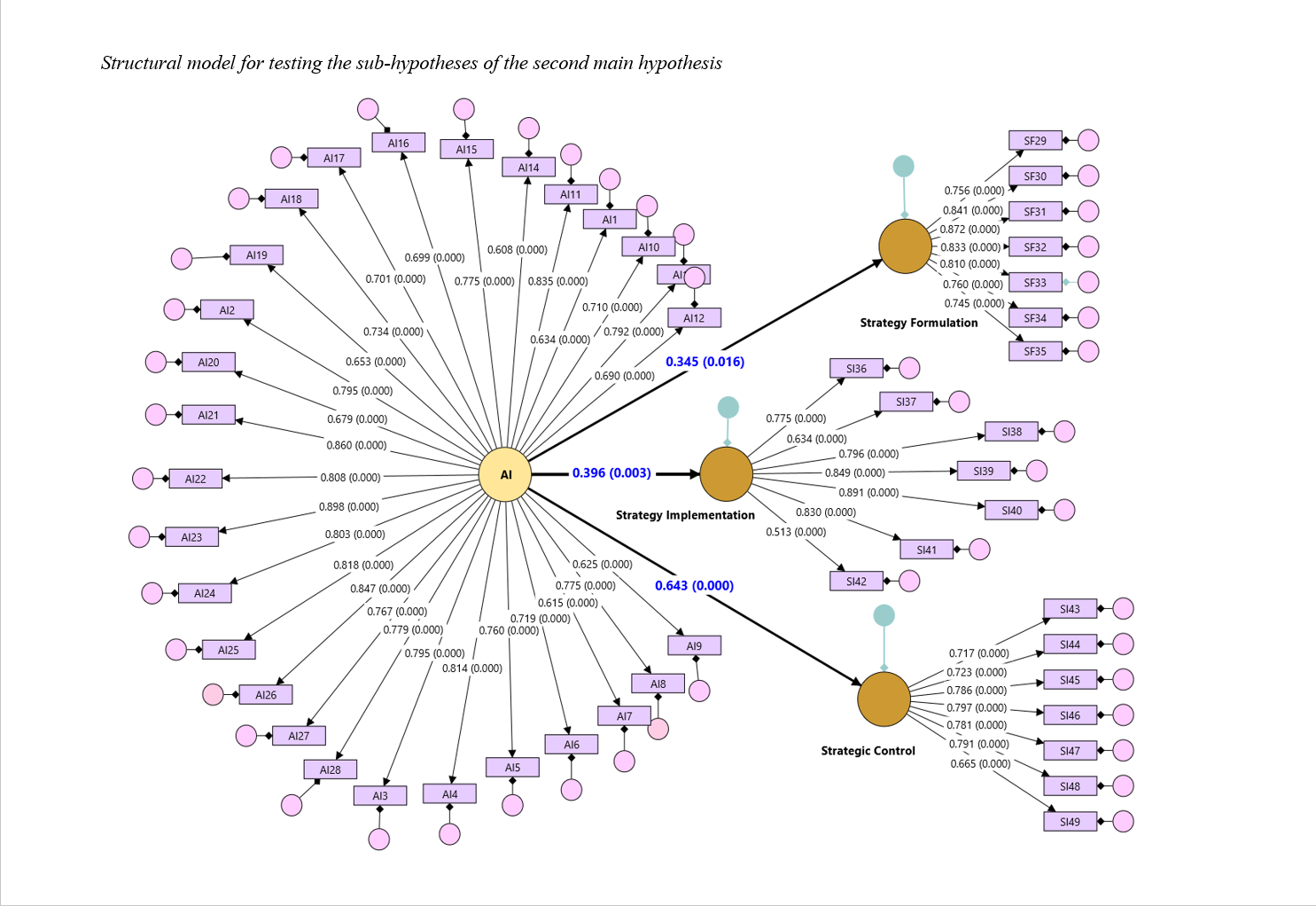
Findings: The inferential results revealed a statistically significant and positive relationship between artificial intelligence and overall strategic management. Structural model analysis demonstrated that artificial intelligence exerted a significant direct effect on strategic management, explaining a substantial proportion of its variance. At the dimensional level, artificial intelligence showed significant positive effects on strategy formulation, strategy implementation, and strategic control, with the strongest effect observed on strategic control.
Conclusion: The findings confirm that artificial intelligence functions as a critical strategic enabler that strengthens the effectiveness of strategic management by enhancing analytical rigor in formulation, operational efficiency in implementation, and real-time oversight in control.
Downloads
References
Alizadeh, H., & Foroughi, M. (2023). A Strategic SWOT Analysis of Leading Electronics Companies based on Artificial intelligence. International Journal of Business Management and Entrepreneurship (IJBME), 2(2), 1-16. https://mbajournal.ir/index.php/IJBME/article/view/42
Anjorin, K. F. (2024). Harnessing Artificial Intelligence to Develop Strategic Marketing Goals. International Journal of Management & Entrepreneurship Research, 6(5), 1625-1650. https://doi.org/10.51594/ijmer.v6i5.1127
Biloslavo, R. (2024). Artificial Intelligence (AI) and Strategic Planning Process Within VUCA Environments: A Research Agenda and Guidelines. Management Decision. https://doi.org/10.1108/md-10-2023-1944
Gusai, O. P., & Rani, A. (2022). Artificial Intelligence: Game Changer in Management Strategies Decision Intelligence Analytics and the Implementation of Strategic Business Management. Springer, Cham. https://doi.org/10.1007/978-3-030-82763-2_4
Hosseini, N., & Sadeghi, Z. (2023). The Role of Artificial Intelligence in Enhancing Strategic Decision-Making in Knowledge-Based Companies in Unstable Environments. Quarterly Journal of Technology and Innovation Management, 15(2), 101-123.
Kiakojouri, D. (2025). The Function of Artificial Intelligence for Transcendent Governance with a Strategic Management Approach. Management Strategies and Engineering Sciences, 7(2), 139-149. https://doi.org/10.61838/msesj.7.2.14
Mahmoud El Sayed El Khouly, S., Yasser, K., & Ahmed Yehia, E. (2022). Developing A New Business Opportunities Via Artificial Intelligence: New Strategic Management Model. 52(4), 677-706. https://doi.org/10.21608/jsec.2022.268733
Meena, R., Mishra, A. K., & Raut, R. K. (2024). Strategic insights: mapping the terrain of artificial intelligence (AI) in banking through mixed method approach. VINE Journal of Information and Knowledge Management Systems, ahead-of-print(ahead-of-print). https://doi.org/10.1108/VJIKMS-01-2024-0028
Mehrabi, R., Hematfar, M., & Safati, F. (2024). Predicting financial distress of companies using a combined artificial immune system model and wavelet neural network (Artificial Intelligence). Technology in Entrepreneurship and Strategic Management, 3(4). https://doi.org/10.61838/kman.jtesm.3.4.10
Mehrani, H., Alizadeh, M., & Rasouli, A. (2022). Evaluation of the Role of Artificial Intelligence Tools in the Development of Financial Services and Marketing. Journal of Technology in Entrepreneurship and Strategic Management, 1(1), 71-82. https://www.journaltesm.com/index.php/journaltesm/article/view/278
Mohammadi, A., Rezaei, S., & Nikzad, H. (2024). The Impact of Artificial Intelligence Technologies on Improving Strategic Decision-Making in Knowledge-Based Organizations: The Mediating Role of Organizational Innovation. Journal of Information Technology Management in Iran, 15(4), 245-270.
Musthafa, H. S. (2024). Strategic Integration of Diversity, Equity, Inclusion (DEI) and Artificial Intelligence (AI) in Human Resource Management (HRM). 173-196. https://doi.org/10.4018/979-8-3693-6402-4.ch006
Nalbant, K. G., & Aydın, S. (2022). Literature review on the relationship between Artificial Intelligence Technologies with Digital Sports Marketing and Sports Management. Indonesian Journal of Sport Management, 2(2), 135-143. https://doi.org/10.31949/ijsm.v2i2.2876
Nazari Zadeh, F., Farsijani, E., & Khazaeil, H. (2023). The Future of Artificial Intelligence in Organizational Strategic Management. Vital Sciences and Emerging Domains, 1(1), 119-156. https://vsna.sndu.ac.ir/article_2565.html
Nazarian-Jashnabadi, J., Ronaghi, M., alimohammadlu, m., & Ebrahimi, A. (2023). The framework of factors affecting the maturity of business intelligence. Business Intelligence Management Studies, 12(46), 1-39. https://doi.org/10.22054/ims.2023.74305.2346
Parsakia, K., & Jafari, M. (2023). Strategies for Enhancing Customer Engagement Using Artificial Intelligence Technologies in Online Markets. Journal of Technology in Entrepreneurship and Strategic Management (JTESM), 2(1), 49-69. https://doi.org/10.61838/kman.jtesm.2.1.6
Pérez-Campuzano, D., Morcillo Ortega, P., Rubio Andrada, L., & López-Lázaro, A. (2021). Artificial Intelligence potential within airlines: a review on how AI can enhance strategic decision-making in times of COVID-19. Journal of Airline and Airport Management; Vol 11, No 2 (2021)DO - 10.3926/jairm.189. http://www.jairm.org/index.php/jairm/article/view/189
Rezaei, M., Ghasemi, N., & Mansouri, A. (2024). Investigating the Impact of Artificial Intelligence on the Strategic Flexibility of Knowledge-Based Companies in VUCA Conditions. Quarterly Journal of Modern Management Research, 9(3), 55-75.
Saadati, E., Ansari, Z., Farahmandnia, A., & Asadi Mehr, K. (2025). A strategy-oriented approach to the application of artificial intelligence technology in accounting: With reference to auditing and management accounting trends. Strategic Management Accounting Quarterly, 2(2), 1-20.
Sajan, A., & Giri, P. (2025). Understanding artificial intelligence and its major role in branding Strategic Brand Management in the Age of AI and Disruption. IGI Global Scientific Publishing. https://doi.org/10.4018/979-8-3693-9461-8.ch006
Sestino, A., & Mauro, A. D. (2021). Leveraging Artificial Intelligence in Business: Implications, Applications and Methods. Technology Analysis and Strategic Management, 34(1), 16-29. https://doi.org/10.1080/09537325.2021.1883583
Shaddel, A. H. (2023). The Future of Management and Decision-Making through the Implementation of Artificial Intelligence Systems. Strategic Foresight Quarterly, 2(5), 121-138. https://civilica.com/doc/2057682/
Sulistiani, A. F. S., & Bustanul, U. (2025). Artificial Intelligence in Financial Forecasting : Enhancing Accuracy and Strategic Planning in Financial Management. Brilliant International Journal Of Management And Tourism, 5(2), 117-124. https://doi.org/10.55606/bijmt.v5i2.4455
Sundari, H., Rajeshkumar, P., Santhanalakshmi, K., & K.N, H. (2025). Artificial Intelligence in Digital Marketing: A Systematic Review and Strategic Framework for AI-Augmented Marketing. International Research Journal on Advanced Engineering and Management (IRJAEM), 3(8), 2595-2611. https://doi.org/10.47392/IRJAEM.2025.0410
Tong, S., Jia, N., Luo, X., & Fang, Z. (2021). The Janus Face of Artificial Intelligence Feedback: Deployment Versus Disclosure Effects on Employee Performance. Strategic management journal, 42(9), 1600-1631. https://doi.org/10.1002/smj.3322
Varkiani Pour, N., & Sarhadi, S. B. (2024). The impact of strategic human resource management and artificial intelligence on determining supply chain agility and supply chain resilience.
Yamin, B. M., Almuteri, S. D., Bogari, K. J., & Ashi, A. K. (2024). The Influence of Strategic Human Resource Management and Artificial Intelligence in Determining Supply Chain Agility and Supply Chain Resilience. Sustainability, 16(7), 2688. https://doi.org/10.3390/su16072688
Downloads
Additional Files
Publication Timeline
- Submitted
- Revised
- Accepted