
The Impact of Smart Tourism Infrastructure and Smart Tourism Governance on Destination Competitiveness with Emphasis on the Mediating Role of Smart Tourism Innovation
DOI:
https://doi.org/10.61838/kman.ijimob.5059Keywords:
smart tourism; smart tourism infrastructure; smart tourism governance; smart tourism innovation; destination competitivenessAbstract
Objective: The objective of this study is to examine the effects of smart tourism infrastructure and smart tourism governance on destination competitiveness, with an emphasis on the mediating role of smart tourism innovation.
Methods and Materials: This study adopts an applied research approach and employs a descriptive–survey design. The statistical population consists of managers, experts, and employees working in tourism companies in the city of Mashhad. A total of 351 respondents were selected using a non-probability convenience sampling method. Data were collected through a standardized questionnaire designed to measure smart tourism infrastructure, smart tourism governance, smart tourism innovation, and destination competitiveness. To analyze the data and test the research hypotheses, structural equation modeling based on the partial least squares approach (PLS-SEM) was used. Reliability and validity of the measurement model were assessed through Cronbach’s alpha, composite reliability, average variance extracted, and discriminant validity tests, followed by evaluation of the structural model using path coefficients, coefficients of determination, predictive relevance, and goodness-of-fit indices.
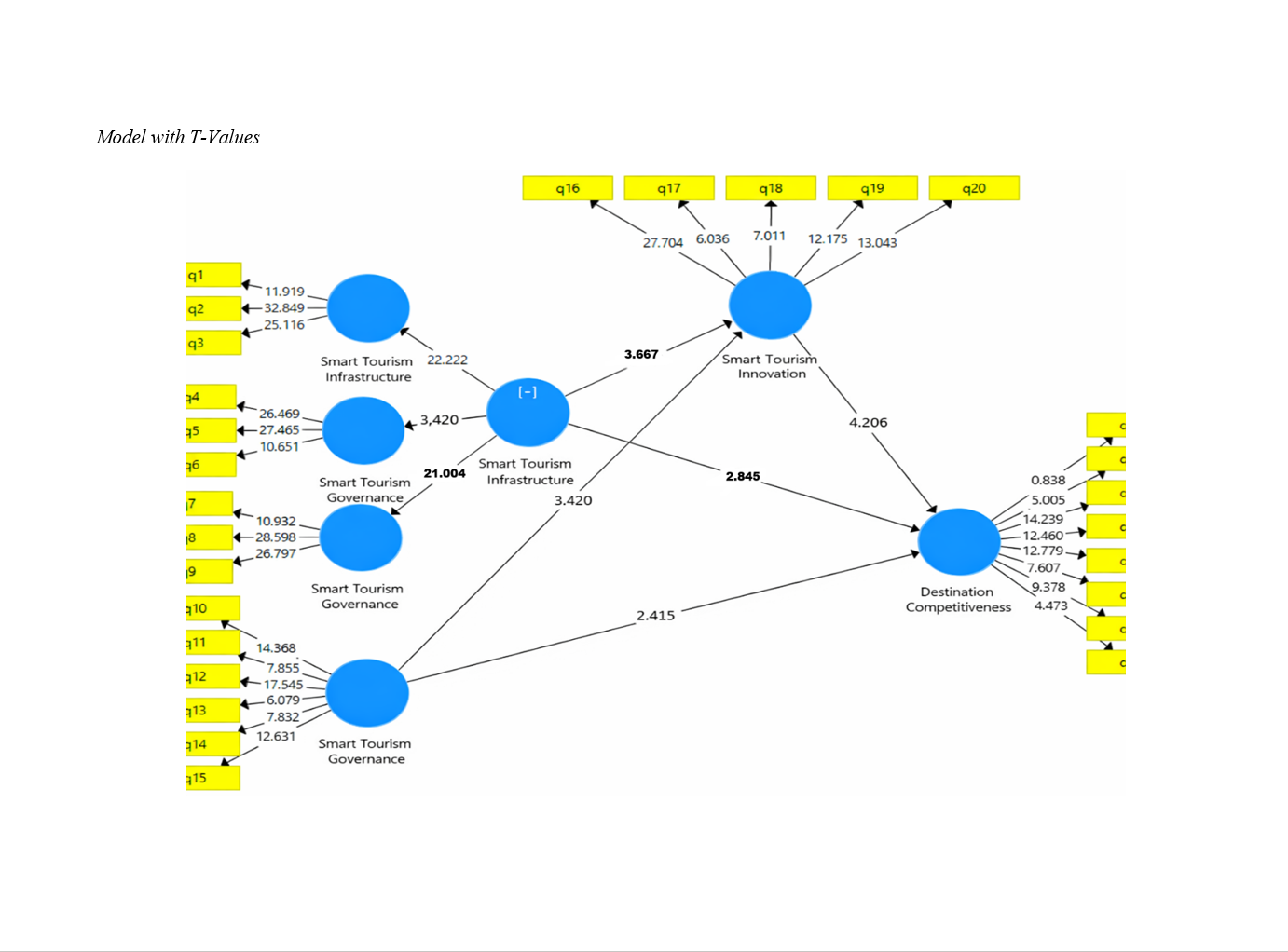
Findings: The results indicate that smart tourism infrastructure has a positive and significant effect on smart tourism innovation and destination competitiveness. Smart tourism governance also shows a positive and significant effect on both smart tourism innovation and destination competitiveness. In addition, smart tourism innovation has a positive and significant effect on destination competitiveness. The mediation analysis confirms that smart tourism innovation plays a significant mediating role in the relationships between smart tourism infrastructure and destination competitiveness, as well as between smart tourism governance and destination competitiveness, indicating that part of the impact of infrastructure and governance on competitiveness is transmitted through innovation.
Conclusion: The findings demonstrate that destination competitiveness in smart tourism contexts is strengthened through the combined effects of smart infrastructure, effective governance, and innovation, highlighting the central role of smart tourism innovation as a strategic mechanism linking technological and institutional capacities to competitive outcomes.
Downloads
References
Abdelmalak, F. (2024). Smart tourism destinations: Governance and resilience: The use of ICTs in destination governance and its impact on resilience. Journal of Smart Tourism, 4(2), 35-45. https://doi.org/10.52255/smarttourism.2024.4.2.5
Afzal, I., Majid, M. B., Tariq, M. I., & Nasir, A. (2024). Investigating the impact of smart tourism technologies on tourist satisfaction, engagement & image and with the mediation of memorable tourist experience. Pakistan Journal of Humanities and Social Sciences, 12(1), 164-177. https://doi.org/10.52131/pjhss.2024.v12i1.1942
Bentley, L., & Jun, Y. (2024). Smart Tourism Infrastructure. International Journal of Environmental Research, 3(2), 17-25. https://scholar.google.com/citations?user=l1R8GR0AAAAJ&hl=en
Bourdin, S., Jean-Pierre, P., & Perrain, D. (2023). European smart specialisation strategies (RIS3): catalysts for tourism innovations? Eastern Journal of European Studies, 14(0), 0-0. https://doi.org/10.47743/ejes-2023-SI02
Elshaer, A. M., & Marzouk, A. M. (2024). Memorable tourist experiences: the role of smart tourism technologies and hotel innovations. Tourism Recreation Research, 49(3), 445-457. https://doi.org/10.1080/02508281.2022.2027203
Errichiello, L., & Micera, R. (2021). Smart tourism destinations governance: A collaborative network approach. Journal of Destination Marketing & Management, 20(0), 0-0. https://doi.org/10.1016/j.jdmm.2021.100548
Ivars-Baidal, J., Casado-Díaz, A. B., Navarro-Ruiz, S., & Fuster-Uguet, M. (2024). Smart tourism city governance: exploring the impact on stakeholder networks. International Journal of Contemporary Hospitality Management, 36(2), 582-601. https://doi.org/10.1108/IJCHM-03-2022-0322
Jovicic, D. Z. (2019). From the traditional understanding of tourism destination to the smart tourism destination. Current Issues in Tourism, 22(3), 276-282. https://doi.org/10.1080/13683500.2017.1313203
Mior Shariffuddin, N. S., Azinuddin, M., Hanafiah, M. H., & Wan Mohd Zain, W. M. A. (2023). A comprehensive review on tourism destination competitiveness (TDC) literature. Competitiveness Review: An International Business Journal, 33(4), 787-819. https://doi.org/10.1108/CR-04-2021-0054
Naveen Kumar, R., Janani, M., Pavithra, R., & John William, A. (2025). The role of TIAS in shaping smart tourism: governance perspectives on choosing intelligent destinations. Business Analyst Journal, 0(0), 0-0. https://doi.org/10.1108/BAJ-02-2024-0009
Nourmandipour, V., Faraji, A., & Esmaeili Mahyari, M. (2025). Identifying and Analyzing the Future Studies of Infrastructure in Achieving Smart Tourism Destinations in Iran. Urban Economics and Planning, 6(1), 128-143. https://doi.org/10.22034/uep.2025.506741.1599
Sun, D., Zhou, Y., Ali, Q., & Khan, M. T. I. (2025). The role of digitalization, infrastructure, and economic stability in tourism growth: A pathway towards smart tourism destinations. Natural Resources Forum, 49(2), 1308-1329. https://doi.org/10.1111/1477-8947.12437
Tulung, L. E., Lapian, S. L. J., Lengkong, V. P., & Tielung, M. V. (2025). The role of smart tourism technologies, destination image and memorable tourism experiences as determinants of tourist loyalty. Revista De Gestão Social E Ambiental, 19(4), 1-26. https://doi.org/10.24857/rgsa.v19n4-013
Wang, H. R., Fang, Y., Shao, J. P., & Li, C. (2025). Digital governance driving tourism development: The mediating role of tourism resources and the moderating effect of provincial economic comprehensive competitiveness. Sustainability, 17(9), 3831-3831. https://doi.org/10.3390/su17093831
Xu, J., Shi, P. H., & Chen, X. (2025). Exploring digital innovation in smart tourism destinations: insights from 31 premier tourist cities in digital China. Tourism Review, 80(3), 681-709. https://doi.org/10.1108/TR-07-2023-0468
Downloads
Additional Files
Publication Timeline
- Submitted
- Revised
- Accepted