Investigating the Impact of Organizational Learning and Innovation on Sustainable Human Resource Development in Hospitals of Kermanshah
DOI:
https://doi.org/10.61838/kman.ijimob.5092Keywords:
Organizational Learning, Organizational Innovation, Sustainable Human Resource Development, Healthcare Organizations, Structural Equation Modeling, Sustainability-Oriented LeadershipAbstract
Objective: The objective of this study was to examine the impact of organizational learning and organizational innovation on sustainable human resource development in hospitals of Kermanshah using a structural equation modeling approach.
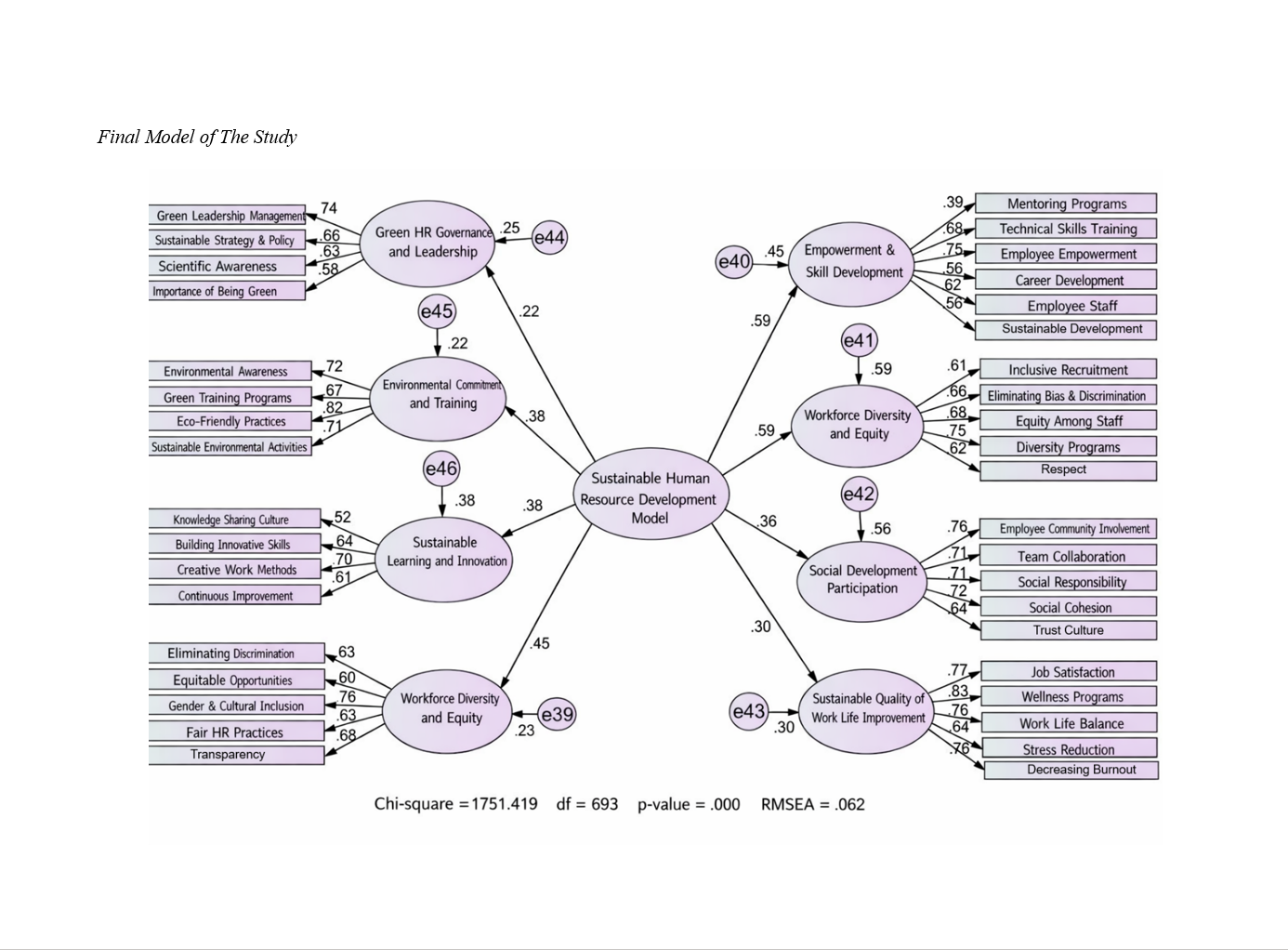
Methods and Materials: This applied study employed a descriptive–correlational design using structural equation modeling to investigate the relationships among organizational learning, innovation, and sustainable human resource development. The statistical population consisted of all employees working in hospitals affiliated with Kermanshah University of Medical Sciences and the Social Security Organization in 2023 (N = 2,560). Using Cochran’s formula and stratified random sampling with proportional allocation, 328 valid questionnaires were collected and analyzed. Data were gathered using a researcher-developed questionnaire consisting of measures for empowerment and skill development, workforce diversity and equity, social development participation, sustainable quality of work life improvement, sustainable human resource development, environmental commitment and training, sustainable learning and innovation, and green human resource governance and leadership. The questionnaire used a five-point Likert scale and demonstrated acceptable validity and reliability. Data were analyzed using SPSS version 26 and SmartPLS version 4, including confirmatory factor analysis and structural equation modeling to evaluate the measurement and structural models.
Findings: The results of structural equation modeling indicated that all components of organizational learning and innovation had significant positive effects on sustainable human resource development (p = 0.001). Sustainable human resource development showed the strongest effect (β = 0.888, t = 8.490), followed by sustainable learning and innovation (β = 0.685, t = 6.854), green human resource governance and leadership (β = 0.655, t = 7.403), and sustainable quality of work life improvement (β = 0.638, t = 6.497). Social development participation (β = 0.597, t = 7.008), environmental commitment and training (β = 0.467, t = 5.801), workforce diversity and equity (β = 0.444, t = 5.684), and empowerment and skill development (β = 0.421, t = 5.647) also demonstrated significant positive effects. The model explained meaningful variance in sustainable human resource development, confirming the validity of the proposed structural model.
Conclusion: The findings demonstrate that organizational learning and innovation play critical roles in enhancing sustainable human resource development in hospital settings. Learning-oriented practices, innovation-driven initiatives, sustainability-focused leadership, and workforce empowerment contribute significantly to the development of sustainable human resource systems. Hospitals that invest in organizational learning, promote innovation, and implement sustainability-oriented human resource strategies are better positioned to enhance workforce capabilities, improve organizational performance, and ensure long-term sustainability.
Downloads
References
Ali, N., Kulsoom, S., & Younas, Z. (2025). Contextual Learning as a Catalyst for Enhancing Intrinsic Motivation in Secondary School Students. Journal of Social & Organizational Matters, 4(2), 27-44. https://doi.org/10.56976/jsom.v4i2.204
Asiabar, M. G., Asiabar, M. G., & Asiabar, A. G. (2025). The Role of AI-Enabled Leadership in Enhancing Organizational Performance: The Mediating Effect of Organizational Learning in Technology-Driven Firms. https://doi.org/10.21203/rs.3.rs-7220642/v1
Chinchilla, N., & Grau, M. G. (2025). Review of Literature on Talent Management and Learning Organizations. In Handbook of Talent Management and Learning Organizations (pp. 68-84). https://doi.org/10.1201/9781003429890-7
Dittmar, E. C. (2025). AI as a Catalyst for Organizational Learning: Moving Beyond Tool Implementation to Learning Transformation. Development in Learning Organizations an International Journal. https://doi.org/10.1108/dlo-11-2024-0326
Järvenpää, A.-M., Jussila, J., Kunttu, L., & Kunttu, I. (2025). Organizational Learning Practices to Develop Digitalization Capabilities in Circular Economy SMEs. Circular Economy. https://doi.org/10.55845/ulpa5543
Jiao, P., & Bu, W. (2024). The Impact of Organizational Learning on Organizational Resilience in Construction Projects. Buildings, 14(4), 975. https://doi.org/10.3390/buildings14040975
Keski̇n, H., & Palaz, Y. (2024). The Relationship Between Organizational Learning and Organizational Resilience Capacity: A Research in Banking Sector. Journal of Global Strategic Management. https://doi.org/10.20460/jgsm.2024.337
Kornberger, M., & Leixnering, S. (2025). Moral Learning in Organizations: An Integrative Framework for Organizational Ethics. Journal of Business Ethics, 1(1), 1-12. https://doi.org/10.1007/s10551-025-05984-0
Kranthi, A. K., Rai, A., & Showry, M. (2024). Linking resonant leadership and learning organizations: The role of psychological empowerment as a mediator in faculty members among higher educational institutions in India. Acta Psychologica, 248, 104365. https://doi.org/10.1016/j.actpsy.2024.104365
Marini, P. (2024). Green innovation strategy improve sustainability competitive advantage: Role of organizational green learning and green technological turbulance. World Journal of Advanced Research and Reviews, 21(2), 782-789. https://doi.org/10.30574/wjarr.2024.21.2.0405
Maulani, G. A. F. (2024). Optimization Model of Learning Organization Capability and Strategic Flexibility on the Performance of Private Universities in West Java. Khazanah Sosial, 6(1), 152-173. https://doi.org/10.15575/ks.v6i1.34170
Meher, J. R., Nayak, L., Mishra, R. K., & Patel, G. (2024). Impact of organizational learning culture on organizational effectiveness: a serial mediation analysis with knowledge sharing and employee competencies. VINE Journal of Information and Knowledge Management Systems, 54(2), 324-338. https://doi.org/10.1108/VJIKMS-10-2021-0230
Olusegun, S., Hinson, R. E., & Zekeri, O. (2024). Artificial Intelligence: A Catalyst to Organizational Learning and Development in 21st Century. Development in Learning Organizations an International Journal, 39(2), 33-35. https://doi.org/10.1108/dlo-02-2024-0037
Park, J. H., & Rahman, N. (2024). Overcoming Bureaucratic Inertia Through Organizational Learning: Evidence from Governmental Reform Projects. Public Organization Review, 24(2), 289-307. https://doi.org/10.1007/s11115-023-00716-9
Qadaar, A., Sholihin, A., Setiyani, D., & Purtina, A. (2024). Optimizing Innovative Learning Strategies and Organizational Environment for Employee Development in Manufacturing Companies in Central Java. Jurnal Riset Ekonomi Manajemen (Rekomen), 7(1), 260-271. https://doi.org/10.31002/rekomen.v7i1.1275
Qaddafi, H., Hamid, H., Haikel, S., Sabri, H., & Loubes, M. (2024). Needs assessment models and frameworks in project-based learning organizations: New perspectives. Journal of Workplace Learning, 36(1), 67-85. https://journals.sagepub.com/doi/abs/10.1177/074171369804900104
Qaiser, A., Siddiqui, S. A., Baig, M., Sherazi, S. K. H., & Faraz, A. (2025). AI Literacy and Workforce Performance: The Mediating Role of Digital Confidence and the Moderating Role of Organizational Learning Culture. Aijss, 4(3), 4489-4502. https://doi.org/10.63056/acad.004.03.0716
Renalwin, R. (2025). The Influence of Learning Organizational Culture, Employee Engagement, Digital Transformation, and Esg on Sustainable Competitive Advantage: The Role of Transformational Leadership at Abc University, Indonesia. International Journal of Social Science Humanity & Management Research, 04(03). https://doi.org/10.58806/ijsshmr.2025.v4i3n08
Reyes-Sánchez, J. D. J. (2025). Gen Alpha and Continuous Learning to Strengthen Organizational Culture in Digitally Converged Corporate Environments. 205-236. https://doi.org/10.4018/979-8-3373-3987-0.ch008
Riva'i, R. A., & Sukarno, G. (2024). Analysis of Knowledge Sharing and Learning Organization on Employee Performance Through Employee Engagement at PT Surabaya Industrial Estate Rungkut. Dinasti International Journal of Education Management and Social Science, 6(1), 416-424. https://doi.org/10.38035/dijemss.v6i1.3273
Sadrkhanian, M. S. (2024). Enhancing Human Resource Productivity in the Education Organization Based on Organizational Learning and Cultural Capital. First Conference on Humanities with a New Approach,
Schneider, E. J. (2024). Reimagining Crisis Management With an Organizational Learning Framework. Journal of Contingencies and Crisis Management, 32(4). https://doi.org/10.1111/1468-5973.70001
Slatvinskyi, M. (2025). Digital Learning Platforms: New Opportunities in the Development of Human Resources in Organizations. Economic Scope(196), 217-224. https://doi.org/10.30838/ep.196.217-224
Smith, R., Johnson, K., & Brown, L. (2024). Organizational learning culture and proactive voice behavior. Human Resource Management Journal, 34(1), 123-140.
Sun, Z. (2025). Determining human resource management key indicators and their impact on organizational performance using deep reinforcement learning. Scientific reports, 15(1), 5690. https://doi.org/10.1038/s41598-025-86910-2
Tafakori, A. (2025). Modeling the Effects of Workplace Fun on Employees' Informal Learning With the Mediating Role of Organizational Trust: An Integrated Approach in Human Resource, Industrial, and Business Management. Journal of Information Systems Engineering & Management, 10(3), 1416-1428. https://doi.org/10.52783/jisem.v10i3.10712
Takeed, Z., Ali, M. D., Shah, S. I., Muhammad, A., & Qiu, S. (2025). The Effect of Entrepreneurial Leadership on Innovative Work Behavior: The Mediating Roles of Creative Self-Efficacy and Organizational Learning. Journal of Entrepreneurship in Emerging Economies, 17(5), 1288-1310. https://doi.org/10.1108/jeee-08-2024-0326
Tan, S., Aartsen, W. M., Hamersveld, D. v., & Jonker, C. M. (2025). Towards Hybrid Intelligence in Learning Organizations. https://doi.org/10.3233/faia250622
Westover, J. (2024). The Innovative Organization: Fostering a Culture of Continuous Learning and Experimentation. HCLReview, 15(3). https://doi.org/10.70175/hclreview.2020.15.3.12
Witt, P. L., Moser, R. P., & Cline, R. J. W. (2024). The role of organizational learning in employee development: A meta-analytic review. Human Resource Development Review, 23(1), 5-30. https://doi.org/10.1177/1534484323123456
Zameer, H., Wang, Y., & Yasmeen, H. (2024). Strengthening green competitive advantage through organizational learning and green marketing capabilities in a big data environment: a moderated-mediation model. Business Process Management Journal. https://doi.org/10.1108/BPMJ-09-2023-0691
Downloads
Additional Files
Publication Timeline
- Submitted
- Revised
- Accepted