Predicting Employee Creativity Trajectories Through Longitudinal Deep Learning Models of Motivation and Job Design
DOI:
https://doi.org/10.61838/kman.ijimob.5277Keywords:
Employee creativity, longitudinal modeling, deep learning, motivation, job design, organizational innovationAbstract
Objective: The objective of this study was to predict long-term employee creativity trajectories by developing a longitudinal deep learning model integrating evolving motivational states and job design characteristics.
Methods and Materials: This longitudinal study followed 611 full-time employees from knowledge-intensive organizations in Spain across four measurement waves over 18 months. Repeated measures of intrinsic and extrinsic motivation, psychological empowerment, and job design characteristics (including autonomy, task significance, skill variety, and feedback quality) were collected using validated instruments. Employee creativity was assessed using a multi-source composite index incorporating self-ratings, supervisor evaluations, and peer nominations. Long Short-Term Memory (LSTM) neural networks were employed to model non-linear temporal relationships and predict individual creativity trajectories. Model performance was evaluated using root mean square error, mean absolute error, explained variance, and trajectory similarity indices. Feature importance was examined using attention mechanisms and SHAP values, and unsupervised clustering was applied to identify distinct creativity development profiles.
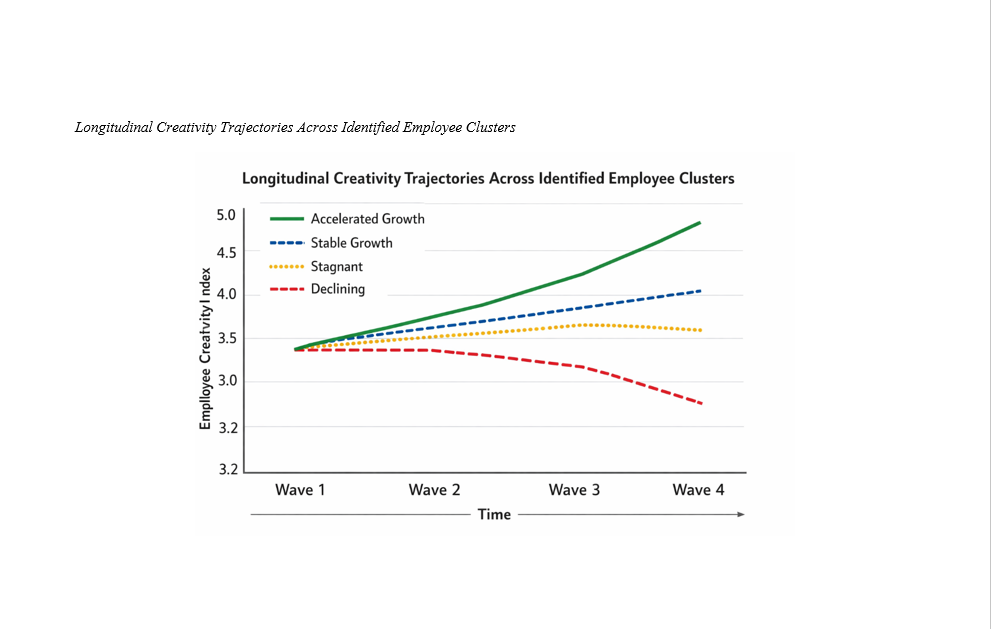
Findings: The deep learning model explained 76.1% of variance in unseen creativity trajectories. Intrinsic motivation (β_importance = 0.31, p < .001) and job autonomy (β_importance = 0.24, p < .001) emerged as the strongest predictors of sustained creative growth. Four statistically distinct creativity trajectories were identified: accelerated growth (34.5%), stable growth (41.2%), stagnant (16.7%), and declining (7.6%). Employees in the accelerated growth cluster demonstrated significantly higher increases in intrinsic motivation and job autonomy over time (p < .001), whereas the stagnant and declining clusters exhibited significant decreases in psychological empowerment and increases in role overload (p < .01).
Conclusion: Employee creativity is a dynamic developmental capability shaped by continuous interactions between motivation and job design, and longitudinal deep learning provides a powerful framework for predicting creative growth and identifying intervention targets.
Downloads
References
Adanlawo, E. F., Nkomo, N. Y., & Vezi-Magigaba, M. F. (2023). Compensation as a Motivating Factor of Job Satisfaction and Performance. International Journal of Research in Business and Social Science (2147-4478), 12(3), 131-139. https://doi.org/10.20525/ijrbs.v12i3.2474
Almazrouei, S., Bani‐Melhem, S., & Mohd-Shamsudin, F. (2024). It’s My Pleasure to Serve You! Examining the Job Contact, Happiness, Prosocial Motivation, and Innovative Work Behavior Link. International Journal of Innovation Science, 17(3), 523-544. https://doi.org/10.1108/ijis-01-2023-0011
Ann, S., Hallab, Z., Choi, H., & Majthoub, U. A. (2023). Motivating Housekeeping Staff in the Lodging Industry in Jordan. Tourism and Hospitality Management, 29(1), 103-118. https://doi.org/10.20867/thm.29.1.9
Au-Yeung, C.-S., & Chao, R.-F. (2024). Why Does Job Anxiety Negatively Impact Employee Creativity? An Ego Depletion Theory Perspective. International Journal of Business Ecosystem and Strategy (2687-2293), 6(2), 88-100. https://doi.org/10.36096/ijbes.v6i2.513
Baroun, A. E. (2025). Challenges in Implementing Safety Procedures: Examining Kuwait’s Labor Law Article 83 Impact on Employee Performance. International Journal of Law and Management. https://doi.org/10.1108/ijlma-11-2024-0411
Chen, I. S., & Choi, J. N. (2025). Does Job Boredom Benefit Creativity? A cross-Domain Process Through Leisure Crafting. European Journal of Innovation Management, 28(9), 4756-4780. https://doi.org/10.1108/ejim-05-2024-0567
Crider, C., Aghaey, A., Lortie, J., Peake, W. O., & Digan, S. P. (2024). Hybrid Entrepreneurship, Job Satisfaction and the Spillover Effect of Creativity. International Journal of Entrepreneurial Behaviour & Research, 30(5), 1197-1223. https://doi.org/10.1108/ijebr-07-2022-0629
David, A., Addo, S. K., & Yornu, I. K. (2025). Analysing the Connection Between Motivation, Compensation, and Employee Job Satisfaction. Dasjr, 10(1), 01-31. https://doi.org/10.4314/dasjr.v10i1.1
Fateh, A., Aslam, M., & Shahzad, F. (2023). Does Personal Mastery Lead To creativity for Complex Jobs: A moderated Mediation Model. Kybernetes, 53(11), 4840-4862. https://doi.org/10.1108/k-03-2023-0390
Hamouche, S., Dettling, N., & Waefler, T. (2025). Applying Job Design Criteria for Effective Human-Ai Collaboration. -5. https://doi.org/10.54941/ahfe1006695
Isac, N., Badshah, W., Ahmad, B., Qammar, A., & Kalyar, M. N. (2024). “Doing It for My Family”: Examining When and How Family Motivation Hinders Creativity Of hospitality Employees By shaping Job-Perception. Journal of Hospitality and Tourism Insights, 8(1), 41-61. https://doi.org/10.1108/jhti-08-2023-0565
Jaffar, H. S., Munir, A., & Waqas, M. (2024). Assessing the Impact of Herzberg’s Two-Factor Motivation Theory on Job Satisfaction: A Study of Employees in the Punjab Healthcare Commission. Sustainable Business and Society in Emerging Economies, 6(3). https://doi.org/10.26710/sbsee.v6i3.3148
Jnaneswar, K., & Ranjit, G. (2022). Explicating Intrinsic Motivation's Impact on Job Performance: Employee Creativity as a Mediator. Journal of Strategy and Management, 15(4), 647-664. https://doi.org/10.1108/jsma-04-2021-0091
Kılıç, E., & Gök, M. Ş. (2022). Employee Proactivity and Proactive Initiatives Towards Creativity: Exploring the Roles of Job Crafting and Initiative Climate. International Journal of Organizational Analysis, 31(6), 2492-2506. https://doi.org/10.1108/ijoa-01-2022-3100
Kurniawan, A. P., Sanosra, A., & Qomariah, N. (2023). Efforts to Increase Motivation and Performance Based on Employee Competency and Job Characteristics. Journal of Economics Finance and Management Studies, 06(07). https://doi.org/10.47191/jefms/v6-i7-17
Liu, H., & Gao, J. (2025). The Impact of Work Gamification on Chinese Employee Creativity: A Moderated Mediation Model. Frontiers in psychology, 16. https://doi.org/10.3389/fpsyg.2025.1494789
Lu, D., Zhao, G., Lee, S. Y., & Jun, T. (2025). Impact of Motivation and Incentives on Job Performance and Job Satisfaction: An Empirical Study on Dance Teachers’ Career Development. International Journal of Innovative Research and Scientific Studies, 8(7), 713-719. https://doi.org/10.53894/ijirss.v8i7.10528
Ma, T., Ali, A. J., & Ndagi, A. (2023). Work Autonomy and Task Variety on Employee Innovative Behavior in Chinese Media Industry, Intrinsic Motivation as a Mediator. International Journal of Academic Research in Economics and Management Sciences, 12(4). https://doi.org/10.6007/ijarems/v12-i4/19083
Mariska, A. T. P., Sumarni, S., & Willian, R. (2024). The Influence of Job Characteristics on Employee Performance With Work Motivation as an Intervening Variable at Pt. Perkebunan Nusantara Vi. Journal of Management and Innovation Entrepreneurship (Jmie), 1(3), 455-462. https://doi.org/10.59407/jmie.v1i3.575
Nantwi, W. K., Essel, H. B., & Osei‐Poku, P. (2023). Creative Arts Teachers Job Satisfaction in the Implementation of Inclusive Creative Art Education. Journal of Science and Technology (Ghana), 41(2), 63-82. https://doi.org/10.4314/just.v41i2.6
Ni Kadek Sari Jayanti, D., & Surya, I. B. K. (2023). Pengaruh Motivasi, Kompensasi Dan Lingkungan Kerja Terhadap Kepuasan Kerja Karyawan (Studi Pada Pt Bali Busana Kreasi Di Kabupaten Badung). E-Jurnal Manajemen Universitas Udayana, 12(6), 602. https://doi.org/10.24843/ejmunud.2023.v12.i06.p04
Pham, V. K., Huynh, A.-V., Vo, M., & Nguyen, N. T. K. (2025). Mechanisms of Job Satisfaction Among Gen Z in Vietnam's Sports Industry Using an Integrated Framework. https://doi.org/10.21203/rs.3.rs-6703127/v1
Putri, A. (2025). The Effect of Motivation and Occupational Safety and Health (K3) on Performance Through Job Satisfaction as a Mediating Variable Among Employees of TM Systems International Trading (Shanghai) Co., Ltd., in Pelalawan Regency. Enrichment Journal of Multidisciplinary Research and Development, 3(7), 3302-3317. https://doi.org/10.55324/enrichment.v3i7.532
Sharma, S., & Gautam, P. (2023). A Study of Extrinsic and Intrinsic Motivation, Employee Job Creativity and Ethical Leadership in the Hospitality Industry. Jme, 17(1), 012-023. https://doi.org/10.70906/20231701012023
Sonnenschein, K., Hagen, Ø., Rostad, I. S., & Wiik, R. (2022). “Make It Possible for More People to Work at Home!” Representations of Employee Motivation and Job Satisfaction in Danish and Norwegian Newspapers During the COVID-19 Pandemic. Frontiers in psychology, 13. https://doi.org/10.3389/fpsyg.2022.972562
Sudha, S. (2023). The Interaction Effect of Job Design and Public Service Motivation on the Job Performance of Maldives Civil Service Employees. Russian Law Journal, 11(6s). https://doi.org/10.52783/rlj.v11i6s.912
Syaputra, D., Telaumbanua, F., & Gobal, R. (2025). The Influence of Compensation, Work Environment and Motivation on Job Satisfaction at Medan Art Work. Amar, 5(2), 185-203. https://doi.org/10.37531/amar.v5i2.2796
Temory, M. D. (2023). The Investigation of Effects of Job Satisfaction on Performance Among Academicians Using Herzberg’s Theory. European Journal of Logistics Purchasing and Supply Chain Management, 11(1), 26-42. https://doi.org/10.37745/ejlpscm.2013/vol11n12642
Wang, X., & Wang, M. (2022). The Boundary Conditions of Leader Creativity Expectations Influencing Employee Creativity: Job Characteristic Factors. Itm Web of Conferences, 45, 01076. https://doi.org/10.1051/itmconf/20224501076
Downloads
Additional Files
Publication Timeline
- Submitted
- Revised
- Accepted