Predicting Employee Innovative Work Behavior from Psychological Safety and Proactive Personality Using Machine Learning Models
DOI:
https://doi.org/10.61838/kman.ijimob.5284Keywords:
Innovative Work Behavior, Psychological Safety, Proactive PersonalityAbstract
Objective: This study aims to predict employee innovative work behavior by evaluating the distinct and interactive contributions of psychological safety and proactive personality through the application of advanced machine learning algorithms.
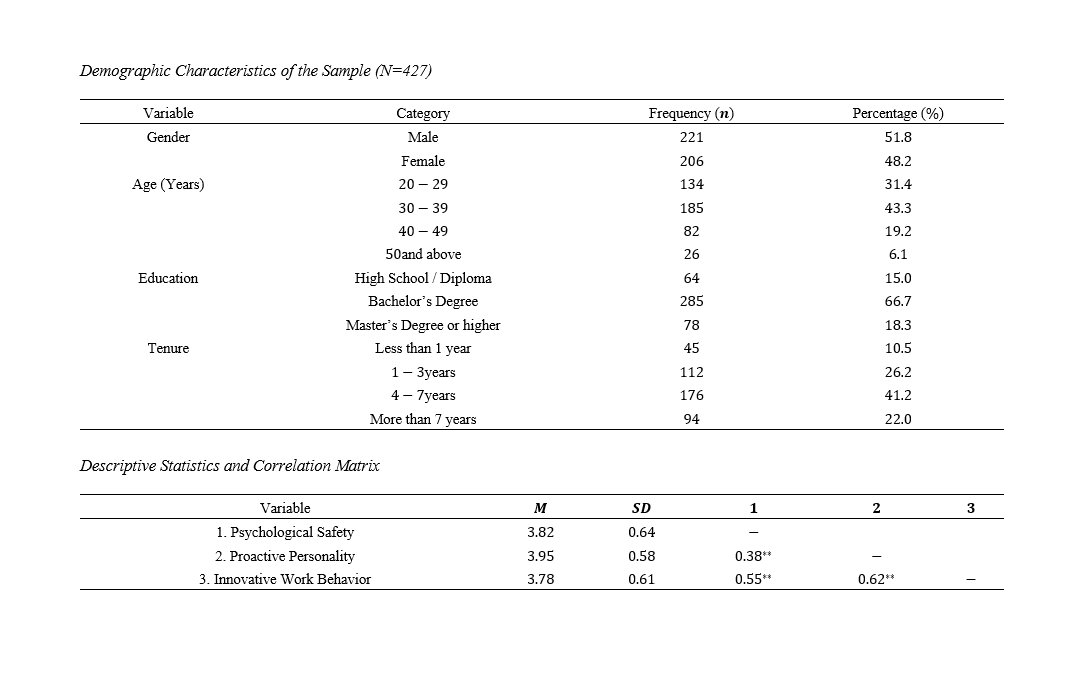
Methods and Materials: A cross-sectional, quantitative design was utilized, drawing a stratified random sample of full-time employees from various dynamic corporate sectors across Indonesia. Data were collected via self-administered, translated questionnaires utilizing established Likert-scale instruments. To evaluate the predictive relationships, the dataset was partitioned into an training and testing split. Four machine learning models—Multiple Linear Regression, Support Vector Regression, Random Forest Regressor, and Gradient Boosting Regressor—were trained and evaluated using five-fold cross-validation, while SHapley Additive exPlanations (SHAP) values were computed to interpret feature importance and non-linear interactions.
Findings: The non-linear ensemble models outperformed traditional linear approaches, with the Gradient Boosting Regressor demonstrating the highest predictive accuracy on the testing set ( , , ). Feature importance analysis using SHAP values identified proactive personality as the dominant predictor of innovative work behavior (mean absolute SHAP value = ), closely followed by psychological safety (mean absolute SHAP value = ). Furthermore, the dependency plots revealed a critical non-linear interaction, indicating that high levels of proactive personality only consistently translate into innovative behavior when a baseline threshold of psychological safety is present in the work environment.
Conclusion: Organizations must concurrently hire for proactive traits and cultivate psychologically safe climates, as both are fundamentally intertwined in actualizing and predicting employee innovation.
Downloads
References
Agina, M. F., Farrag, D. A., Khairy, H. A., Alhemimah, A., & Al-Romeedy, B. S. (2025). Talent management and innovative work behavior in tourism and hospitality businesses: Does absorptive capacity matter? Journal of Human Resources in Hospitality & Tourism, 24(2), 367-391. https://doi.org/10.1080/15332845.2025.2432621
Andayesh, S. (2025). The mediating role of creativity in the relationship between artificial intelligence and librarians' innovative work behavior. Library and Information Organization Studies. https://doi.org/10.30484/nastinfo.2025.3769.2329
Aziz, B. (2025). Innovative Work Behavior on Education Sector: A Systematic Literature Review. Journal of Social Science (Joss), 4(12). https://doi.org/10.59188/jcs.v4i12.3862
Caroline, A., Coun, M. J. H., Gunawan, A., & Stoffers, J. (2025). A systematic literature review on digital literacy, employability, and innovative work behavior: emphasizing the contextual approaches in HRM research. Frontiers in psychology, 15, 1448555. https://doi.org/10.3389/fpsyg.2024.1448555
Hamidah, O. D., & Antonio, T. (2025). The Influence of Transformational Leadership and Shared Leadership on Innovative Work Behavior Among Generation Z Employees in the Creative Industry in Surabaya: The Role of Organizational Climate as a Mediating Variable. Dinasti International Journal of Education Management and Social Science, 6(4), 3223-3234. https://doi.org/10.38035/dijemss.v6i4.4415
Hock‐Doepgen, M., Montasser, J. S., Klein, S., Clauss, T., & Maalaoui, A. (2025). The role of innovative work behavior and organizational support for business model innovation. R&D Management, 55(1), 7-26. https://doi.org/10.1111/radm.12671
Lee, S. E., & Seo, J. K. (2024). Effects of Nurse Managers' Inclusive Leadership on Nurses' Psychological Safety and Innovative Work Behavior: The Moderating Role of Collectivism. Journal of Nursing Scholarship, 56(4), 554-562. https://doi.org/10.1111/jnu.12965
Liu, Q., & Sun, Y. (2025). The impact of collaborative atmosphere on innovative work behavior of college teachers, North China. Frontiers in psychology, 15, 1497503. https://doi.org/10.3389/fpsyg.2024.1497503
Lukitasari, D., & Etikariena, A. (2024). Transformational Leadership and Innovative Work Behavior: The Mediation-Moderation Model of Ambidextrous Culture. Psikologika Jurnal Pemikiran Dan Penelitian Psikologi, 29(2). https://doi.org/10.20885/jstl.vol29.iss2.art5
Masoudnia, S., & Nasti Zayi, N. (2025). Human Resource Management Actions on Innovative Work Behaviors Mediated by Human Resource Flexibility. Public Management Research, 18(68), 139-170. https://ejournal.lucp.net/index.php/ijrtbt/article/download/2782/2825
Mukapit, M., Daud, S. R., & Selamat, M. N. (2024). Bridging innovation and sustainability: A systematic review of innovative work behavior and green practices. HAL Post-Print. https://doi.org/10.22610/imbr.v16i4(I).3886
Munawaroh, M. S. A., Rugaiyah, R., & Susanto, T. T. D. (2025). Collaboration and Creativity: How Interpersonal Communication and Knowledge Sharing Shape Innovative Work Behavior. Multidisciplinary Science Journal, 8(1), 2026019. https://doi.org/10.31893/multiscience.2026019
Paijan. (2025). Exploring the Existence of Innovative Work Behavior Among Government Employees in Meruya Selatan Sub-District. Dinasti International Journal of Economics Finance & Accounting, 6(4), 3245-3257. https://doi.org/10.38035/dijefa.v6i4.5012
Pham, T. P. T., Nguyen, T. V., Nguyen, P. V., & Ahmed, Z. U. (2024). The pathways to innovative work behavior and job performance: Exploring the role of public service motivation, transformational leadership, and person-organization fit in Vietnam's public sector. Journal of Open Innovation: Technology, Market, and Complexity, 10, 100315. https://doi.org/10.1016/j.joitmc.2024.100315
Piwowar-Sulej, K., & Iqbal, Q. (2025). A novel approach to green innovative work behavior: green HRM and employee participation. Baltic Journal of Management, 20(6), 39-59. https://doi.org/10.1108/BJM-09-2024-0593
Ramezani, M., & Mirkazemi, S. A. (2025). Professional Development Strategies with an Emphasis on the Innovative Work Behavior of Physical Education Teachers in South Khorasan Province. Qualitative Research in Behavioral Sciences (QRBS), 3(2), 37-56. https://doi.org/10.22077/qrbs.2025.8364.1067
Ratri, V. M. (2024). The Relationship Between Leader Member Exchange (LMX) and Psychological Capital With Innovative Work Behavior in State Civil Apparatus (ASN). Ajesh, 3(2), 420-435. https://doi.org/10.46799/ajesh.v3i2.255
Sanusi, A., Yohana, C., & Parimita, W. (2025). Modeling the Drivers of Innovative Work Behavior: The Influence of Talent Management and Psychological Empowerment Through Structural Equation Modeling. International Journal of Current Science Research and Review, 08(10). https://doi.org/10.47191/ijcsrr/v8-i10-32
Sharif, S., Tongkachok, K., Akbar, M., Iqbal, K., & Lodhi, R. N. (2024). Transformational leadership and innovative work behavior in three-star hotels: mediating role of leader-member exchange, knowledge sharing and voice behavior. VINE Journal of Information and Knowledge Management Systems, 54(1), 1-21. https://doi.org/10.1108/VJIKMS-07-2021-0122
Sofia, S., & Aseanty, D. (2024). Pengaruh Transformational Leadership, Knowledge Sharing, Dan Work Engagement Terhadap Innovative Work Behavior Pada Karyawan Jasa Marga Group. Modus, 36(2), 176-197. https://doi.org/10.24002/modus.v36i2.8666
Takeed, Z., Ali, M. D., Shah, S. I., Muhammad, A., & Qiu, S. (2025). The Effect of Entrepreneurial Leadership on Innovative Work Behavior: The Mediating Roles of Creative Self-Efficacy and Organizational Learning. Journal of Entrepreneurship in Emerging Economies, 17(5), 1288-1310. https://doi.org/10.1108/jeee-08-2024-0326
Waheed, K. Z., & Khan, M. I. (2025). Fostering Innovative Work Behavior in New Product Development Projects: A Theoretical Review. Pakistan Journal of Humanities and Social Sciences, 13(2), 479-495. https://doi.org/10.52131/pjhss.2025.v13i2.2884
Wahid, M., & Ayub, N. (2024). Predictive Role of Psychological Capital and Perceived Organizational Support on Innovative Work Behavior Among Higher Education Teachers of Pakistan. Tuning Journal for Higher Education, 11(2), 191-219. https://doi.org/10.18543/tjhe.2715
Xu, Y., & Phanniphong, K. (2025). The Impact of Organizational Commitment on Innovative Work Behavior in TCM Universities: A Social-Psychological Driving Mechanism Perspective. Environment and Social Psychology, 10(7). https://doi.org/10.59429/esp.v10i7.3882
Yusriani, S., Isham, F., Azis, E., Yulina, Y., & Kamal, N. M. (2025). Promoting Innovative Work Behaviors for Greener and Sustainable Development Among Service Sector Workers in Denmark. Icbem(2), 279-294. https://doi.org/10.47747/icbem.v2i2.2722
Downloads
Additional Files
Publication Timeline
- Submitted
- Revised
- Accepted