Validation of the Citizenship Education Model in Enhancing Civic Culture in the Cultural and Artistic Organization of Tehran Municipality
DOI:
https://doi.org/10.61838/Keywords:
Citizenship Education, Civic Culture, Structural Equation Modeling, Cultural and Artistic Organization of Tehran Municipality, Social CapitalAbstract
Objective: The objective of this study was to validate a citizenship education model for enhancing civic culture within the Cultural and Artistic Organization of Tehran Municipality.
Methods and Materials: This study employed an applied, quantitative approach using a descriptive–survey design. The statistical population consisted of 1,857 employees and experts of the Cultural and Artistic Organization of Tehran Municipality, from which a sample of 384 participants was selected through simple random sampling based on Cochran’s formula at a 95% confidence level. Data were collected using a researcher-developed questionnaire derived from the qualitative phase and grounded theory components, designed on a five-point Likert scale. Content validity was confirmed by expert review, and reliability was established using Cronbach’s alpha (α > 0.70). Data analysis was conducted using descriptive and inferential statistics, and structural equation modeling (SEM) based on the Partial Least Squares (PLS) approach was applied to test the conceptual model and examine relationships among variables.
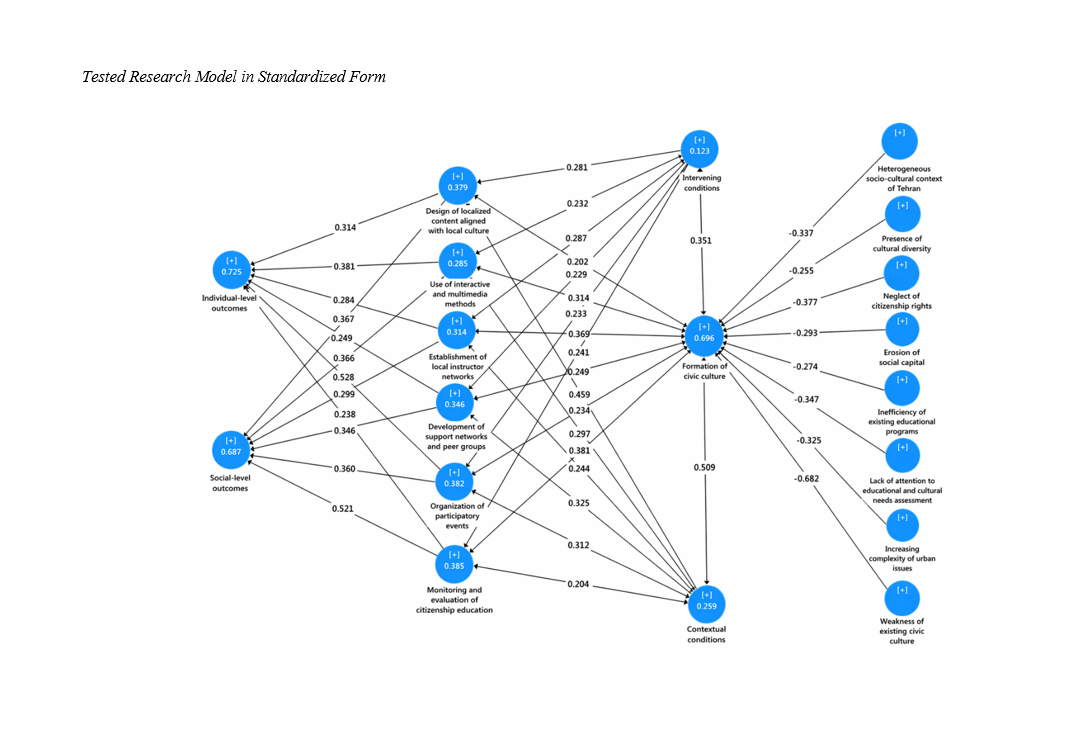
Findings: The results indicated that causal factors, including heterogeneous socio-cultural context (β = -0.337), cultural diversity (β = -0.255), neglect of citizenship rights (β = -0.377), erosion of social capital (β = -0.293), and inefficiency of educational programs (β = -0.274), had significant negative effects on civic culture. Contextual conditions such as access to demographic data (β = 0.351) and the background of citizenship education programs (β = 0.509) positively influenced the implementation of strategies. Intervening factors (β = 0.281) significantly affected the effectiveness of strategies. Furthermore, strategies including localized content design (β = 0.379), interactive and multimedia methods (β = 0.285), local instructor networks (β = 0.314), peer support groups (β = 0.346), participatory events (β = 0.382), and monitoring and evaluation (β = 0.385) demonstrated significant positive effects on outcomes, including civic culture, social capital, civic participation, and urban quality of life.
Conclusion: The validated model demonstrates that effective citizenship education, supported by appropriate contextual conditions and strategic interventions, can significantly enhance civic culture, strengthen social capital, and improve civic participation and urban quality of life, providing a robust framework for policy and practice in urban cultural organizations.
Downloads
References
Ayeneh Nama, S. (2022). Investigating the relationship between the quality of urban services and civic culture: A case study of citizens aged 20 to 64 in Gilan-e Gharb County Payame Noor University of West Azerbaijan Province, Boukan Center].
Azimi, M., & Afshari, M. (2025). The place of citizenship education in urban development plans: A case study of development plans for the Herandi neighborhood of Tehran. Urban Studies Quarterly, 14(55), 77-90.
Bruce, J., North, C., & FitzPatrick, J. (2019). Preservice teachers' views of global citizenship and implications for global citizenship education. Globalisation, Societies and Education, 1-16. https://doi.org/10.1080/14767724.2018.1558049
Caballero, F. D. (2023). Information and communication technology through global [digital] citizenship education.
Estellés, M., Oliveira, A., & Castellví, J. (2023). National curricula and citizenship education in populist times: The cases of Brazil and Spain. Compare: A Journal of Comparative and International Education, 1-19. https://doi.org/10.1080/03057925.2023.2170167
Gholami, H. (2022). The role of municipal environmental advertising in the civic culture of the people of Isfahan Daneshpazhoohan Institute of Higher Education].
Houser, N. O. (2023). The value of a personal philosophy of citizenship education. The Social Studies, 114(2), 59-66. https://doi.org/10.1080/00377996.2022.2084011
Joris, M., Simons, M., & Agirdag, O. (2022). Citizenship-as-competence, what else? Why European citizenship education policy threatens to fall short of its aims. European Educational Research Journal, 21(3), 484-503. https://doi.org/10.1177/1474904121989470
Kester, K. (2023). Global citizenship education and peace education: Toward a postcritical praxis. Educational Philosophy and Theory, 55(1), 45-56. https://doi.org/10.1080/00131857.2022.2040483
Khair, Q. (2013). Factors contributing to quality of training and effecting employee job satisfaction. The Business & Management Review, 3(4), 61-74.
Mohammadi, H., Mazidi, M., & Beheshti, S. (2017). A conceptual analysis of the stages and dimensions of citizenship education. New Approach in Educational Management, 8(4), 83-104.
Schiller, H. I. (2022). The privatization and transnationalization of culture. In Cultural Politics in Contemporary America (pp. 317-332). Routledge. https://doi.org/10.4324/9781003326427-27
Sincer, I., Severiens, S., & Volman, M. (2019). Teaching diversity in citizenship education: Context-related teacher understandings and practices. Teaching and Teacher Education, 78, 183-192. https://doi.org/10.1016/j.tate.2018.11.015
Tarahani, M. (2023). The educational status of citizenship rights in textbooks Shahid Chamran University of Ahvaz, Faculty of Economics and Social Sciences].
Tuhuteru, L., Ausat, A. M. A., Pratiwi, E. Y. R., & Suherlan, S. (2023). The role of civic education in promoting diversity and tolerance in schools. Edumaspul: Jurnal Pendidikan, 7(1), 275-280.
Downloads
Additional Files
Publication Timeline
- Submitted
- Revised
- Accepted