Predicting Employee Engagement Through Extreme Gradient Boosting (XGBoost): An Explainable AI Approach
DOI:
https://doi.org/10.61838/kman.ijimob.5426Keywords:
Employee Engagement, Extreme Gradient Boosting, XGBoost, Explainable Artificial Intelligence, SHAP, Human Resource AnalyticsAbstract
Objective: This study aimed to predict employee engagement using Extreme Gradient Boosting (XGBoost) and Explainable Artificial Intelligence (XAI) techniques while identifying the relative importance of psychological, organizational, leadership, and demographic factors influencing employee engagement among employees in South African organizations.
Methods and Materials: This quantitative cross-sectional study was conducted among 1,248 employees working in diverse South African organizations across multiple industries. Data were collected using standardized instruments measuring employee engagement, psychological empowerment, perceived organizational support, job satisfaction, psychological safety, and transformational leadership, alongside demographic and organizational variables. Following data preprocessing, feature engineering, and missing value treatment, the dataset was divided into training and testing subsets using an 80:20 ratio. Extreme Gradient Boosting (XGBoost) served as the primary predictive model and was compared with Multiple Linear Regression, Decision Tree Regression, Support Vector Regression, and Random Forest models. Model performance was evaluated using coefficient of determination (R²), root mean square error (RMSE), mean absolute error (MAE), and mean absolute percentage error (MAPE). Explainable Artificial Intelligence was implemented using SHapley Additive exPlanations (SHAP) to determine feature importance and interpret model predictions.
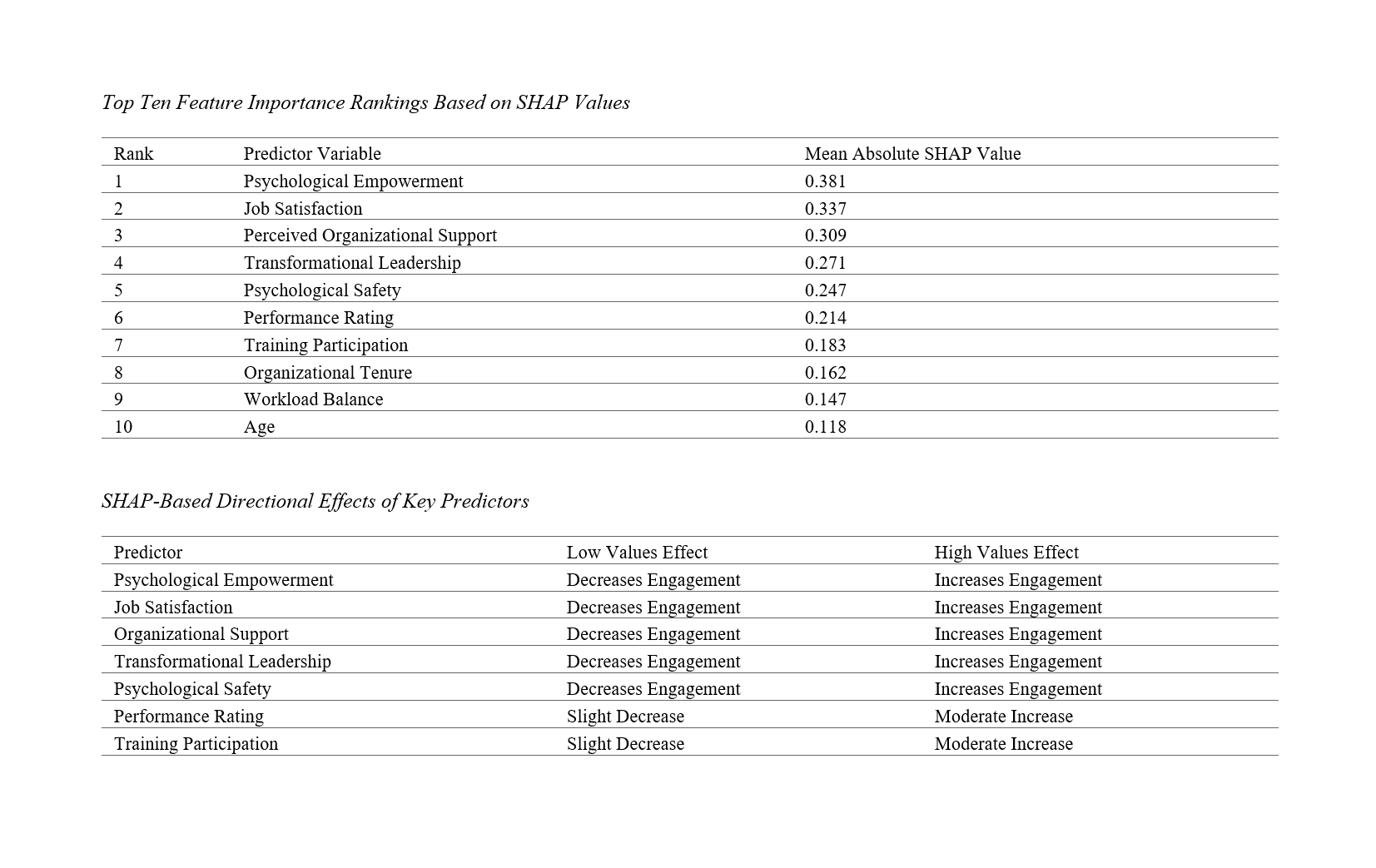
Findings: The results demonstrated that XGBoost outperformed all competing models, achieving the highest predictive accuracy (R² = 0.902) and the lowest prediction errors (RMSE = 0.276, MAE = 0.198, and MAPE = 4.88%). Random Forest exhibited the second-highest predictive performance, while Multiple Linear Regression produced the weakest results. SHAP analysis revealed that psychological empowerment was the most influential predictor of employee engagement, followed by job satisfaction, perceived organizational support, transformational leadership, and psychological safety. Additional contributors included performance ratings, training participation, organizational tenure, and workload balance. The explainability analysis further indicated that higher levels of these organizational and psychological resources consistently generated positive effects on engagement predictions, whereas demographic characteristics exhibited comparatively limited predictive influence.
Conclusion: The findings demonstrate that employee engagement can be predicted with high accuracy using XGBoost and explainable artificial intelligence techniques. Psychological empowerment, job satisfaction, organizational support, transformational leadership, and psychological safety emerged as the most critical drivers of engagement. The integration of predictive analytics and explainable AI provides organizations with a powerful evidence-based framework for understanding, forecasting, and enhancing employee engagement while supporting strategic human resource decision-making.
Downloads
References
Akinwande, A. S., Tanova, C., Bayighomog, S. W., & Ajayi, D. O. (2025). Roots and Wings: The Role of Job Embeddedness in Mitigating Nurses’ Emigration Intention Through a Serial Mediation Lens. Journal of nursing management, 2025(1). https://doi.org/10.1155/jonm/9917479
Alhajaj, W. E., & Ahmad, S. Z. (2023). The Effectiveness of Human Resource Management Practices, Work Engagement and Self-Efficacy in Minimizing Talent turnover Intention. International Journal of Productivity and Performance Management, 73(8), 2414-2440. https://doi.org/10.1108/ijppm-02-2023-0090
Ali, M., Niu, X., & Rubel, M. R. B. (2024). The Influence of Transformational and Transactional Leadership on Employee Retention: Mediating Role of Employee Engagement. Management Matters, 21(2), 164-190. https://doi.org/10.1108/manm-03-2024-0022
Bernardo, A. L., Lacap, J. P. G., Talon, C., Bolante, P., Aumentado, Z. J., Capalao, M. W., Llado, M. C. E., & Dubrea, E. M. (2023). The Mediating Role of Employee Engagement on the Link Between Person-Organization Fit and Turnover Intention: Evidence From Business Process Outsourcing Companies in the Philippines. Journal of Entrepreneurship and Business, 11(2), 69-94. https://doi.org/10.17687/jeb.v11i2.1025
Chagadama, P. D. J., Luamba, D. S., & Prof. Dr. Ir. Edouard, M. M. (2022). Reducing Voluntary Employee Turnover in Small Construction Companies for Long-Term Productivity. International Journal of Business and Management Research, 10(3), 53-70. https://doi.org/10.37391/ijbmr.100301
Chen, X., Li, Y., Hu, Y., & Yu, G. (2023). The Impact of General Manager’s Responsible Leadership and Executive Compensation Incentive on Enterprise ESG Performance. Sustainability, 15(15), 11883. https://doi.org/10.3390/su151511883
Darko, I. L. O., Bans-Akutey, A., Amoako, P., & Affum, L. K. (2024). Employee Retention and Organizational Performance: Evidence From Ghana Police Service. Annals of Management and Organization Research, 5(3), 219-230. https://doi.org/10.35912/amor.v5i3.1855
Gelencsér, M., Szabó-Szentgróti, G., Kőműves, Z., & Hollósy-Vadász, G. (2023). The Holistic Model of Labour Retention: The Impact of Workplace Wellbeing Factors on Employee Retention. Administrative Sciences, 13(5), 121. https://doi.org/10.3390/admsci13050121
Ghani, B., Zada, M., Memon, K. R., Ullah, R., Khattak, A., Han, H., Ariza‐Montes, A., & Araya-Castillo, L. (2022). Challenges and Strategies for Employee Retention in the Hospitality Industry: A Review. Sustainability, 14(5), 2885. https://doi.org/10.3390/su14052885
Iqbal, S., Bureš, V., Zanker, M., Abdullah, M., & Tootell, B. (2023). A System Dynamics Perspective on Workplace Spirituality and Employee Behavior. Administrative Sciences, 14(1), 7. https://doi.org/10.3390/admsci14010007
Islam, M. A., Adekoya, O. D., & Olawoyin, F. S. (2025). Team Reflexivity for Employee Engagement and Retention During Market Turbulence: A Moderated Mediation Study. International Journal of Tourism Research, 27(3). https://doi.org/10.1002/jtr.70067
Kaaria, A. G. (2024). Essential Human Resource Metrics and Analytics for Sustainable Work Environments: Literature Mapping and Conceptual Synthesis. East African Journal of Business and Economics, 7(1), 241-262. https://doi.org/10.37284/eajbe.7.1.1976
Kendrick, T., Artley, J. B., & Mujtaba, B. G. (2023). Mental Health Intervention in the Workplace Amidst the COVID-19 Pandemic. Health, 15(04), 289-311. https://doi.org/10.4236/health.2023.154021
Lim, Y. S. (2022). Relationship Between Employee’s Satisfaction, Engagement and Turnover Intention. Malaysian Journal of Social Sciences and Humanities (MJSSH), 7(6), e001546. https://doi.org/10.47405/mjssh.v7i6.1546
Masood, R. Z. (2024). Strategies for Employee Retention in High Turnover Sectors: An Empirical Investigation. International Journal of Research in Human Resource Management, 6(1), 33-41. https://doi.org/10.33545/26633213.2024.v6.i1a.167
Novrianto, A., Fitriadi, Y., & Nengsi, N. S. W. (2024). Cultivating a Growth Mindset: HR's Role in Fostering Continuous Learning Cultures. Equator Journal of Management and Entrepreneurship (Ejme), 12(3), 235-243. https://doi.org/10.26418/ejme.v12i3.78187
Obeng, H. A., & Atan, T. (2025). The Public Hospital Exodus: Unraveling the Interplay of Turnover Intentions and Organizational Politics. Sage Open, 15(3). https://doi.org/10.1177/21582440251337902
Orabi, T. A., Al-Hyari, H. S., Almomani, H. M., Ababne, A., Huson, Y. A., Ahmed, E., & Albanna, H. (2023). A Bibliometric Review of Job Satisfaction and Organizational Commitment in Businesses Area Literatures. Human Systems Management, 43(3), 407-430. https://doi.org/10.3233/hsm-230130
Orujaliyev, R. (2024). The Effect of Non-Financial Incentives on Employee Engagement and Employee Retention. European Journal of Humanities and Social Sciences, 3-10. https://doi.org/10.29013/ejhss-24-2-3-10
Otoo, F. N. K. (2024). Does Employee Engagement Mediate the Nexus of Job Resource and Employee Turnover Intentions? Iimt Journal of Management, 1(2), 130-170. https://doi.org/10.1108/iimtjm-10-2023-0032
Poluru, N. V. (2024). Exploring the Impact of Flexible Work Arrangements on Turnover Intention: The Mediating Role of Job Satisfaction and the Moderating Effect of Perceived Supervisory Support. Journal of Accounting Business and Management (Jabm), 32(1), 217. https://doi.org/10.31966/jabminternational.v32i1.1467
Prajapati, N. (2022). Factors Influencing Employee Engagement and Its Impact on Organizational Performance. Bagiswori Journal, 2(1), 1-13. https://doi.org/10.3126/bagisworij.v2i1.56320
Rashmi, M., & Dsouza, L. B. (2023). Employee Engagement Among Nurses in a Selected Hospital - A Case Study. International Journal of Management Technology and Social Sciences, 92-105. https://doi.org/10.47992/ijmts.2581.6012.0313
Salmero, A. J. P. (2024). Factors Contributing to Millennial Employees’ Turnover Rates. International Journal of Current Science Research and Review, 07(06). https://doi.org/10.47191/ijcsrr/v7-i6-67
Santoso, J. B. (2024). Employee Well-Being Programs: Assessing the Impact on Engagement, Productivity, and Retention. Productivity, 1(3), 472-484. https://doi.org/10.62207/fhxmdw77
Spencer, D., & Kalyvaki, M. (2023). Millennials, the Last Standing Heroes of the Workforce: A Comprehensive Literature Review on Synching Millennials’ Values With Organizational Culture to Boost Retention Rates. American Journal of Management, 23(4). https://doi.org/10.33423/ajm.v23i4.6526
Susanto, P. C., & Rony, Z. T. (2023). Analysis of Employee Retention Programs and Talent Engagement to Prevent Employee Turnover in Organizations (Systematic Literature Review). Asian Journal of Community Services, 2(6), 489-500. https://doi.org/10.55927/ajcs.v2i6.4560
Taufan, A., & Rachmawati, R. (2023). Sustaining Talent: Reducing Employee Turnover at Tax Authority Through Value Proposition and Social Identity. Jurnal Manajemen Teori Dan Terapan | Journal of Theory and Applied Management, 16(3), 506-521. https://doi.org/10.20473/jmtt.v16i3.51754
Urme, U. N. (2023). The Impact of Talent Management Strategies on Employee Retention. International Journal of Science and Business, 28(1), 127-146. https://doi.org/10.58970/ijsb.2209
Vihma, P., & Hukkinen, J. (2024). Bracing Urban Governance Against Climate Crises: How to Integrate High Reliability Into Strategic Decision‐making? Environmental Policy and Governance, 35(1), 103-113. https://doi.org/10.1002/eet.2129
Yadav, A., Pandita, D., & Singh, S. (2022). Work-Life Integration, Job Contentment, Employee Engagement and Its Impact on Organizational Effectiveness: A Systematic Literature Review. Industrial and Commercial Training, 54(3), 509-527. https://doi.org/10.1108/ict-12-2021-0083
Downloads
Additional Files
Publication Timeline
- Submitted
- Revised
- Accepted