Artificial Intelligence Readiness, Digital Transformation Capability, Organizational Agility, Innovation Ambidexterity, and Sustainable Competitive Advantage: A Structural Equation Modeling Approach
DOI:
https://doi.org/10.61838/kman.ijimob.5436Keywords:
Artificial Intelligence Readiness, Digital Transformation Capability, Organizational Agility, Innovation Ambidexterity, Sustainable Competitive AdvantageAbstract
Objective: This study aimed to examine the structural relationships among artificial intelligence readiness, digital transformation capability, organizational agility, innovation ambidexterity, and sustainable competitive advantage and to evaluate the direct and indirect pathways through which these organizational capabilities contribute to long-term competitive success.
Methods and Materials: This quantitative study employed a cross-sectional survey design and Structural Equation Modeling (SEM) to test the proposed conceptual framework. The study population consisted of managers, executives, digital transformation specialists, and innovation professionals employed in medium-sized and large organizations across Canada. Using a stratified random sampling approach, data were collected from 587 participants through a structured questionnaire measuring artificial intelligence readiness, digital transformation capability, organizational agility, innovation ambidexterity, and sustainable competitive advantage. The psychometric properties of the measurement model were assessed using Confirmatory Factor Analysis (CFA), composite reliability, and convergent and discriminant validity tests. Structural relationships were examined using maximum likelihood estimation in AMOS 26, while model adequacy was evaluated through multiple goodness-of-fit indices.
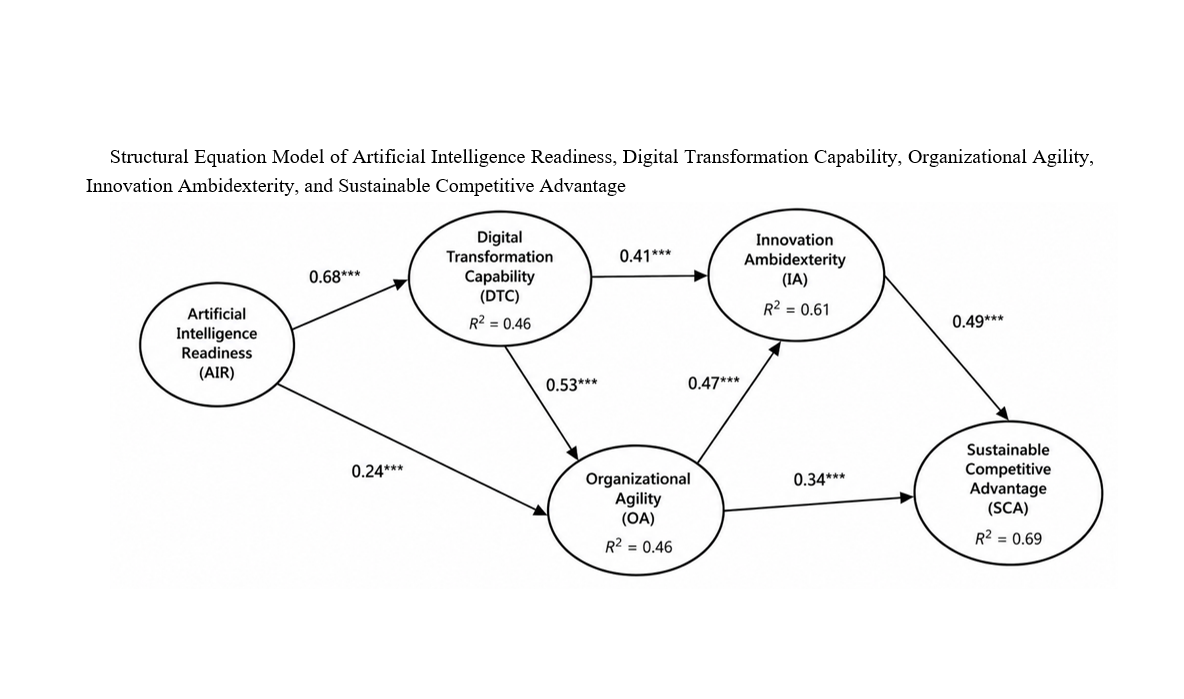
Findings: The measurement model demonstrated excellent fit to the data (χ²/df = 2.41, CFI = 0.957, TLI = 0.951, IFI = 0.958, GFI = 0.921, AGFI = 0.903, RMSEA = 0.049, SRMR = 0.042). Artificial intelligence readiness exerted significant positive effects on digital transformation capability (β = 0.68, p < .001) and organizational agility (β = 0.24, p < .001). Digital transformation capability positively influenced organizational agility (β = 0.53, p < .001) and innovation ambidexterity (β = 0.41, p < .001). Organizational agility significantly enhanced innovation ambidexterity (β = 0.47, p < .001) and sustainable competitive advantage (β = 0.34, p < .001). Innovation ambidexterity emerged as the strongest direct predictor of sustainable competitive advantage (β = 0.49, p < .001). The model explained 46% of the variance in organizational agility, 61% of the variance in innovation ambidexterity, and 69% of the variance in sustainable competitive advantage.
Conclusion: The findings indicate that artificial intelligence readiness serves as a foundational capability that strengthens digital transformation and organizational agility, which subsequently foster innovation ambidexterity and sustainable competitive advantage. The study highlights the strategic importance of integrating technological readiness, digital transformation initiatives, agile organizational structures, and balanced innovation practices to achieve enduring competitive performance in dynamic and technology-intensive business environments.
Downloads
References
Adhiatma, A., Nurhidayati, N., Fachrunnisa, O., Lukman, N., & Majid, M. N. A. (2023). Comparative Study on Workforce Transformation Strategy and SME Policies in Indonesia and Malaysia. Engineering Management in Production and Services, 15(4), 1-11. https://doi.org/10.2478/emj-2023-0024
Alamsjah, F., & Yunus, E. N. (2022). Achieving Supply Chain 4.0 and the Importance of Agility, Ambidexterity, and Organizational Culture: A Case of Indonesia. Journal of Open Innovation Technology Market and Complexity, 8(2), 83. https://doi.org/10.3390/joitmc8020083
Alaskar, T. H., Alsadi, A. K., Aloulou, W. J., & Ayadi, F. (2024). Big Data Analytics, Strategic Capabilities, and Innovation Performance: Mediation Approach of Organizational Ambidexterity. Sustainability, 16(12), 5111. https://doi.org/10.3390/su16125111
Aldianto, L., Anggadwita, G., Permatasari, A., Mirzanti, I. R., & Williamson, I. O. (2021). Toward a Business Resilience Framework for Startups. Sustainability, 13(6), 3132. https://doi.org/10.3390/su13063132
Ali, J. (2023). Convergence Innovation for Sustainable Development: Unraveling post‐COVID Dynamics for a Resilient Future. Sustainable Development, 32(3), 2858-2868. https://doi.org/10.1002/sd.2810
Ameen, N., Tarba, S. Y., Cheah, J. H., Xia, S., & Sharma, G. D. (2024). Coupling Artificial Intelligence Capability and Strategic Agility for Enhanced Product and Service Creativity. British Journal of Management, 35(4), 1916-1934. https://doi.org/10.1111/1467-8551.12797
Anwari, A., & Suzianti, A. (2024). Mapping Future Competencies: A Comprehensive Review of Organizational Challenges, Competencies, and Strategies to Survive and Compete in the Digital Era. Syntax Literate Jurnal Ilmiah Indonesia, 9(3), 1971-1983. https://doi.org/10.36418/syntax-literate.v9i3.14874
Benga, B., & Elhamma, A. (2024). Navigating the Digital Frontier: A Literature Review on Business Digitalization. European Scientific Journal Esj, 27. https://doi.org/10.19044/esipreprint.3.2024.p507
Bibi, M., Guan, T. T., & Yao, H. (2025). Exploring the Impact of AI Capabilities on Employee Well-Being: A Mediated Moderation Analysis. Sage Open, 15(3). https://doi.org/10.1177/21582440251361981
Bohashko, I., & Bohashko, O. (2024). Development of Organisational Competencies During Transition and Adaptation to Industry 4.0. Environment Technology Resources Proceedings of the International Scientific and Practical Conference, 3, 34-38. https://doi.org/10.17770/etr2024vol3.8134
Cao, Q., Trimi, S., & Schniederjans, D. G. (2024). Ambidextrous Supply Chain Strategy: Roles and Consequences With Agile Manufacturing and Resilience. The International Journal of Logistics Management, 35(6), 1981-2011. https://doi.org/10.1108/ijlm-10-2023-0429
Duwe, J. (2021). Introduction: The Trade-Off. 1-17. https://doi.org/10.1007/978-3-662-64032-6_1
Giudice, M. D., Scuotto, V., Papa, A., Tarba, S. Y., Bresciani, S., & Warkentin, M. (2021). A Self‐Tuning Model for Smart Manufacturing SMEs: Effects on Digital Innovation. Journal of Product Innovation Management, 38(1), 68-89. https://doi.org/10.1111/jpim.12560
Gouda, G. K., & Tiwari, B. (2023). Dynamic Nexus Between Smart HR 4.0 and Innovation Ambidexterity: A Fuzzy-Tism And MICMAC Approach. Journal of Organizational Effectiveness People and Performance, 11(4), 807-824. https://doi.org/10.1108/joepp-07-2023-0281
Hashem, G. (2024). Adopting Industry 4.0 Through Absorptive Capacity and Innovation Ambidexterity With the Moderation of Learning Capability. Business Process Management Journal, 30(6), 1995-2024. https://doi.org/10.1108/bpmj-12-2023-0939
Helbin, T., & Looy, A. V. (2021). Is Business Process Management (BPM) Ready for Ambidexterity? Conceptualization, Implementation Guidelines and Research Agenda. Sustainability, 13(4), 1906. https://doi.org/10.3390/su13041906
Hokmabadi, H., Seyed, M. H. S. R., & Matos, C. A. d. (2024). Business Resilience for Small and Medium Enterprises and Startups by Digital Transformation and the Role of Marketing Capabilities—A Systematic Review. Systems, 12(6), 220. https://doi.org/10.3390/systems12060220
Issa, H., Jabbouri, R., & Mehanna, R.-A. (2023). AI Micro-Decisions in FinTechs: A mixed Method Research Design. Management Decision, 61(11), 3316-3342. https://doi.org/10.1108/md-10-2022-1336
Jha, G. J. R. (2023). Exploring the Impact of Information and Communication Technology (ICT) on Innovative Businesses: An Investigative Analysis. Interantional Journal of Scientific Research in Engineering and Management, 07(09). https://doi.org/10.55041/ijsrem25854
Nuerk, J., & Dařena, F. (2025). Systems Engineering Methodology for Digital Supply Chain Business Models. Systems Engineering, 28(3), 411-437. https://doi.org/10.1002/sys.21802
Panda, S. (2024). The Role of Employee Ambidexterity on Employee Agility: A Moderation Analysis With Employee Organizational Tenure. Evidence-Based HRM a Global Forum for Empirical Scholarship, 13(1), 68-84. https://doi.org/10.1108/ebhrm-07-2023-0178
Przytuła, S., Rank, S., & Tracz‐Krupa, K. (2022). Ambidexterity as the Response of Smart Industry 4.0 – Towards Better HR Practices. 51-67. https://doi.org/10.1108/s1877-636120220000028006
Ragazou, K., Passas, I., Garefalakis, A., & Dimou, I. (2022). Investigating the Research Trends on Strategic Ambidexterity, Agility, and Open Innovation in SMEs: Perceptions From Bibliometric Analysis. Journal of Open Innovation Technology Market and Complexity, 8(3), 118. https://doi.org/10.3390/joitmc8030118
Rahman, M. K., Piprani, A. Z., Mohiuddin, S., Nazir, S., & Shah, A. A. (2026). Unraveling the Impact of Organizational Ambidexterity: The Role of Integration and Agility in Enhancing Performance Amidst Supply Chain Disruptions. Global Business and Organizational Excellence. https://doi.org/10.1002/joe.70028
Razzak, M. R., Al‐Riyami, S., & Palalić, R. (2022). Organizational Meta Capabilities in the Digital Transformation Era. Foresight and Sti Governance, 16(4), 24-31. https://doi.org/10.17323/2500-2597.2022.4.24.31
Roh, T., & Xiao, S. (2024). Extending the Research Agenda for Supply Chain Management in the Age of Disruption: The Multifaceted Role and Implications of Dynamic Capabilities. Journal of General Management, 50(1), 5-15. https://doi.org/10.1177/03063070241272373
Singh, V., Singh, J., & Singh, N. (2025). Fuelling Organisational Capabilities for Sustainable Innovation Disruption: Performing to Be a Pioneer. Business Strategy and the Environment, 34(7), 8052-8078. https://doi.org/10.1002/bse.70013
Szelągowski, M., & Berniak‐Woźny, J. (2024). BPM Challenges, Limitations and Future Development Directions – A systematic Literature Review. Business Process Management Journal, 30(2), 505-557. https://doi.org/10.1108/bpmj-06-2023-0419
Ürü, F. O., Gözükara, E., & Ünsal, A. A. (2024). Organizational Ambidexterity, Digital Transformation, and Strategic Agility for Gaining Competitive Advantage in SMEs. Sosyal Mucit Academic Review, 5(1), 1-23. https://doi.org/10.54733/smar.1386357
Utomo, P., & Cham, T. H. (2023). Development Trends of Digital Transformation in Entrepreneurship and Innovation: A Bibliometric Analysis. Journal The Winners, 24(1), 33-44. https://doi.org/10.21512/tw.v24i1.10064
Verleyen, W., & McGinnis, W. (2022). Framework for Disruptive AI/ML Innovation. https://doi.org/10.48550/arxiv.2204.12641
Wetering, R. v. d., & Versendaal, J. (2021). Information Technology Ambidexterity, Digital Dynamic Capability, and Knowledge Processes as Enablers of Patient Agility: Empirical Study (Preprint). https://doi.org/10.2196/preprints.32336
Zhang, S., & Suntrayuth, S. (2024). The Synergy of Ambidextrous Leadership, Agility, and Entrepreneurial Orientation to Achieve Sustainable AI Product Innovation. Sustainability, 16(10), 4248. https://doi.org/10.3390/su16104248
Downloads
Additional Files
Publication Timeline
- Submitted
- Revised
- Accepted