Exploring the Mediating Role of Green Transformational Leadership in the Relationship between Corporate Social Responsibility and Environmental Performance
DOI:
https://doi.org/10.61838/Keywords:
Corporate Social Responsibility, Green Transformational Leadership, Environmental Performance, Sustainability Performance, Sustainable ManagementAbstract
Objective: The present study aimed to investigate the mediating role of green transformational leadership in the relationship between corporate social responsibility (CSR) and environmental performance among companies listed on the Tehran Stock Exchange.
Methods and Materials: This applied research employed a descriptive–correlational survey design. The statistical population consisted of financial managers, heads of accounting departments, and senior accounting experts working in companies listed on the Tehran Stock Exchange in 2025. Using Cochran’s formula and a stratified random sampling approach, 395 valid questionnaires were collected and analyzed. Standardized instruments were used to measure corporate social responsibility, green transformational leadership, and environmental performance. Data analysis was conducted using Partial Least Squares Structural Equation Modeling (PLS-SEM) through SmartPLS 3 software. Reliability, convergent validity, discriminant validity, and overall model fit were assessed prior to hypothesis testing. The results confirmed satisfactory psychometric properties and a strong model fit (GOF = 0.672), indicating the adequacy of the measurement and structural models.
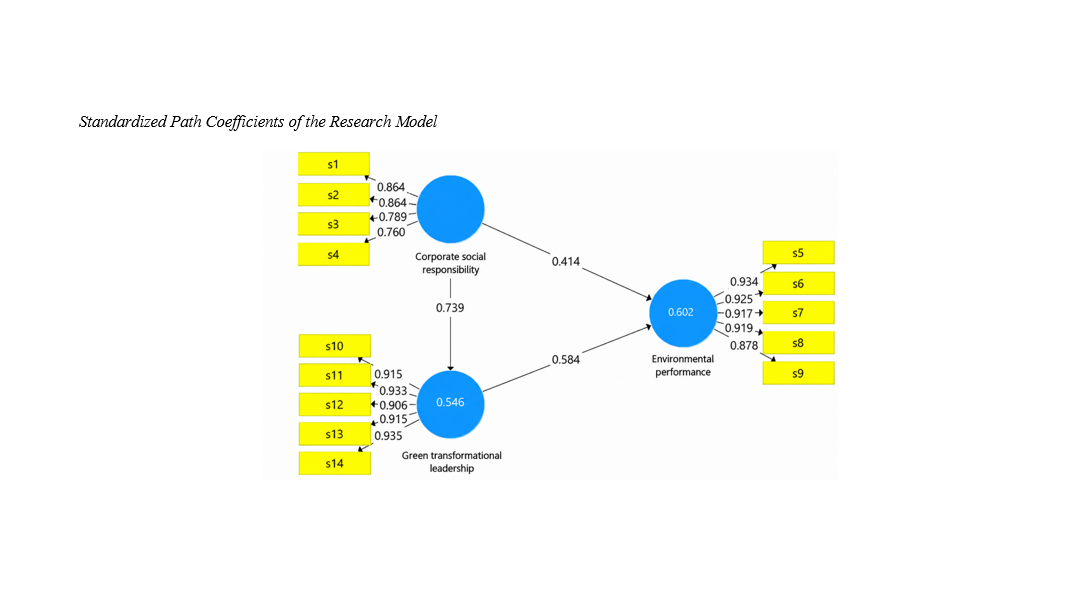
Findings: The structural model results demonstrated that corporate social responsibility had a significant positive effect on environmental performance (β = 0.414, t = 9.370, p < 0.001). Corporate social responsibility also exerted a significant positive effect on green transformational leadership (β = 0.739, t = 29.310, p < 0.001). Furthermore, green transformational leadership significantly enhanced environmental performance (β = 0.584, t = 13.958, p < 0.001). The findings additionally confirmed the mediating role of green transformational leadership in the relationship between corporate social responsibility and environmental performance, indicating that CSR contributes to superior environmental outcomes both directly and indirectly through the development of green transformational leadership practices.
Conclusion: The findings indicate that corporate social responsibility serves as a strategic driver of environmental performance and that green transformational leadership plays a pivotal intermediary role in translating social commitments into tangible environmental achievements.
Downloads
References
Aghajani, A., & Behboudi, O. (2023). The Influence of Customers' Sustainable Interactive Behavior by Perceived Brand Social Responsibility, Environmental Concerns, and Green Trust: A Study of Agricultural Product Customers. Entrepreneurship and Sustainable Agricultural Development Studies, 10(3), 1-18.
Ahmad, M., Ullah, S., & Suganthi, L. (2022). Corporate Social Responsibility, Green Finance and Environmental Performance: Empirical Evidence from Developing Countries. Sustainability, 14(20), 13607. https://doi.org/10.3390/su142013607
Ahmad, N. (2021). Relationship between Corporate Social Responsibility at the Micro-Level and Environmental Performance: The Mediating Role of Employee Pro-Environmental Behavior and the Moderating Role of Gender. Sustainable Production and Consumption, 27, 1138-1148.
Ahmad, U. S., Usman, M., Hussain, S., Jahanger, A., & Abrar, M. (2022). Determinants of Renewable Energy Sources in Pakistan: An Overview. Environmental Science and Pollution Research. https://doi.org/10.1007/s11356-022-18502-w
Al-Ali, H. A., & O'Mahony, B. (2025). Corporate Social Responsibility and Environmental Performance: The Mediating Role of Green Capabilities and Green Innovation. Journal of Asia Business Studies.
Amoako, G. K., Adam, A. M., Tackie, G., & Arthur, C. L. (2021). Environmental Accountability Practices of Environmentally Sensitive Firms in Ghana: Does Institutional Isomorphism Matter? Sustainability, 13(3), 122-141. https://doi.org/10.3390/su13010122
Andrades, J., Martinez-Martinez, D., & Larrán, M. (2024). Sustainability Reporting, Institutional Pressures and Universities: Evidence from the Spanish Setting. Sustainability Accounting, Management and Policy Journal. https://doi.org/10.1108/SAMPJ-07-2023-0455
Awan, F. H., Dunnan, L., Jamil, K., & Gul, R. F. (2023). Stimulating Environmental Performance via Green Human Resource Management, Green Transformational Leadership, and Green Innovation: A Mediation-Moderation Model. Environmental Science and Pollution Research, 30(2), 2958-2976.
Basheer, M. F., Hassan, S. G., & Ali, A. (2025). The Influence of Renewable Energy, Humanistic Culture, and Green Knowledge on Corporate Social Responsibility and Corporate Environmental Performance. Clean Technologies and Environmental Policy, 27, 1407-1426. https://doi.org/10.1007/s10098-024-02889-w
Bhat, A. A., Mir, A. A., Allie, A. H., Lone, M. A., Al-Adwan, A. S., Jamali, D., & Riyaz, I. (2024). Unlocking Corporate Social Responsibility and Environmental Performance: Mediating Role of Green Strategy, Innovation, and Leadership. Innovation and Green Development, 3(2), 100112.
Bonsu, M. O. A., Guo, Y., & Zhu, X. (2024). Does Green Innovation Mediate Corporate Social Responsibility and Environmental Performance? Empirical Evidence from Emerging Markets. Journal of Applied Accounting Research, 25(2), 221-239.
Chen, H., Shi, Y., & He, H. (2025). A Sustainable Urban Framework Based on Natural Capital and Ecosystem Services Accounting. Applied Spatial Analysis and Policy, 18(1), 23-45. https://doi.org/10.1007/s12061-024-09575-w
Childress, M. J., & Lung, M. A. (2023). Predation Risk, Gender and the Group Size Effect: Does Elk Vigilance Depend on the Behaviour of Conspecifics? Animal Behaviour, 66, 389-398. https://doi.org/10.1016/j.anbehav.2022.12.007
Dehghanizadeh, M., & Tavakoli Elahabadi, M. (2024). The Role of Green Organizational Culture, Green Transformational Leadership Strategy, and Environmental Regulations in Predicting Green Performance and Competitive Advantage through Green Transformational Leadership. Journal of Environmental Education and Sustainable Development, 13(1), 37-58.
Demir, B., Akdemir, M. A., Kara, A. U., Sagbas, M., Sahin, Y., & Topcuoglu, E. (2025). The Mediating Role of Green Innovation and Environmental Performance in the Effect of Green Transformational Leadership on Sustainable Competitive Advantage. Sustainability, 17(4), 1407.
Dhar, B. K., Sarkar, S. M., & Ayittey, F. K. (2022). Impact of Social Responsibility Disclosure between Implementation of Green Accounting and Sustainable Development: A Study on Heavily Polluting Companies in Bangladesh. Corporate Social Responsibility and Environmental Management, 29(1), 71-78. https://doi.org/10.1002/csr.2174
Faraji, O., Jannati Daryakenari, F., Mansouri, K., & Younesi Motie, F. (2020). Social Responsibility and Firm Value: The Moderating Role of Earnings Management. Social Capital Management, 7(1), 25-58.
Ghisellini, P., Quinto, I., Passaro, R., & Ulgiati, S. (2024). Evaluating Good Practices of Ecological Accounting and Auditing in a Sample of Circular Start-Ups. In Place Based Approaches to Sustainability Volume II: Business, Economic, and Social Models (pp. 201-227). Springer Nature. https://doi.org/10.1007/978-3-031-25358-2_10
Heydari, M. (2023). The Mediating Role of Organizational Identity in the Relationship between Social Responsibility, Job Engagement, and Organizational Citizenship Behavior. Quarterly Journal of Health Psychology and Social Behavior, 3(1), 28-41.
Hou, Y., Bello-Pintado, A., & García-Marco, T. (2025). Pay to Be Green? The Effect of Corporate Social Responsibility Contracting on Green Innovation Performance. BRQ Business Research Quarterly, 28(2), 421-437.
Huy, P. Q., & Phuc, V. K. (2023). Unfolding Sustainable Auditing Ecosystem Formation Path through Digitalization Transformation: How Digital Intelligence of Accountant Fosters the Digitalization Capabilities. Heliyon, 9(2), e13529. https://doi.org/10.1016/j.heliyon.2023.e13529
Ikechukwu, O., Anichebe, S., Emeka-Nwokeji, N., & Agubata, S. (2022). Sustainability Environmental Disclosure and Financial Performance of Oil and Gas Companies in Nigeria. International Journal of Energy Economics and Policy, 6(1), 11-31. https://doi.org/10.32479/ijeep.12654
Kamal, M., Usman, M., Jahanger, A., & Balsalobre-Lorente, D. (2021). Revisiting the Role of Fiscal Policy, Financial Development, and Foreign Direct Investment in Reducing Environmental Pollution during Globalization Mode: Evidence from Linear and Nonlinear Panel Data Approaches. Energies, 14(21), 6968. https://doi.org/10.3390/en14216968
Khalafi, S., & Ashrafi, Z. (2025). The Effect of FinTech-Based Innovation on Green Transformational Leadership Considering the Role of Green Finance and Green Human Resource Management in Financial Institutions Listed on the Tehran Stock Exchange. Economic Strategy Quarterly, 13(51), 1-22.
Khalid, K., Usman, M., & Mehdi, M. A. (2021). The Determinants of Environmental Quality in the SAARC Region: A Spatial Heterogeneous Panel Data Approach. Environmental Science and Pollution Research, 28(6), 6422-6436. https://doi.org/10.1007/s11356-020-10896-9
Khalili, M., Zabihi, A., & Faghani Makrani, K. (2024). Explaining a Model for the Effect of Organizational Culture and Contingency Factors on Sustainability Reporting with an Economic Performance Approach (GRI 201). Management Accounting and Auditing Knowledge, 13(50), 319-338.
Khan, S., Rehman, S., & Nasir, A. (2025). Investigating the Factors Affecting Green Innovation of Service Sector: A Moderated Mediation Model. European Journal of Innovation Management, 28(2), 141-165.
Luo, W., Guo, X., Zhong, S., & Wang, J. (2019). Environmental Information Disclosure Quality, Media Attention and Debt Financing Costs: Evidence from Chinese Heavy Polluting Listed Companies. Journal of Cleaner Production, 231, 268-277. https://doi.org/10.1016/j.jclepro.2019.05.237
Ma, X., Jiang, P., & Jiang, Q. (2020). Research and Application of Association Rule Algorithm and an Optimized Grey Model in Carbon Emissions Forecasting. Technological Forecasting and Social Change, 158, Article 120159.
Mahmoudi, R., Talebnia, G., Vakilifard, H. R., Ahmadi, F., & Moradi Shahdadi, K. (2023). Presenting a Sustainability Reporting Model Based on Grounded Theory in Companies Listed on the Tehran Stock Exchange. Financial Economics, 17(64), 207-222.
Mansour, G., Poursoleiman, E., Homayoun, S., Rezaei, Z., & Rezaee, Z. (2022). Business Sustainability Performance and Corporate Financial Performance: The Mediating Role of Optimal Investment. Managerial Finance, 48(8), 1201-1223. https://doi.org/10.1108/MF-01-2021-0040
Mukhtar, B., Shad, M. K., Woon, L. F., Haider, M., & Waqas, A. (2024). Integrating ESG Disclosure into the Relationship between CSR and Green Organizational Culture toward Green Innovation. Social Responsibility Journal, 20(2), 288-304. https://doi.org/10.1108/SRJ-03-2023-0125
Nasir, A., Zakaria, N., Do, N., & Velasquez, S. (2024). The Impact of Knowledge Management on Sustainable Performance with Mediation Effect of Green Innovation in Malaysian SMEs. VINE Journal of Information and Knowledge Management Systems.
Ramzan, M., Raza, S. A., Usman, M., Sharma, G. D., & Iqbal, H. A. (2021). Environmental Cost of Non-Renewable Energy and Economic Progress: Do ICT and Financial Development Mitigate Some Burden? Journal of Cleaner Production, Article 130066. https://doi.org/10.1016/j.jclepro.2021.130066
Shahabi, S., Jamshidi Navid, B., & Ghanbari, M. (2025). Investigating Environmental Cost Management in Petrochemical Companies Listed on the Tehran Stock Exchange Using Financial Performance Indicators. Management Accounting and Auditing Knowledge, 14(55), 111-127.
Shakil, M. H., Munim, Z. H., Zamore, S., & Tasnia, M. (2024). Sustainability and Financial Performance of Transport and Logistics Firms: Does Board Gender Diversity Matter? Journal of Sustainable Finance & Investment, 14(1), 100-115. https://doi.org/10.1080/20430795.2023.2210532
Singh, S. K., Del Giudice, M., Chierici, R., & Graziano, D. (2020). Green Innovation and Environmental Performance: The Role of Green Transformational Leadership and Green Human Resource Management. Technological Forecasting and Social Change, 150, Article 119762.
Su, L., & Zhang, H. (2019). Environmental Information Disclosure Quality and Equity Financing Cost. Proceedings of the 2019 International Conference on Advanced Education, Business and Management (AEBMR 2019),
Tolliver, C., Keeley, A. R., & Managi, S. (2020). Policy Targets behind Green Bonds for Renewable Energy: Do Climate Commitments Matter? Technological Forecasting and Social Change, 157, Article 120051.
Trotta, A., Iannuzzi, A., Cavallaro, G., & Dell'Atti, S. (2017). Banking Reputation and CSR: A Stakeholder Value Approach. Corporate Social Responsibility and Environmental Management, 24(6), 440-454. https://doi.org/10.1002/csr.1420
Wang, K., & Zhang, X. (2020). The Effect of Media Coverage in Disciplining Firms' Pollution Behaviors: Evidence from Chinese Heavy Polluting Listed Companies. Journal of Cleaner Production, 280, 123035. https://doi.org/10.1016/j.jclepro.2020.123035
Wu, T., & Kung, C. C. (2020). Carbon Emissions, Technology Upgradation and Financing Risk of the Green Supply Chain Competition. Technological Forecasting and Social Change, 152, Article 119884.
Xu, H., Zhao, L., & Wang, Y. (2024). Exploring the Symbiosis of Corporate Social Responsibility, Green Innovation, and Environmental Performance in China's Manufacturing. Sustainability, 16(23), 10720. https://doi.org/10.3390/su162310720
Yang, B., & Usman, M. (2021). Do Industrialization, Economic Growth and Globalization Processes Influence the Ecological Footprint and Healthcare Expenditures? Fresh Insights Based on the STIRPAT Model for Countries with the Highest Healthcare Expenditures. Sustainable Production and Consumption, 28, 893-910. https://doi.org/10.1016/j.spc.2021.07.020
Yu, W., Ramanathan, R., & Nath, P. (2017). Environmental Pressures and Performance: An Analysis of the Roles of Environmental Innovation Strategy and Marketing Capacity. Technological Forecasting and Social Change, 117, 160-169.
Zameer, H., Wang, Y., Yasmeen, H., & Mubarak, S. (2022). Green Innovation as a Mediator in the Impact of Business Analytics and Environmental Orientation on Green Competitive Advantage. Management Decision, 60(2), 488-507.
Zimon, G., Arianpoor, A., & Salehi, M. (2022). Sustainability Reporting and Corporate Reputation: The Moderating Effect of CEO Opportunistic Behavior. Sustainability, 14(3), 1257. https://doi.org/10.3390/su14031257
Downloads
Additional Files
Publication Timeline
- Submitted
- Revised
- Accepted