Random Forest Prediction of Employee Turnover Intention Using Organizational, Psychological, and Job-Related Variables
Keywords:
Employee Turnover Intention, Random Forest, Machine Learning, Job Satisfaction, Organizational Commitment, Burnout, Organizational Support, Job InsecurityAbstract
Objective: This study aimed to develop and evaluate a Random Forest model for predicting employee turnover intention using organizational, psychological, and job-related variables among employees in Canada.
Methods and Materials: This quantitative, cross-sectional predictive study was conducted among 428 employees working in public and private organizations across Canada. Participants were recruited from diverse occupational sectors and completed measures of perceived organizational support, organizational commitment, organizational justice, supervisor support, career development opportunities, perceived stress, psychological well-being, work engagement, burnout, occupational self-efficacy, job satisfaction, workload, job autonomy, role clarity, job insecurity, work–life balance, compensation adequacy, and turnover intention. The dataset was stratified into training and independent test subsets using an 80:20 ratio. A Random Forest classifier was optimized through stratified five-fold cross-validation. Predictive performance was assessed using accuracy, precision, sensitivity, specificity, F1 score, and receiver operating characteristic area under the curve. Permutation importance and SHapley Additive exPlanations were used to interpret predictor contributions.
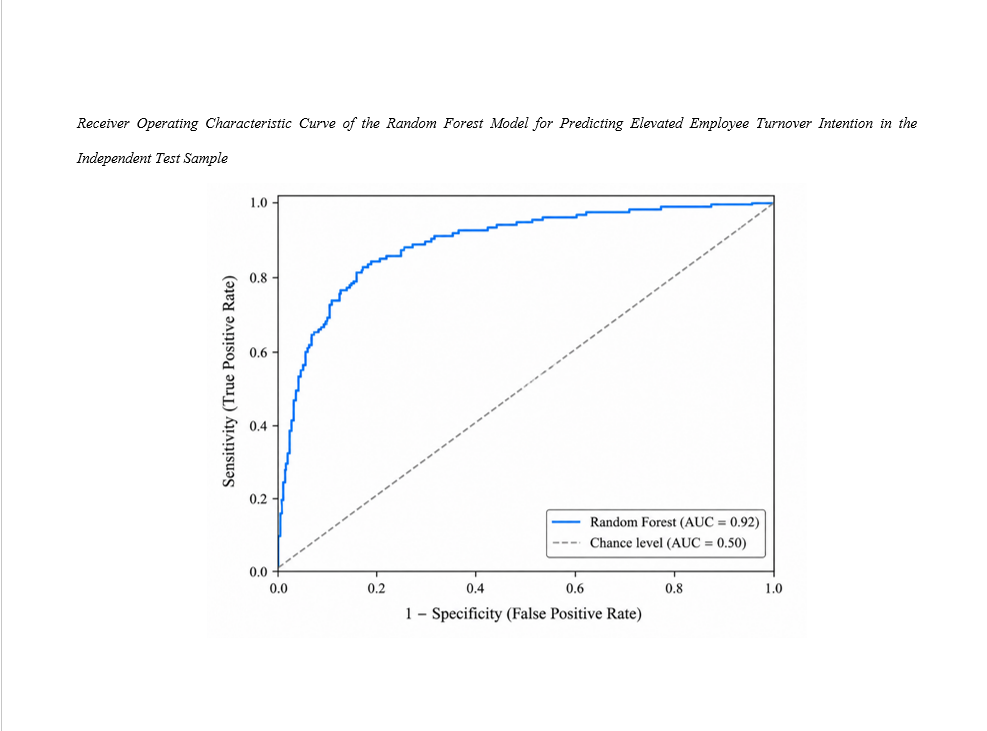
Findings: Turnover intention was significantly associated with all examined predictors. The strongest correlations were observed for job satisfaction (r = -.62, p < .001), organizational commitment (r = -.58, p < .001), burnout (r = .55, p < .001), perceived organizational support (r = -.51, p < .001), and job insecurity (r = .49, p < .001). In the independent test sample, the optimized Random Forest model achieved an accuracy of .86, precision of .83, sensitivity of .82, specificity of .89, F1 score of .82, and ROC-AUC of .92. Feature-importance analyses identified job satisfaction, organizational commitment, burnout, perceived organizational support, and job insecurity as the most influential predictors.
Conclusion: Employee turnover intention can be predicted with high discriminatory accuracy by integrating organizational, psychological, and job-related variables, with job satisfaction, commitment, burnout, organizational support, and job insecurity representing particularly important indicators of turnover risk.
Downloads
References
Abdou, A. H., & Albohnayh, A. S. M. (2026). When Nursing Leadership Turns Toxic: Mediating, Amplifying, and Buffering Effects of Emotional Exhaustion, Job Insecurity, and Coworker Support. BMC Nursing, 25(1). https://doi.org/10.1186/s12912-026-04545-8
Alharbi, M. F. (2023). MEDIATING ROLE OF COGNITIVE RUMINATION AND CAREER INSECURITY ON RELATIONSHIP BETWEEN NURSES’ JOB SATISFACTION &Amp; TURNOVER INTENTION. Journal of Social Research Development, 4(03), 542-557. https://doi.org/10.53664/jsrd/04-03-2023-02-542-557
Azazz, A. M. S., Elshaer, I. A., El-Shamy, H., Fayyad, S., Elsawy, O. M., & Mohammad, A. A. A. (2026). Emotional Contagion in the Workplace: A Moderated Mediation Model of Psychological Well-Being, Job Performance, and Turnover Intention in Hotels. European Journal of Investigation in Health Psychology and Education, 16(4), 50. https://doi.org/10.3390/ejihpe16040050
Boateng, R. K., Appiah, S. O., Amfo-Antiri, D., Okorley, E. N., Kwao, I. T., Essandoh, E., & Opoku, F. K. (2026). Social Undermining and Coping Mechanisms as Predictors of Turnover Intentions Among Healthcare Workers in Ghana. https://doi.org/10.21203/rs.3.rs-9305225/v1
Caputo, A., Costa, P., Gatti, P., Cortese, C. G., & Ferreira, A. I. (2025). Effects of Consensus on Leader–Member Exchange (LMX) Within Nursing Teams on the Relationship Between Abusive Supervision, Job Satisfaction, and Unit Turnover: A Multilevel Moderation Study. Journal of nursing management, 2025(1). https://doi.org/10.1155/jonm/6220416
Carbone, D., Colabucci, A., & Marcatto, F. (2026). When Drivers Step Off the Bus: Well-Being and Turnover Intention in the Public Transport Sector. International journal of environmental research and public health, 23(4), 485. https://doi.org/10.3390/ijerph23040485
Chaichi, K., Zawawi, D., Aziz, Y. A., & Leong, M. K. (2024). Uncovering the Hidden Intangible Factors of Hotel Employees’ Turnover Intention During COVID Phenomenon. Management and Labour Studies, 49(4), 590-614. https://doi.org/10.1177/0258042x241244577
Chen, S., Wang, S., & Wu, J. (2025). The Impact of Destructive Leadership on Turnover Intention Among Chinese Technology Professionals: The Mediating Role of Job Burnout and the Moderating Role of Regulatory Emotional Self-Efficacy. Frontiers in psychology, 16. https://doi.org/10.3389/fpsyg.2025.1698652
Chen, Y.-C., Chang, C.-L., Chu, H.-C., & Chien, T. R. (2026). Workplace Bullying in Taiwan: A Meta-Analysis of Multilevel Impacts on Employees and Organizations. https://doi.org/10.21203/rs.3.rs-8528317/v1
Chen, Y. C., Wu, J.-Y., & Chu, H.-C. (2025). Correlations of Workload With Personality Traits, Perceived Negative and Positive Behaviors, and Organizational Factors: A Meta-Analysis. Work a Journal of Prevention Assessment & Rehabilitation, 83(1), 227-241. https://doi.org/10.1177/10519815251365103
Choi, J., & Choi, H.-Y. (2025). Feeling Drained at Work? The Effects of Workplace Incivility Among Frontline Restaurant Employees. Cornell Hospitality Quarterly, 67(1), 97-110. https://doi.org/10.1177/19389655251363935
Christensen, J. O., & Knardahl, S. (2022). “I'm Too Old for This!”: A Prospective, Multilevel Study of Job Characteristics, Age, and Turnover Intention. Frontiers in psychology, 13. https://doi.org/10.3389/fpsyg.2022.1015313
Czerw, A., Grabowski, D., Chudzicka‐Czupała, A., & Stąpor, K. (2025). Trust in the Organization as a Mediator in the Relationship of Good Organizational Context With Employee Well-Being. International Journal of Occupational Medicine and Environmental Health, 38(4), 335-351. https://doi.org/10.13075/ijomeh.1896.02615
Fuzi, N. A. M., & Baki, N. U. (2025). Understanding Turnover Intentions in the Financial Services Sector: A Systematic Review of the Quit Mindset. Sage Open, 15(4). https://doi.org/10.1177/21582440251385892
Guchait, P., Peyton, T., Madera, J. M., Gip, H., & Molina, A. (2023). 21st Century Leadership Research in Hospitality Management: A State-of-the-Art Systematic Literature Review. International Journal of Contemporary Hospitality Management, 35(12), 4259-4296. https://doi.org/10.1108/ijchm-05-2022-0620
Gupta, S. K., & Bhatia, N. (2023). A Decade of Trend in the Employee Turnover Intention Study in India: A Systematic Review and Recommendation. Fiib Business Review, 15(2), 199-220. https://doi.org/10.1177/23197145231158907
İlhan, Ü. D., Güler, B. K., Turgut, D., & Duran, C. (2025). Unique Challenges in the Turkish Workforce: Examining the Impact of Job Demands and Resources on Work-Related Outcomes of Blue- And White-Collar Workers. Frontiers in psychology, 16. https://doi.org/10.3389/fpsyg.2025.1588266
Ivziku, D., Duka, B., Dervishi, A., Filomeno, L., Polverini, F., Notarnicola, I., Stievano, A., Rocco, G., González, C. I. A., Podgorica, N., D’Angelo, D., Benedictis, A. D., Micco, F. D., Gualandi, R., Lommi, M., & Tartaglini, D. (2025). Exploring Nurses’ Quit Intentions: A Structural Equation Modelling and Mediation Analysis Based on the JD-R and Social Exchange Theories. Healthcare, 13(7), 692. https://doi.org/10.3390/healthcare13070692
Katıtaş, S. (2026). Unpacking the Effect of Organizational Silence on Teachers’ Turnover Intention: The Mediating Role of Work Alienation. Sage Open, 16(1). https://doi.org/10.1177/21582440251414812
Mitterer, D. M., & Mitterer, H. E. (2023). The Mediating Effect of Trust on Psychological Safety and Job Satisfaction. Journal of Behavioral and Applied Management, 23(1). https://doi.org/10.21818/001c.73642
Moisoglou, I., Katsiroumpa, A., Konstantakopoulou, O., Μangoulia, P., Tsiachri, M., Koinis, A., Kyriakatis, G. M., & Galanis, P. (2025). Workplace Gaslighting: Implications for Employees’ Mental Health and Work Life in Greece. Healthcare, 13(24), 3255. https://doi.org/10.3390/healthcare13243255
Mondo, M., Cicotto, G., Pileri, J., Cois, E., & Simone, S. D. (2023). Promote Well-Being and Innovation in Sustainable Organizations: The Role of Job Crafting as Mediator. Sustainability, 15(11), 8899. https://doi.org/10.3390/su15118899
Nielsen, M. B., Gjerstad, J., & Einarsen, S. (2023). The Moderating Role of Transformational Leadership in the Relationships Between Job Demands and Turnover Intentions. Scandinavian Journal of Work and Organizational Psychology, 8(1). https://doi.org/10.16993/sjwop.193
Pires, M. L. (2025). The Effects of Job Insecurity on Psychological Well-Being and Work Engagement: Testing a Moderated Mediation Model. Behavioral Sciences, 15(7), 979. https://doi.org/10.3390/bs15070979
Poluru, N. V. (2024). Exploring the Impact of Flexible Work Arrangements on Turnover Intention: The Mediating Role of Job Satisfaction and the Moderating Effect of Perceived Supervisory Support. Journal of Accounting Business and Management (Jabm), 32(1), 217. https://doi.org/10.31966/jabminternational.v32i1.1467
Priyanka, Khera, S. N., & Suri, P. K. (2024). Towards Crafting a Cure for Employee Turnover: A Social Exchange Theory Perspective. Industrial and Commercial Training, 56(4), 434-448. https://doi.org/10.1108/ict-03-2024-0020
Qureshi, T. M., Ghadi, M. Y., & Sindhu, M. (2024). Examining the Influence of Continuance Performance Management on Turnover Intention: Exploring the Mediating Effects of Employee Motivation and Job Autonomy – A Practical Study in the Banking Industry in Dubai. Industrial and Commercial Training, 56(3), 148-165. https://doi.org/10.1108/ict-09-2023-0066
Radigan, P., Gilbreath, B., & Scroggins, W. A. (2025). Perceived Leader Concern, Employee Authentic Self-Expression, and Self-Concept-Job Fit. Journal of Management & Organization, 31(5), 2385-2403. https://doi.org/10.1017/jmo.2025.10035
Rani, C., Kaur, R., & Goel, P. (2022). Work-Life Balance of Nurses and Its Antecedents: A Systematic Literature Review. Orissa Journal of Commerce, 161-175. https://doi.org/10.54063/ojc.2022.v43i02.11
Shao, L., Guo, H., Yue, X., & Zhang, Z. (2022). Psychological Contract, Self-Efficacy, Job Stress, and Turnover Intention: A View of Job Demand-Control-Support Model. Frontiers in psychology, 13. https://doi.org/10.3389/fpsyg.2022.868692
Yıldız, B., Kaptan, Z., Yıldız, T., Elibol, E., Yıldız, H., & Özbilgin, M. F. (2023). A Systematic Review and Meta-Analytic Synthesis of the Relationship Between Compulsory Citizenship Behaviors and Its Theoretical Correlates. Frontiers in psychology, 14. https://doi.org/10.3389/fpsyg.2023.1120209
Zhang, Y., & Zhao, D. (2025). How Psychological Empowerment Affects Early Childhood Teachers' Turnover Intention: The Mediating Role of Organizational Support and the Moderating Role of Organizational Justice. https://doi.org/10.21203/rs.3.rs-8184620/v1
Downloads
Additional Files
Publication Timeline
- Submitted
- Revised
- Accepted