Support Vector Machine Classification of Employees with High Innovative Work Behavior Using Psychological and Organizational Indicators
Keywords:
Innovative work behavior, Support Vector Machine, machine learning, creative self-efficacy, organizational climate, psychological capital, work engagement, TunisiaAbstract
Objective: This study aimed to classify Tunisian employees with high innovative work behavior using a Support Vector Machine model based on psychological and organizational indicators and to determine the relative contribution of these predictors to classification performance.
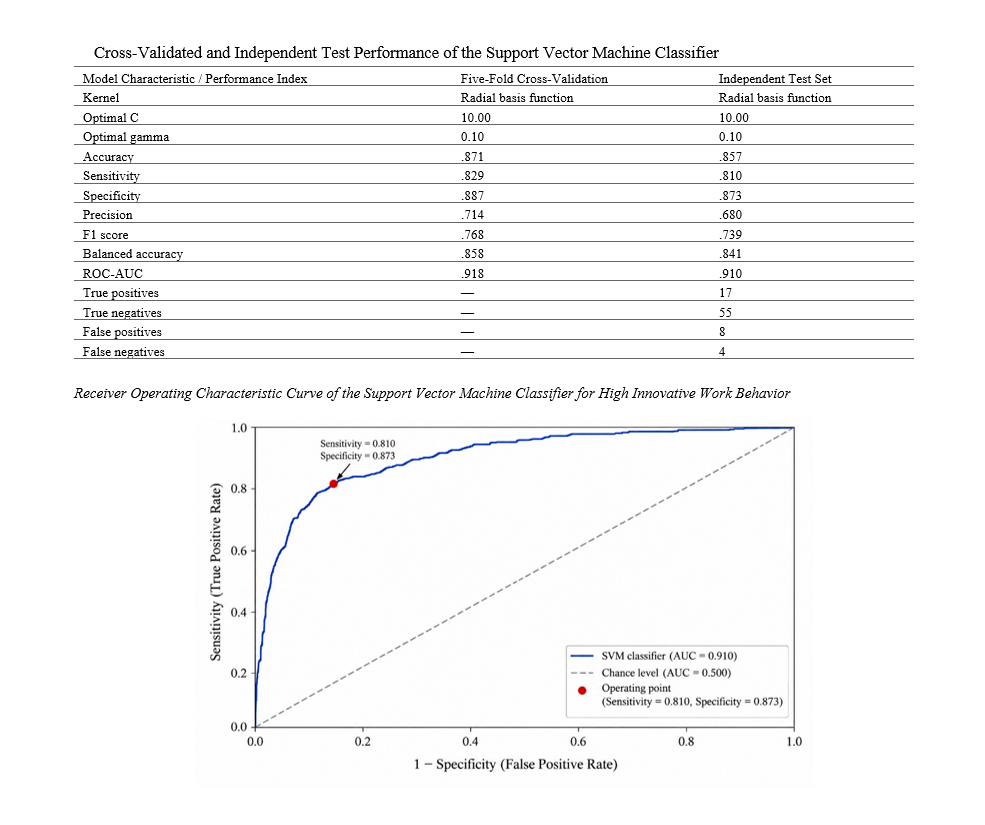
Methods and Materials: This quantitative cross-sectional predictive study was conducted among 418 employees working in public and private organizations in Tunis, Sfax, Sousse, and Monastir, Tunisia. Participants completed standardized measures of innovative work behavior, psychological capital, work engagement, intrinsic work motivation, creative self-efficacy, perceived organizational support, perceived supervisor support, organizational climate for innovation, job autonomy, and knowledge sharing. Employees scoring at or above the 75th percentile of innovative work behavior were classified as having high innovative work behavior. The dataset was divided into stratified training and independent test sets using an 80/20 ratio. A radial basis function Support Vector Machine was optimized through stratified five-fold cross-validation and grid search for C and gamma parameters. Classification performance was evaluated using accuracy, sensitivity, specificity, precision, F1 score, balanced accuracy, and ROC-AUC. Permutation-based feature importance was used to estimate the relative predictive contribution of each indicator.
Findings: The optimized SVM achieved cross-validated accuracy of .871, balanced accuracy of .858, and ROC-AUC of .918. In the independent test set, the model achieved accuracy of .857, sensitivity of .810, specificity of .873, precision of .680, F1 score of .739, balanced accuracy of .841, and ROC-AUC of .910. Creative self-efficacy showed the greatest permutation importance (.082), followed by organizational climate for innovation (.069), psychological capital (.058), work engagement (.046), knowledge sharing (.040), job autonomy (.034), intrinsic work motivation (.029), perceived organizational support (.024), and perceived supervisor support (.017).
Conclusion: Psychological and organizational indicators can classify employees with high innovative work behavior with substantial out-of-sample accuracy, with creative self-efficacy and organizational climate for innovation emerging as the strongest discriminative predictors.
Downloads
References
Andayesh, S. (2025). The mediating role of creativity in the relationship between artificial intelligence and librarians' innovative work behavior. Library and Information Organization Studies. https://doi.org/10.30484/nastinfo.2025.3769.2329
Attique, A., Hameed, F., & Ahmed, M. (2025). Ambidextrous Leadership and Innovative Work Behavior: A Case Study of Pakistani Hospitals. Research Journal for Social Affairs, 3(5), 699-712. https://doi.org/10.71317/RJSA.003.05.0366
Aziz, B. (2025). Innovative Work Behavior on Education Sector: A Systematic Literature Review. Journal of Social Science (Joss), 4(12). https://doi.org/10.59188/jcs.v4i12.3862
Bui, H., Vu, X. T. M., & Tran, A. D. (2025). The Moderating Role of Emotional Intelligence in the Relationship Between Transformational Leadership, Organizational Citizenship Behavior, Innovative Work Behavior, and Employee Performance in Commercial Banks in Vietnam. Human Systems Management, 45(3), 359-378. https://doi.org/10.1177/01672533251369706
Caroline, A., Coun, M. J. H., Gunawan, A., & Stoffers, J. (2025). A systematic literature review on digital literacy, employability, and innovative work behavior: emphasizing the contextual approaches in HRM research. Frontiers in psychology, 15, 1448555. https://doi.org/10.3389/fpsyg.2024.1448555
Ghanbari, S., & Norouzi, M. (2025). The Role of Principals' Empowering Leadership Style in Teachers' Innovative Work Behavior with the Mediating Role of Professional Development. Journal of Innovation and Creativity in Human Sciences, 11(3), 25-48.
Hamidah, O. D., & Antonio, T. (2025). The Influence of Transformational Leadership and Shared Leadership on Innovative Work Behavior Among Generation Z Employees in the Creative Industry in Surabaya: The Role of Organizational Climate as a Mediating Variable. Dinasti International Journal of Education Management and Social Science, 6(4), 3223-3234. https://doi.org/10.38035/dijemss.v6i4.4415
Hock‐Doepgen, M., Montasser, J. S., Klein, S., Clauss, T., & Maalaoui, A. (2025). The role of innovative work behavior and organizational support for business model innovation. R&D Management, 55(1), 7-26. https://doi.org/10.1111/radm.12671
Husin, N. H., Mansor, N. N. A., Javaid, M. U., & Widarman, B. (2025). The Influence of Perceived High-Performance Work Systems on Innovative Work Behavior: Mediating Role of Work Engagement. Work a Journal of Prevention Assessment & Rehabilitation, 81(2), 2713-2725. https://doi.org/10.1177/10519815241311188
Khan, K., Gogia, E. H., Shao, Z., Rehman, M. Z., & Ullah, A. (2025). The Impact of Green HRM Practices on Green Innovative Work Behaviour: Empirical Evidence From the Hospitality Sector of China and Pakistan. BMC psychology, 13(1). https://doi.org/10.1186/s40359-025-02417-5
Liu, Q., & Sun, Y. (2025). The impact of collaborative atmosphere on innovative work behavior of college teachers, North China. Frontiers in psychology, 15, 1497503. https://doi.org/10.3389/fpsyg.2024.1497503
Marampa, A. M., Pongtuluran, A. K., & Pariyanti, E. (2025). From Sharing to Success: Enhancing Innovative Work Behavior through Psychological Empowerment and Kinship Employee Engagement. Industrial and Commercial Training, 57(1), 99-117. https://doi.org/10.1108/ICT-07-2024-0064
Masoudnia, S., & Nasti Zayi, N. (2025). Human Resource Management Actions on Innovative Work Behaviors Mediated by Human Resource Flexibility. Public Management Research, 18(68), 139-170. https://ejournal.lucp.net/index.php/ijrtbt/article/download/2782/2825
Munawaroh, M. S. A., Rugaiyah, R., & Susanto, T. T. D. (2025). Collaboration and Creativity: How Interpersonal Communication and Knowledge Sharing Shape Innovative Work Behavior. Multidisciplinary Science Journal, 8(1), 2026019. https://doi.org/10.31893/multiscience.2026019
Phairat, P., Kim‐Lim, T., Ting, H., Soonsan, N., & Tanticharatwarodom, P. (2026). Driving Idea Exploration to Implementation: The Role of Transformational Leadership in Fostering Innovative Work Behavior. Global Business and Organizational Excellence, 45(5), 545-559. https://doi.org/10.1002/joe.70034
Piwowar-Sulej, K., & Iqbal, Q. (2025). A novel approach to green innovative work behavior: green HRM and employee participation. Baltic Journal of Management, 20(6), 39-59. https://doi.org/10.1108/BJM-09-2024-0593
Ramezani, M., & Mirkazemi, S. A. (2025). Professional Development Strategies with an Emphasis on the Innovative Work Behavior of Physical Education Teachers in South Khorasan Province. Qualitative Research in Behavioral Sciences (QRBS), 3(2), 37-56. https://doi.org/10.22077/qrbs.2025.8364.1067
Sanusi, A., Yohana, C., & Parimita, W. (2025). Modeling the Drivers of Innovative Work Behavior: The Influence of Talent Management and Psychological Empowerment Through Structural Equation Modeling. International Journal of Current Science Research and Review, 08(10). https://doi.org/10.47191/ijcsrr/v8-i10-32
Siregar, J., Widodo, W., Permana, R., Sriyono, H., & Saputro, A. (2026). Evoking Teachers' Innovative Work Behavior: Perspective of Digital Leadership, Creativity, and Proactive Personality through Work Engagement. European Journal of Educational Research, 15(1), 323-339. https://doi.org/10.12973/eu-jer.15.1.323
Takeed, Z., Ali, M. D., Shah, S. I., Muhammad, A., & Qiu, S. (2025). The Effect of Entrepreneurial Leadership on Innovative Work Behavior: The Mediating Roles of Creative Self-Efficacy and Organizational Learning. Journal of Entrepreneurship in Emerging Economies, 17(5), 1288-1310. https://doi.org/10.1108/jeee-08-2024-0326
Vu, G. T. H., Nguyen, D. T., & Le, T. P. (2025). Transformational Leadership and Innovative Work Behaviors: The Mediating Effects of Psychological Empowerment and Work Engagement. Sage Open, 15(2). https://doi.org/10.1177/21582440251335464
Waheed, K. Z., & Khan, M. I. (2025). Fostering Innovative Work Behavior in New Product Development Projects: A Theoretical Review. Pakistan Journal of Humanities and Social Sciences, 13(2), 479-495. https://doi.org/10.52131/pjhss.2025.v13i2.2884
Xu, Y., & Phanniphong, K. (2025). The Impact of Organizational Commitment on Innovative Work Behavior in TCM Universities: A Social-Psychological Driving Mechanism Perspective. Environment and Social Psychology, 10(7). https://doi.org/10.59429/esp.v10i7.3882
Yusriani, S., Isham, F., Azis, E., Yulina, Y., & Kamal, N. M. (2025, 2025). Promoting Innovative Work Behaviors for Greener and Sustainable Development among Service Sector Workers in Denmark. Proceedings International Conference on Business, Economics & Management,
Downloads
Additional Files
Publication Timeline
- Submitted
- Revised
- Accepted