Analysis of the Dimensions of Gender Justice in the Process of Appointing Managers: A Case Study in the Welfare Organization of Fars Province
DOI:
https://doi.org/10.61838/Keywords:
Gender justice, managerial appointment, managerial competency, organizational justice, women’s leadership, Welfare OrganizationAbstract
Objective: This study aimed to analyze the dimensions of gender justice in the process of appointing managers in the Welfare Organization of Fars Province and to develop a qualitative model of fair and merit-based managerial appointment.
Methods and Materials: This study was conducted using a qualitative research design based on the grounded theory approach. The research participants included 15 managers, experts, and informed organizational actors in the Welfare Organization of Fars Province who had direct knowledge or practical experience regarding managerial appointment, promotion procedures, organizational justice, and gender-related challenges in administrative advancement. Participants were selected through purposive sampling, and data collection continued until theoretical saturation was achieved. Data were collected through semi-structured interviews focused on managerial appointment criteria, gender justice in promotion, organizational barriers, supportive policies, and contextual conditions affecting women’s access to leadership positions. The interview data were transcribed and analyzed through open, axial, and selective coding.
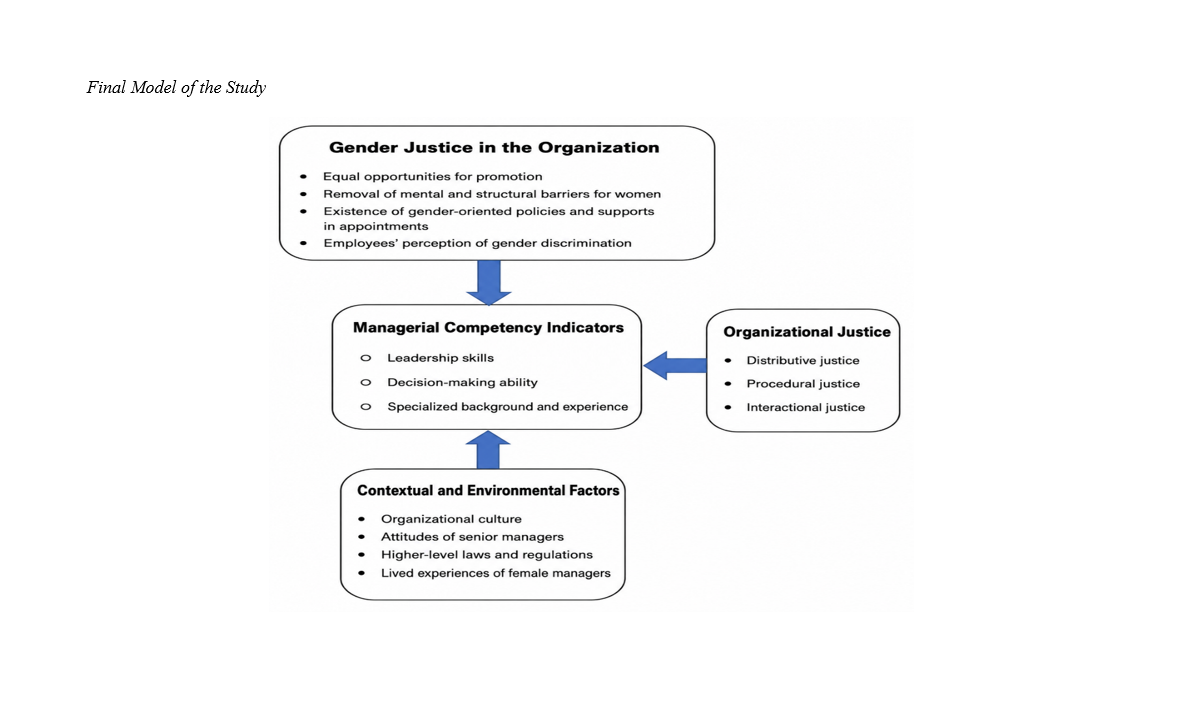
Findings: The inferential analysis of the qualitative data showed that managerial competency indicators formed the central phenomenon of the extracted model. These indicators included leadership skills, decision-making ability, specialized background, and professional experience. Organizational justice and gender justice were identified as causal conditions influencing fair appointment. Organizational justice consisted of distributive, procedural, and interactional justice, while gender justice included equal opportunities for promotion, removal of mental and structural barriers for women, gender-oriented policies and supports in appointments, and employees’ perception of gender discrimination. Contextual and environmental factors, including organizational culture, attitudes of senior managers, higher-level laws and regulations, and lived experiences of female managers, were identified as background conditions shaping the realization of gender justice in managerial appointment.
Conclusion: The results indicated that gender justice in managerial appointment is achieved when competence-based evaluation is combined with transparent procedures, equal promotion opportunities, supportive organizational policies, and a culture that recognizes women’s leadership capacity.
Downloads
References
Adamu, A. Y. (2023). Barriers to Women’s Participation in and Contribution to Leadership in Ethiopian Higher Education. Education Policy Analysis Archives, 31. https://doi.org/10.14507/epaa.31.7884
Bjegović-Mikanović, V., Matović-Miljanović, S., Seitalieva, C., Makarova, T., Murzalieva, G., Kozhokeev, K., Wenzel, H., & Laaser, U. (2024). Rights and Responsibilities: Women Leadership for Health in Kyrgyzstan. PLoS One, 19(2), e0295239. https://doi.org/10.1371/journal.pone.0295239
Chudnovsky, M., & Farill, C. E. C. (2024). Gender Discrimination and Merit‐based Selection: A Case Study of Mexico. Public Administration and Development, 44(2), 118-133. https://doi.org/10.1002/pad.2041
Chudnovsky, M., Medina, D. M., & Filippo, A. (2025). Parity in Public Administration as a Moving Target: The Role of Women Policy Agencies in Mexico. Public Administration and Development, 46(1), 60-76. https://doi.org/10.1002/pad.70034
Chukwudi, C. E., Oladipo, V. O., & Gberevbie, P. D. E. (2024). The Legislative Enactments on Women’s Inclusion in Governance: A Study of Lagos State House of Assembly, Nigeria (2015- 2022). Kuey. https://doi.org/10.53555/kuey.v30i5.1394
Erwin, A., Mutzenberg, M. D., Neves, M. A. S., Smid, S., Usheva, F., & Wilde, A. (2025). Representation and Participation in Public Institutions – A Gender Lens. Statistical Journal of the IAOS, 41(3), 723-736. https://doi.org/10.1177/18747655251366925
Galbally, M., Kotzé, B., Mackersey, S., Barber, R. M., Kannakkahewa, N., & Every‐Palmer, S. (2025). Through the Looking Glass: Resetting the Royal Australian and New Zealand College of Psychiatry’s Approach to Gender Equity. Australian & New Zealand Journal of Psychiatry, 59(11), 943-945. https://doi.org/10.1177/00048674251366796
Gunnarsdóttir, S., Christiansen, Þ. H., Óladóttir, Á. D., & Kristjánsdóttir, E. S. (2025). Exploring Women’s Leadership in CEO Appointments: A Qualitative Study of Board Member Perspectives in Iceland’s Listed Companies. Sage Open, 15(2). https://doi.org/10.1177/21582440251339804
Gunnarsdóttir, S., Óladóttir, Á. D., Christiansen, Þ. H., & Kristjánsdóttir, E. S. (2023). Do Women Have the Right Skills, Network and Support to Become CEOs? International Conference on Gender Research, 6(1), 138-145. https://doi.org/10.34190/icgr.6.1.1092
Haines, A. C., & McKeown, E. (2023). Exploring Perceived Barriers for Advancement to Leadership Positions in Healthcare: A Thematic Synthesis of Women's Experiences. Journal of Health Organization and Management, 37(3), 360-378. https://doi.org/10.1108/jhom-02-2022-0053
Hawatmeh, C. Z., Hashish, I. A., & Alazzeh, R. R. (2024). Outnumbered and Outranked: A Macrostructural Snapshot of Gendered Inequalities in Higher Academia in Jordan. International Journal of Organizational Analysis, 33(2), 332-348. https://doi.org/10.1108/ijoa-09-2023-3953
Head, B., & Colley, L. (2021). Senior Executive Service Case Study: Commonwealth. https://doi.org/10.54810/jzso5617
Kalbarczyk, A., Banchoff, K., Perry, K. E., Malhotra, A., & Morgan, R. (2025). A Scoping Review on the Impact of Women’s Global Leadership: Evidence to Inform Health Leadership. BMJ Global Health, 10(2), e015982. https://doi.org/10.1136/bmjgh-2024-015982
Kalumba, M., Daka, H., Kalimaposo, K., Phiri, C., Mulenga-Hagane, L. M., & Mugala, A. (2023). Navigation Strategies by Women Into Decision-Making Positions in the Ministry of Education, Zambia. European Journal of Development Studies, 3(3), 147-155. https://doi.org/10.24018/ejdevelop.2023.3.3.276
Mathetha, K. N., & Dhanpat, N. (2025). A View From the Top: How South African Women Leaders Shatter the Glass Ceiling. Frontiers in Sociology, 10. https://doi.org/10.3389/fsoc.2025.1601448
Mbukanma, I., & Strydom, K. (2022). Challenges to and Enablers of Women's Advancement in Academic Careers at a Selected South African University. International Journal of Learning Teaching and Educational Research, 21(12), 44-64. https://doi.org/10.26803/ijlter.21.12.3
Mendiratta, E., Mukherjee, S., & Oehmichen, J. (2025). Breaking Through Only to Break Up: A Cross‐Country Analysis of the Speed of Advancement and Exit of Female Executives. Human Resource Management, 64(3), 769-791. https://doi.org/10.1002/hrm.22277
Musili, F. (2024). Drivers of Gender Imbalance in the Senior Management of the Parliamentary Service Commission of Kenya. American Journal of Public Policy and Administration, 9(1), 27-39. https://doi.org/10.47672/ajppa.1771
Mwahombela, L. (2023). Women’s Participation in Leadership in Schools and Local Government in Ibumu and Image Wards in Kilolo District, Iringa Region,Tanzania. Asian Journal of Education and Social Studies, 1-9. https://doi.org/10.9734/ajess/2023/v38i3824
Ntuli, N., Jili, N. N., & Xaba, M. R. (2023). Women Participation in Leadership Positions in Mtubatuba Local Municipality, South Africa. Journal of Leadership in Organizations, 5(1). https://doi.org/10.22146/jlo.74881
Okonta, V., & Nkedishu, V. C. (2024). Gender Disparity in Principal Officers’ Positions in Nigerian Universities: Implications for Educational Planners and Administrators. International Journal of Education Learning and Development, 12(4), 16-37. https://doi.org/10.37745/ijeld.2013/vol12n41637
Othman, N., Radin Siti Aishah Radin, A. R., Abdullah, N., & Ramly, R. (2023). Female Leadership in Malaysia: Issues and Challenges. Asian Women, 39(1), 1. https://doi.org/10.14431/aw.2023.12.39.1.1
Pape, M., & Schoch, L. (2022). Gendering Strategic Action Fields in Sports Governance. International Review for the Sociology of Sport, 58(6), 996-1013. https://doi.org/10.1177/10126902221136084
Ravindran, T. S., Atiim, G., Remme, M., & Riha, J. (2023). A Compendium of the History of Gender Mainstreaming in Five United Nations Agencies. https://doi.org/10.37941/rr/2023/1
Reed, E. F., Chong, A. S., Levings, M. K., Mutrie, C., Laufer, T. M., Roncarolo, M. G., & Sykes, M. (2022). The Women of FOCIS: Promoting Equality and Inclusiveness in a Professional Federation of Clinical Immunology Societies. Frontiers in Immunology, 13. https://doi.org/10.3389/fimmu.2022.816535
Saeed, A., Ali, A., & Riaz, H. (2023). Open-Up or Stay Closed: The Effect Of TMT Gender Diversity On open Innovation. European Journal of Innovation Management, 27(6), 1813-1836. https://doi.org/10.1108/ejim-08-2022-0425
Sánchez, I., Bohorquez, M. V. U., Guzmán, C. A., & Guzmán, B. A. (2023). The COVID-19, a Crossroads for Female Directors. Management Decision, 62(7), 2136-2163. https://doi.org/10.1108/md-06-2023-0953
Smith, S. G., & Sinkford, J. C. (2022). Gender Equality in the 21st Century: Overcoming Barriers to Women's Leadership in Global Health. Journal of Dental Education, 86(9), 1144-1173. https://doi.org/10.1002/jdd.13059
Sokolova, M. V., DiCaprio, A., Collinson, N. B., & Quirante, Z. (2023). Beating the Odds: Women’s Leadership in International Organizations. Politics & Gender, 19(4), 1087-1109. https://doi.org/10.1017/s1743923x23000107
Vundi, N. (2024). When Will It Be Our Turn to Lead? An Evaluation of Women's Perceptions on Barriers to Access the Top Positions in Educational Institutions' Leadership in Kenya. East African Journal of Arts and Social Sciences, 7(1), 292-303. https://doi.org/10.37284/eajass.7.1.1917
Wagner, E., Pernsteiner, H., & Riaz, A. (2023). Blood Is Thicker Than Water: An Analysis of Women’s Presence on Pakistani Boards. Gender in Management an International Journal, 39(4), 516-533. https://doi.org/10.1108/gm-04-2022-0139
Zaccone, M. C. (2023). Unveiling the Relationship Between Women on Board and Woman CEO Selection: What Is the Role of Sustainability Governance? Sinergie Italian Journal of Management, 41(3), 215-234. https://doi.org/10.7433/s122.2023.10
Zeinali, Z., Muraya, K., Molyneux, S., & Morgan, R. (2021). The Use of Intersectional Analysis in Assessing Women’s Leadership Progress in the Health Workforce in LMICs: A Review. International Journal of Health Policy and Management. https://doi.org/10.34172/ijhpm.2021.06
Downloads
Additional Files
Publication Timeline
- Submitted
- Revised
- Accepted