Strategic Risk Management and Business Continuity: A Framework for Enhancing Enterprise Risk Governance
Keywords:
Strategic risk management, business continuity, enterprise risk governance, organizational resilience, risk management, structural equation modelingAbstract
Objective: This study aimed to examine the relationship between strategic risk management, business continuity, and enterprise risk governance and to propose an integrated framework for enhancing enterprise risk governance.
Methods and Materials: This applied quantitative study was conducted using a descriptive-correlational and cross-sectional survey design. The statistical population consisted of university faculty members, risk managers, members of risk committees, and members of the boards of directors of companies listed on the stock exchange. Since it was anticipated that some questionnaires might not be returned or might not be completed correctly, 390 questionnaires were distributed to ensure access to 384 valid questionnaires. After data collection and screening, 384 questionnaires were confirmed as complete and usable, indicating an approximate return rate of 98%. Data were collected using a structured questionnaire measuring strategic risk management, business continuity, and enterprise risk governance. The questionnaire items were scored on a five-point Likert scale. Data were analyzed using descriptive statistics, Pearson correlation, multiple regression analysis, and structural equation modeling through SPSS and AMOS.
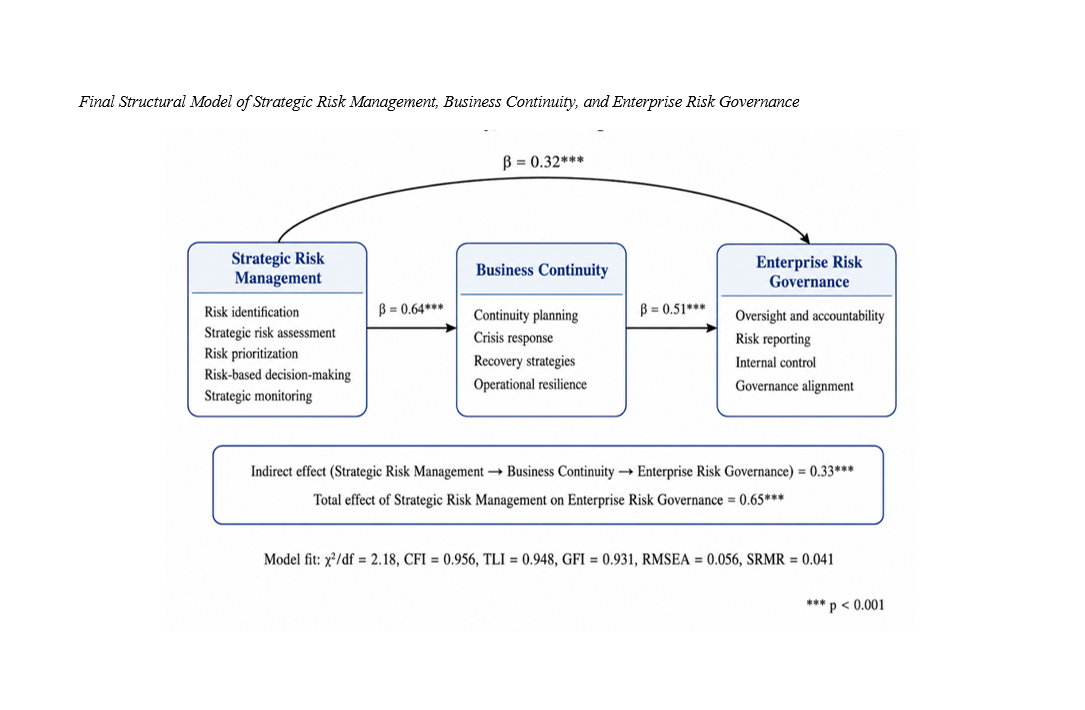
Findings: The inferential findings showed significant positive correlations between strategic risk management and business continuity (r = 0.63, p < 0.001), strategic risk management and enterprise risk governance (r = 0.68, p < 0.001), and business continuity and enterprise risk governance (r = 0.71, p < 0.001). Regression analysis indicated that strategic risk management and business continuity significantly predicted enterprise risk governance, F(2, 381) = 296.14, p < 0.001, explaining 61% of its variance. Business continuity had the stronger predictive effect (β = 0.52, p < 0.001) compared with strategic risk management (β = 0.36, p < 0.001). Structural equation modeling confirmed acceptable model fit and showed that strategic risk management significantly affected business continuity (β = 0.64, p < 0.001), strategic risk management directly affected enterprise risk governance (β = 0.32, p < 0.001), and business continuity directly affected enterprise risk governance (β = 0.51, p < 0.001). The indirect effect of strategic risk management on enterprise risk governance through business continuity was also significant (β = 0.33, p < 0.001).
Downloads
References
Abhulimen, A. O., & Ejike, O. G. (2024). Solving Supply Chain Management Issues With AI and Big Data Analytics for Future Operational Efficiency. Computer Science & It Research Journal, 5(8), 1780-1805. https://doi.org/10.51594/csitrj.v5i8.1396
Adewusi, A. O., Komolafe, A. M., Ejairu, E., Aderotoye, I. A., Abiona, O. O., & Oyeniran, O. C. (2024). The Role of Predictive Analytics in Optimizing Supply Chain Resilience: A Review of Techniques and Case Studies. International Journal of Management & Entrepreneurship Research, 6(3), 815-837. https://doi.org/10.51594/ijmer.v6i3.938
Alzaabi, H. (2025). Strategic Cyber-Risk Alignment: A New Framework for Financial Institutions Facing the Digital Future. https://doi.org/10.21203/rs.3.rs-6560364/v1
Apasrawirote, D., & Yawised, K. (2023). The Emerging of Business Resilience Plans (BRPs) in Dealing With Business Turbulence. Management Research Review, 47(1), 141-161. https://doi.org/10.1108/mrr-04-2022-0273
Benjamin, L. B., Adegbola, A. E., Amajuoyi, P., Adegbola, M. D., & Adeusi, K. B. (2024). Digital Transformation in SMEs: Identifying Cybersecurity Risks and Developing Effective Mitigation Strategies. Global Journal of Engineering and Technology Advances, 19(2), 134-153. https://doi.org/10.30574/gjeta.2024.19.2.0084
Casal-Ribeiro, M., Boavida-Portugal, I., Peres, R., & Seabra, C. (2023). Review of Crisis Management Frameworks in Tourism and Hospitality: A Meta-Analysis Approach. Sustainability, 15(15), 12047. https://doi.org/10.3390/su151512047
Ding, J., & Lee, E.-S. (2024). Improving the Maritime Supply Chain Resilience: The Role of Firms’ Dynamic Knowledge Management and Organizational Innovation. Journal of Organizational Change Management, 37(6), 1322-1339. https://doi.org/10.1108/jocm-01-2024-0006
Dube, N., Selviaridis, K., Oorschot, K. E. v., & Jahre, M. (2024). Riding the Waves of Uncertainty: Towards Strategic Agility in Medicine Supply Systems. Journal of Operations Management, 70(8), 1234-1260. https://doi.org/10.1002/joom.1330
Ekweozor, C. I. (2024). The Potential Effects of De-Risking From China on Global Economic Growth and Trade Patterns. International Journal of Science and Business, 35(1), 59-71. https://doi.org/10.58970/ijsb.2355
Erwin, A., Mutzenberg, M. D., Neves, M. A. S., Smid, S., Usheva, F., & Wilde, A. (2025). Representation and Participation in Public Institutions – A Gender Lens. Statistical Journal of the IAOS, 41(3), 723-736. https://doi.org/10.1177/18747655251366925
Esan, O., Ajayi, F. A., & Olawale, O. (2024). Human Resource Strategies for Resilient Supply Chains in Logistics and Transportation: A Critical Review. International Journal of Science and Research Archive, 12(1), 082-102. https://doi.org/10.30574/ijsra.2024.12.1.0691
Eyo-Udo, N. L. (2024). Leveraging Artificial Intelligence for Enhanced Supply Chain Optimization. Open Access Research Journal of Multidisciplinary Studies, 7(2), 001-015. https://doi.org/10.53022/oarjms.2024.7.2.0044
Fuchs, D., Kuys, B., Eisenbart, B., & Gericke, K. (2025). A Systematic Literature Review on Emerging Technology Risks in Industry 4.0/5.0: Identification, Clustering and Developing Mitigation Strategies. Proceedings of the Design Society, 5, 299-308. https://doi.org/10.1017/pds.2025.10044
Gattie, S. U. (2025). Risk Management and Good Governance Support Organizational Value. Frontiers of Health Services Management, 41(3), 14-18. https://doi.org/10.1097/hap.0000000000000212
Grant, O. C. (2024). Exploring Supplier Relationship Management in the Context of E-Commerce. https://doi.org/10.20944/preprints202407.0471.v1
Hamza, A., Elemam, W., & Abuosekken, M. (2023). The Role of Strategic Planning in Environmental Crisis Management Article Review and Case Study. International Journal of Environmental Studies and Researches, 2(4), 85-104. https://doi.org/10.21608/ijesr.2023.346718
Hokmabadi, H., Seyed, M. H. S. R., & Matos, C. A. d. (2024). Business Resilience for Small and Medium Enterprises and Startups by Digital Transformation and the Role of Marketing Capabilities—A Systematic Review. Systems, 12(6), 220. https://doi.org/10.3390/systems12060220
Kalbarczyk, A., Banchoff, K., Perry, K. E., Malhotra, A., & Morgan, R. (2025). A Scoping Review on the Impact of Women’s Global Leadership: Evidence to Inform Health Leadership. BMJ Global Health, 10(2), e015982. https://doi.org/10.1136/bmjgh-2024-015982
Kiers, J., Seinhorst, J., Zwanenburg, M., & Stek, K. (2022). Which Strategies and Corresponding Competences Are Needed to Improve Supply Chain Resilience: A COVID-19 Based Review. Logistics, 6(1), 12. https://doi.org/10.3390/logistics6010012
Kılıç, Y., & Vayvay, Ö. (2025). Integrating Occupational Health and Safety Into Enterprise Risk Management: A Structural Evaluation. Frontiers in Public Health, 13. https://doi.org/10.3389/fpubh.2025.1608227
Marquez-Tejon, J., Partearroyo, M. J., & Benito‐Osorio, D. (2023). Integrated Security Management Model: A Proposal Applied to Organisational Resilience. Security Journal, 37(2), 375-398. https://doi.org/10.1057/s41284-023-00381-6
Matteis, J. D., Elia, G., & Vecchio, P. D. (2023). Business Continuity Management and Organizational Resilience: A Small and Medium Enterprises (SMEs) Perspective. Journal of Contingencies and Crisis Management, 31(4), 670-682. https://doi.org/10.1111/1468-5973.12470
Monazzam, A., & Crawford, J. (2024). The Role of Enterprise Risk Management in Enabling Organisational Resilience: A Case Study of the Swedish Mining Industry. Journal of Management Control, 35(1), 59-108. https://doi.org/10.1007/s00187-024-00370-9
Moşteanu, N. R. (2024). Adapting to the Unpredictable: Building Resilience for Business Continuity in an Ever-Changing Landscape. European Journal of Theoretical and Applied Sciences, 2(1), 444-457. https://doi.org/10.59324/ejtas.2024.2(1).37
Nagy, S. (2021). Organizational Strategic Management Responses and Consequences During Covid-19 Era. Review on Agriculture and Rural Development, 10(1-2), 133-149. https://doi.org/10.14232/rard.2021.1-2.133-149
Narkhede, G., Samuel, C., Mahajan, S., Verma, D., Sakhare, N. N., & Chaudhari, T. (2024). Beyond Traditional Supply Chain Management: Addressing Sociopolitical Challenges in Increasingly Turbulent Global Trade Landscape. Business Strategy & Development, 7(2). https://doi.org/10.1002/bsd2.397
Nassar, F. S., & Abbas, A. O. (2025). Crisis and Risk Management in Poultry Production: Preparing Future Leaders for Sustainability and Food Security. Poultry Science, 104(12), 105903. https://doi.org/10.1016/j.psj.2025.105903
Nketsiah, I., & Westhuizen, T. v. d. (2024). Governance and Leadership in Enhancing SME Resilience in Ghana: A Systematic Literature Review. European Conference on Management Leadership and Governance, 20(1), 417-424. https://doi.org/10.34190/ecmlg.20.1.3138
Phương, N. D., & Huy, P. D. (2024). Challenges and Opportunities in Cross-Border E-Commerce Logistics: A Systematic Literature Review. Journal of Economics Finance and Management Studies, 07(11). https://doi.org/10.47191/jefms/v7-i11-28
Russo, N., Mamede, H. S., Reis, L., Martins, J., & Branco, F. (2023). Exploring a Multidisciplinary Assessment of Organisational Maturity in Business Continuity: A Perspective and Future Research Outlook. Applied Sciences, 13(21), 11846. https://doi.org/10.3390/app132111846
Shrivastava, V. K., Balasubramanian, J., Katyal, A., Yadav, A., & Yogananthan, S. (2024). Understanding the Significance of Risk Management in Enterprise Management Dynamics. Multidisciplinary Reviews, 6, 2023ss2093. https://doi.org/10.31893/multirev.2023ss093
Smith, S. G., & Sinkford, J. C. (2022). Gender Equality in the 21st Century: Overcoming Barriers to Women's Leadership in Global Health. Journal of Dental Education, 86(9), 1144-1173. https://doi.org/10.1002/jdd.13059
Sofyan, A. S., Abror, A., Putra, T. W., Muslihati, M., Sofyan, S., Sirajuddin, S., Katman, M. N., & Darussalam, A. (2021). Crisis and Disaster Management for Halal Tourism: A Systematic Review. Tourism Review, 77(1), 129-145. https://doi.org/10.1108/tr-08-2020-0390
Stanimirović, D., Umek, L., & Ravšelj, D. (2025). Charting Advances in Asset Management Systems: A Bibliometric Analysis Revealing Applications and Potential in Healthcare. Healthcare, 13(22), 2979. https://doi.org/10.3390/healthcare13222979
Widianti, T., Dinaseviani, A., Ayundyahrini, M., Sumaedi, S., Rakhmawati, T., Astrini, N. J., Bakti, I., Damayanti, S., Yarmen, M., Jati, R. K., Yaman, A., Pandin, M., Hidayat, M., Prihanto, I. G., Gunawan, H., & Mahmudi, M. (2024). Business Continuity Management: Trends, Structures and Future Issues. Business Process Management Journal, 30(7), 2352-2379. https://doi.org/10.1108/bpmj-01-2024-0046
Zighan, S. (2023). Mitigating the “Cobra Effect” When Pursuing Organizational Resilience. Journal of Contingencies and Crisis Management, 31(4), 635-647. https://doi.org/10.1111/1468-5973.12467
Downloads
Additional Files
Publication Timeline
- Submitted
- Revised
- Accepted