Investigating the Effect of Artificial Intelligence Capabilities on Operational Performance with the Mediating Role of Production System Resilience and the Moderating Role of Human–Organization–Technology Fit in the Abadan Oil Industry
DOI:
https://doi.org/10.61838/Keywords:
Artificial intelligence capabilities, operational performance, production system resilience, human–organization–technology fitAbstract
Objective: The present study investigated the effect of artificial intelligence capabilities on operational performance, with the mediating role of production system resilience and the moderating role of human–organization–technology fit in the Abadan oil industry.
Methods and Materials: In terms of purpose, this study was applied and quantitative, and in terms of nature, it was descriptive-survey and correlational. The statistical population included 420 managers and experts working in the Abadan oil industry. Based on Cochran’s formula, the sample size was calculated as 201. The questionnaires were distributed randomly among the participants, and 200 completed questionnaires were returned. To examine the research questions, structural equation modeling (SEM) was used through the structural equation modeling approach with the assistance of SmartPLS 3 software.
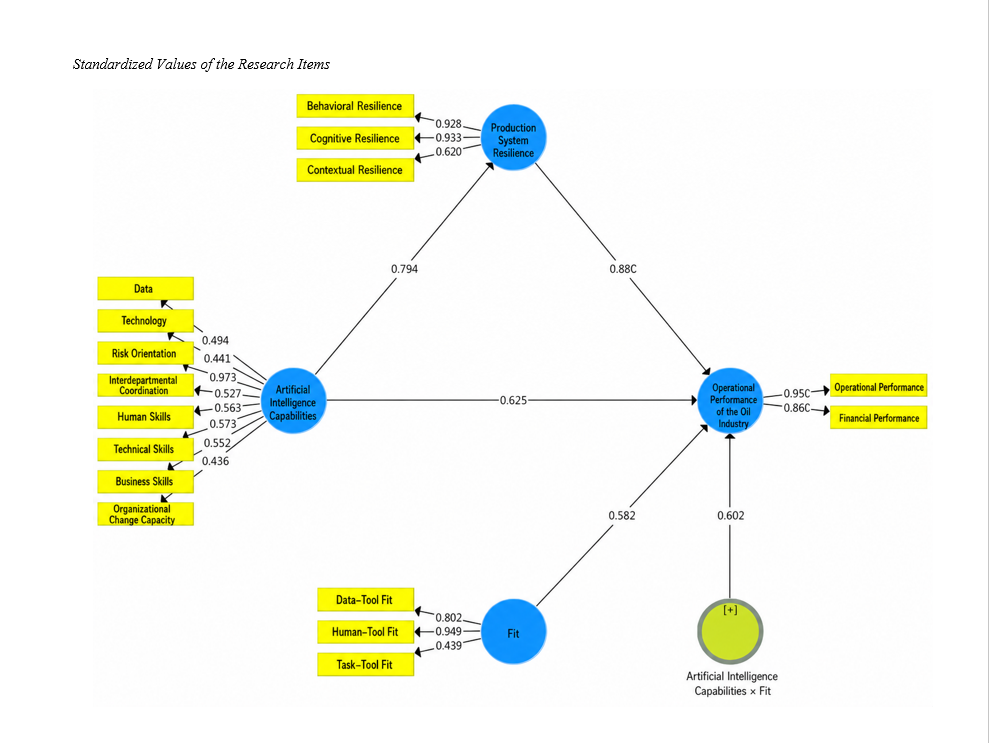
Findings: The findings showed that the path coefficient between artificial intelligence capability and production system resilience was 0.794, with a t-statistic of 9.053. The path coefficient between production system resilience and operational performance was 0.880, with a t-statistic of 10.574. The path coefficient for the moderating role of human–organization–technology fit was 0.602, with a t-statistic of 8.029. This means that fit positively moderates the effect of artificial intelligence capability on production system resilience. Therefore, artificial intelligence capability positively improves operational performance through production system resilience.
Conclusion: The findings indicate that artificial intelligence capabilities indirectly improve the refinery’s operational performance by strengthening production system resilience. Moreover, human–organization–technology fit plays a positive moderating role in the relationship between artificial intelligence and resilience. These results emphasize the necessity of simultaneous attention to technological infrastructure, personnel training, and the preparation of organizational structures in order to achieve sustainable and resilient operations in the Abadan oil industry.
Downloads
References
Abdulmuhsin, A. A., Hussein, H. D., Rehman, S. U., Bhat, M. A., & Dbesan, A. H. (2026). Driving interactive green innovation in traditional industries: the impact of AI and KM in the oil and gas sector. International Journal of Energy Sector Management, 20(3), 814-856. https://doi.org/10.1108/IJESM-01-2025-0031
AlAbdouli, M. A., & Al-Shihabi, S. (2025). Artificial Intelligence and Its Performance Impacts in the Oil and Gas Industry: Challenges, Insights, and Evaluation Approaches. Results in Engineering, 107636. https://doi.org/10.1016/j.rineng.2025.107636
Arroyabe, M. F., Arranz, C. F., De Arroyabe, I. F., & de Arroyabe, J. C. F. (2024). Analyzing AI adoption in European SMEs: A study of digital capabilities, innovation, and external environment. Technology in Society, 79, 102733. https://doi.org/10.1016/j.techsoc.2024.102733
Bakhtiari, H., Afshari, A., & Norouzi, M. (2025). Importance-Performance Analysis of Digital Transformation Components in Industries: A Study of Selected Industries in Zanjan Province. Improvement Management, 19(1), 111-148.
Belhadi, A., Mani, V., Kamble, S. S., Khan, S. A. R., & Verma, S. (2024). Artificial intelligence-driven innovation for enhancing supply chain resilience and performance under the effect of supply chain dynamism: an empirical investigation. Annals of Operations Research, 333(2), 627-652. https://doi.org/10.1007/s10479-021-03956-x
Dabbagh, R., Farzan, M., & Mohseni, B. (2025). Identifying the Challenges of Industry 4.0 Technologies for Sustainable Operations in Small and Medium-Sized Enterprises. Research in Production and Operations Management, 16(1), 1-24.
Ghazi-Nouri, S., Aghazadeh Masrour, S., Naghizadeh, M., & Hajian Heydari, M. (2024). Dimensions of Alignment between Digital Capabilities and Innovation Strategy in the Petrochemical Industry. Intelligent Business Management Studies, 13(47), 223-269.
Gupta, S., Modgil, S., Meissonier, R., & Dwivedi, Y. K. (2024). Artificial intelligence and information system resilience to cope with supply chain disruption. Ieee Transactions on Engineering Management, 71, 10496-10506. https://doi.org/10.1109/TEM.2021.3116770
Gur, N., & Dilek, S. (2023). US-China economic rivalry and the reshoring of global supply chains. The Chinese Journal of International Politics, 16(1), 61-83. https://doi.org/10.1093/cjip/poac022
Hu, W., Ahmed, F., & Su, Y. (2023). Transactive memory system and entrepreneurial team performance: The impact of ability to improvise and market competition. International Journal of Emerging Markets, 18(12), 6234-6259. https://doi.org/10.1108/IJOEM-09-2021-1340
Ivanov, D. (2023). Intelligent digital twin (iDT) for supply chain stress-testing, resilience, and viability. International Journal of Production Economics, 263, 108938. https://doi.org/10.1016/j.ijpe.2023.108938
Kumar, V., Verma, P., Mittal, A., Tuesta Panduro, J. A., Singh, S., Paliwal, M., & Sharma, N. K. (2023). Adoption of ICTs as an emergent business strategy during and following COVID-19 crisis: Evidence from Indian MSMEs. Benchmarking: An International Journal, 30(6), 1850-1883. https://doi.org/10.1108/BJI-11-2021-0685
Melberg, K., & Gressgård, L. J. (2023). Digitalization and changes to work organization and management in the Norwegian petroleum industry. Cognition, Technology & Work, 25(4), 447-460. https://doi.org/10.1007/s10111-023-00739-1
Mikalef, P., Lemmer, K., Schaefer, C., Ylinen, M., Fjørtoft, S. O., Torvatn, H. Y., & Niehaves, B. (2023). Examining how AI capabilities can foster organizational performance in public organizations. Government Information Quarterly, 40(2), 101797. https://doi.org/10.1016/j.giq.2022.101797
Min, H. (2023). Assessing the impact of a COVID-19 pandemic on supply chain transformation: An exploratory analysis. Benchmarking: An International Journal, 30(6), 1765-1781. https://doi.org/10.1108/BIJ-04-2022-0260
Mukherjee, S., Baral, M. M., Nagariya, R., Chittipaka, V., & Pal, S. K. (2024). Artificial intelligence-based supply chain resilience for improving firm performance in emerging markets. Journal of Global Operations and Strategic Sourcing, 17(3), 516-540. https://doi.org/10.1108/JGOSS-06-2022-0049
Ning, Y., Li, L., Xu, S. X., & Yang, S. (2023). How do digital technologies improve supply chain resilience in the COVID-19 pandemic? Evidence from Chinese manufacturing firms. Frontiers of Engineering Management, 10(1), 39-50. https://doi.org/10.1007/s42524-022-0230-4
Papagiannidis, E., Mikalef, P., & Conboy, K. (2025). Responsible artificial intelligence governance: A review and research framework. The Journal of Strategic Information Systems, 34(2), 101885. https://doi.org/10.1016/j.jsis.2024.101885
Qrunfleh, S., Vivek, S., Merz, R., & Mathivathanan, D. (2023). Mitigation themes in supply chain research during the COVID-19 pandemic: A systematic literature review. Benchmarking: An International Journal, 30(6), 1832-1849. https://doi.org/10.1108/BIJ-11-2021-0692
Rostamzadeh Ganji, E., & Jayeravandi, S. (2025). Providing a Model for Developing Employees' Cognitive Trust in Artificial Intelligence. Quarterly Journal of Value Creation in Business Management, 5(2), 294-317.
Sadeghi, K., Ojha, D., Kaur, P., Mahto, R. V., & Dhir, A. (2024). Explainable artificial intelligence and agile decision-making in supply chain cyber resilience. Decision Support Systems, 180, 114194. https://doi.org/10.1016/j.dss.2024.114194
Sjodin, D., Parida, V., & Kohtamaki, M. (2023). Artificial intelligence enabling circular business model innovation in digital servitization: Conceptualizing dynamic capabilities, AI capacities, business models and effects. Technological Forecasting and Social Change, 197, 122903. https://doi.org/10.1016/j.techfore.2023.122903
Smyth, C., Dennehy, D., Fosso Wamba, S., Scott, M., & Harfouche, A. (2024). Artificial intelligence and prescriptive analytics for supply chain resilience: a systematic literature review and research agenda. International Journal of Production Research, 62(23), 8537-8561. https://doi.org/10.1080/00207543.2024.2341415
Toghraei, S. M. J., Nilforoushan, H., & Azari, F. (2024). Measuring and Analyzing the Readiness of the Upstream Oil Industry to Adopt Artificial Intelligence. Science and Technology Policy, 17(3), 53-66.
Vega, D., Arvidsson, A., & Saiah, F. (2023). Resilient supply management systems in times of crisis. International Journal of Operations & Production Management, 43(1), 70-98. https://doi.org/10.1108/IJOPM-03-2022-0192
Venkatesh, V., Raman, R., & Cruz-Jesus, F. (2023). AI and emerging technology adoption: A research agenda for operations management. International Journal of Production Research, 62(15), 5367-5377. https://doi.org/10.1080/00207543.2023.2192309
Wang, S., & Zhang, H. (2025). Leveraging generative artificial intelligence for sustainable business model innovation in production systems. International Journal of Production Research, 63(18), 6732-6757. https://doi.org/10.1080/00207543.2025.2485318
Zeng, T., Chen, G., Reniers, G., & Hu, K. (2023). Resilience assessment of chemical industrial areas during Natech-related cascading multi-hazards. Journal of Loss Prevention in the Process Industries, 81, 104967. https://doi.org/10.1016/j.jlp.2022.104967
Zhou, C., Li, H., Zhang, L., & Ren, Y. (2023). Optimal recommendation strategies for AI- powered E-commerce platforms: A study of duopoly manufacturers and market competition. Journal of Theoretical and Applied Electronic Commerce Research, 18(2), 1086-1106. https://doi.org/10.3390/jtaer18020055
Downloads
Additional Files
Publication Timeline
- Submitted
- Revised
- Accepted